All species › Rodents › Mice and rats › Broad-toothed Field Mouse
Broad-toothed Field Mouse | Apodemus mystacinus
Oostelijke rotsmuis | Apodemus mystacinus
The Broad-toothed Field Mouse is a large, grey mouse with a heavy head and long whiskers, found in the mountains of Crete, the cedar forests of Anatolia and the limestone country of the Levant. Until 2005 the Balkan populations were also included in this species; since then they have been split off as the Western Broad-toothed Field Mouse. The range now covers the Aegean islands, Anatolia, the Caucasus and the Near East.
No photograph of a living wild animal of this species with a suitable Creative Commons licence exists. Do you have one that meets the rules? Send it in.
Tracks
As in the western species, the signs are found under and between stones. It shelters in rock crevices and under boulders and builds its nest there; walls, terrace walls, stone heaps and scree below rock faces are the places to search. It leaves polished passages, and at a regular entrance a small heap of remains: gnawed pine seeds, acorns and carob opened with a round hole, cereal grains and empty snail shells. It also takes eggs and nestlings and is a candidate predator at a plundered ground nest in a Cretan mountain gorge. The droppings are dark, spindle-shaped pellets 4 to 6 mm long, larger than those of the Wood Mouse. Prints in sand are rare because it avoids sand; the bounding print is sometimes found in fine dust under an overhanging rock: four prints in a block, hind feet in front. In pellets of Barn Owl, Eagle Owl and Scops Owl on Crete and in Turkey it stands out by its size.
Identification
A very large mouse: head-body 9.8 to 13.2 cm, tail 9.8 to 14.5 cm, weight 25 to 57 g. The tail is longer than head and body together in 98 per cent of animals, which is a usable field character. The upperparts are mostly grey, varying from brownish grey to buff; the underparts are pure white to pale grey. The head is heavy and broad, the ears large (17 to 22 mm) and the whiskers very long. The hind foot is sturdy, 24 to 28 mm. In the field the animal looks more like a small rat than a wood mouse.
Similar species
Only the Western Broad-toothed Field Mouse closely resembles this species, and it can barely be separated by eye: the two were regarded as one species until 2005 and were separated on the basis of DNA studies. The boundary runs through the Aegean: the mainland Balkans and the Ionian islands hold the western species; Crete, Rhodes, the eastern Aegean islands, Anatolia, western Georgia and the Levant hold this one. Without a locality neither can be identified. It can be separated from the smaller Apodemus: Wood Mouse, Steppe Field Mouse and Yellow-necked Mouse are smaller, warm brown or yellowish brown rather than grey, with shorter whiskers and a lighter head. The Black Rat, common throughout the region, is larger and has small eyes in a long head; the broad-toothed mouse has the large, bulging eyes of an Apodemus. In Anatolia and the Levant a large House Mouse may be taken at a distance for a small broad-toothed mouse, but it is dull greyish brown without a sharp belly line and has small ears.
Habitat
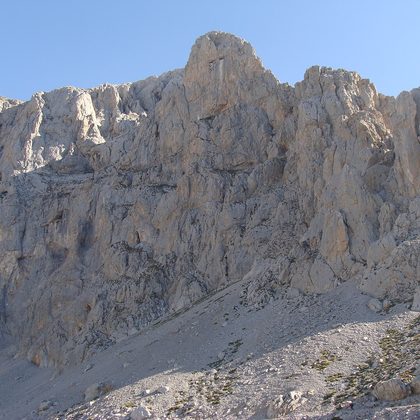
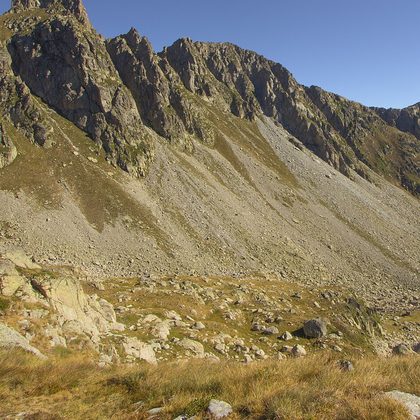
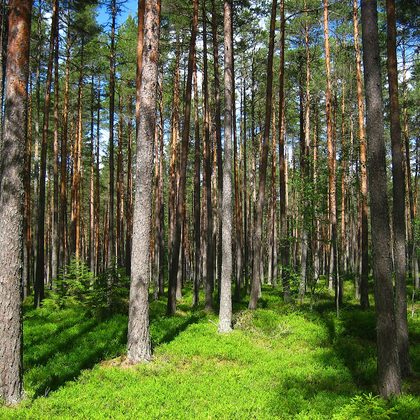
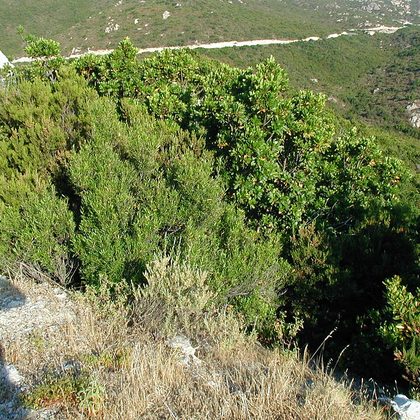
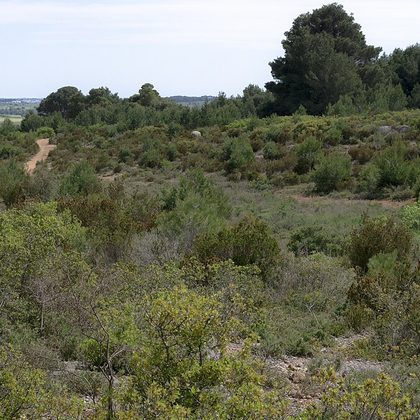
Mediterranean woodland on rocky ground: deciduous and coniferous forest with oak, pine and cedar, degraded woodland, scrub and farmland, always with rocks, boulders or walls. It is less strictly tied to bare karst than the western species and also occurs in orchards and fields, provided there are stones to shelter in. It occurs from sea level to 2,700 m.
Where the animal is most at home, classified with EUNIS — the European standard for habitats.

Distribution
Greece (Crete and the eastern Aegean islands), Turkey, western Georgia, western Syria, Lebanon, northern Israel, Palestine, Jordan and northern Iraq. Of the Aegean islands, Rhodes and a number of smaller inshore islands are occupied; on Crete it is a regular inhabitant of the mountains. Since the split of 2005 the Balkan mainland is no longer part of its range; the Western Broad-toothed Field Mouse occurs there. The Aegean and Anatolian part of the range lies within the guide area; the Iraqi and Levantine part lies largely at its edge. The species does not occur in western or northern Europe.
- Native
- dark = core range, pale = thinly spread
Way of life
Nocturnal and mainly ground-dwelling, though it climbs trees well; it digs or shelters under rocks. It eats seeds of herbs, pine seed, cereals, acorns and carob, supplemented with insects, snails, birds' eggs and nestlings; the proportion of animal food is high for a mouse. It does not hibernate. There are three or four litters a year, with a gestation of 23 to 26 days and up to five young per litter. The home range is small: a radius of 8 to 15 m around the shelter has been measured. Little is known about social organisation and density.
Where and when to look
On Crete May is a suitable month: search after dark with a torch along the terrace walls and stone heaps of a mountain village or along the rim of a gorge. The species is not scarce there and can be watched at close range. In Anatolia the same method works in the cedar forests of the Taurus Mountains and along old terraces. Note size and head: a mouse that looks like a young rat at a distance but at close range has the large, bulging eyes of a wood mouse is this species. Always include the locality when reporting a record; the locality, not the image, determines the species.
Conservation status
Least Concern (LC, 2021, an amended version of the 2016 assessment). The species is widespread and locally numerous in Anatolia, on Crete, on the eastern Aegean islands and in the Levant, lives in a landscape type under little pressure and tolerates degraded woodland and farmland. Small, isolated populations on islands off the Turkish coast are vulnerable to fire and feral cats. The main open question concerns delimitation: which island populations belong to which of the two broad-toothed mice, and how old that separation is.
Scientific name
Apodemus mystacinus | (Danford & Alston, 1877)
Danford & Alston described the species in 1877 as Mus mystacinus; because it was later moved to another genus, the author and year stand in brackets. Apodemus is Greek, from apodēmos, 'away from home'. mystacinus is formed on Greek mystax, 'upper lip, moustache', and means 'moustached', after the strikingly long whiskers. The specimen the first description was based on came from Türkiye, Adana.