All species › Bats › Horseshoe bats › Blasius's Horseshoe Bat
Blasius's Horseshoe Bat | Rhinolophus blasii
Blasius' hoefijzerneus | Rhinolophus blasii
Blasius's Horseshoe Bat is a medium-sized horseshoe bat with a large, disjunct range: south-eastern Europe, north-western Africa and south-west Asia, and in addition eastern and southern Africa. Wilhelm Peters described it in 1866 and named it after the German zoologist Johann Heinrich Blasius. According to the Handbook of the Mammals of the World it is one of the rarest horseshoe bats in Europe; it has disappeared from north-eastern Italy and has not been recorded in Slovenia for fifty years.
No photograph of a living wild animal of this species with a suitable Creative Commons licence exists. Do you have one that meets the rules? Send it in.
Tracks
In caves and underground sites the species hangs free from the ceiling, usually in groups of 20 to 40, sometimes in threes or fours or alone, and in Bulgaria and Greece in mixed horseshoe bat colonies of up to 2000 animals. It shares roosts with other horseshoe bats, long-eared bats, Myotis species and Schreiber's Bent-winged Bat. To drink, the bats skim the water surface or land and lap water; they can take off from the ground. On a detector the call is a long constant-frequency tone around 94 kHz; in Greece calls last 44 milliseconds on average, with a mean interpulse interval of 71.8 milliseconds.
Identification
Medium-sized, with a forearm of 41 to 51 mm and a weight of 7 to 15 g. The back is light brown to yellowish brown (hairs with cream bases and dark tips), the belly greyish, white or cream. The nape is slightly paler and can show as a light band. The sides of the face are yellowish white with a dark brown patch below each eye. The ears are translucent light to dark brown, medium-sized and without a tragus. The nose-leaf: a roughly triangular lancet with slightly concave sides and a rounded tip; a well-developed connecting process rising to a high, narrow, pointed horn; a wedge-shaped sella whose sides converge upwards, with a narrow, forward-tilted top; a narrow horseshoe of 7.2 to 9 mm that does not cover the whole muzzle. Flight is agile: the bats can turn suddenly by banking, stalling and twisting, and hover briefly. Echolocation is FM/CF/FM with a constant frequency of 85 to 98 kHz across the range and 94 kHz on average in Europe and the Middle East. Females call higher than males and juveniles lower than adults.
Similar species
At 94 kHz on average, Blasius's Horseshoe Bat calls between the Greater Horseshoe Bat (Rhinolophus ferrumequinum, around 82 kHz, forearm 51–61 mm) and the Mediterranean Horseshoe Bat (R. euryale, 100–109 kHz). The Mediterranean is the same size but has a narrow, forward-curving connecting process that rises less high, and a sella with almost parallel sides and a broad top. Mehely's Horseshoe Bat (R. mehelyi, forearm 48–56 mm, 104–112 kHz) has a white belly, a dark patch around each eye, a subtriangular connecting process and a parallel-sided sella. The Lesser Horseshoe Bat (R. hipposideros) is smaller (forearm 35–42.5 mm), has a low, rounded connecting process and calls around 110 kHz. In the Levant R. clivosus also occurs, calling around 85 kHz in Israel and with a rounded, raised connecting process. In the hand, the side views of sella and connecting process are decisive; in a dark cave they cannot be judged without a photograph.
Habitat
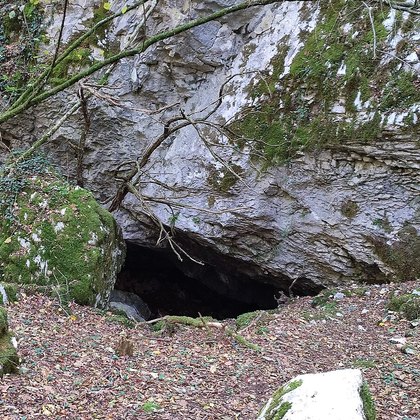
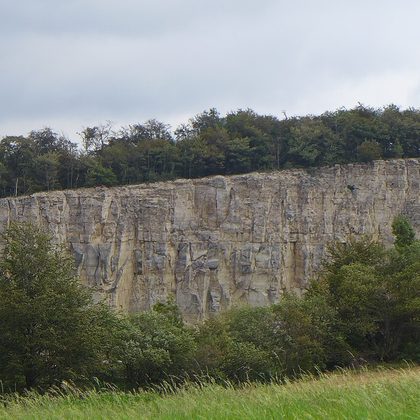
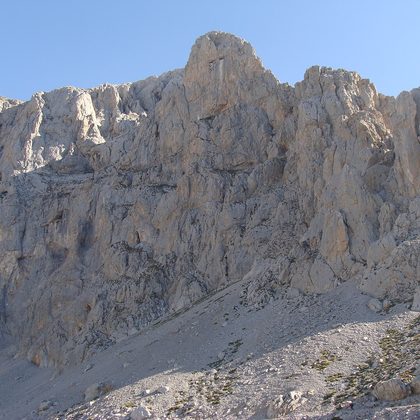
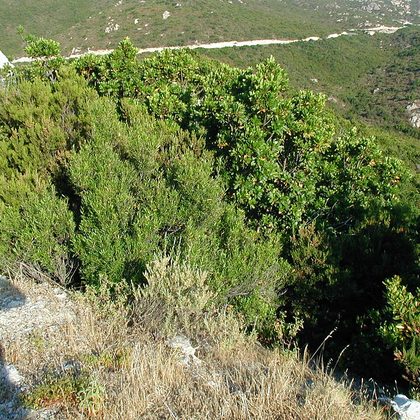
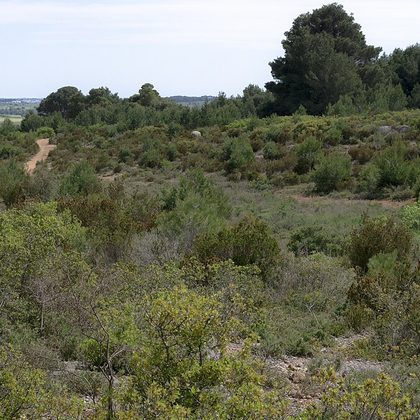
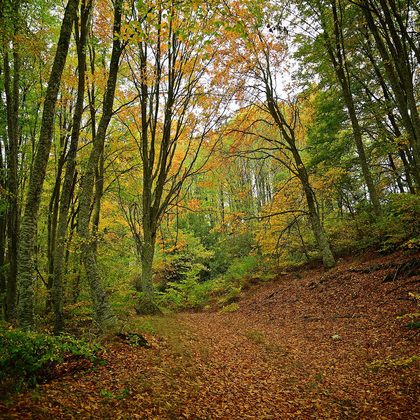
Scrub, grassland and woodland, and in the dry part of the range stony and gravel desert where water is available. Around the Mediterranean it has been found in sclerophyllous forest, sub-Mediterranean semi-desert grassland and scrub. In Europe it is often associated with limestone, frequently near streams in vegetated terrain. The species is strongly dependent on water. Roosts are underground: caves, crevices between boulders, mine shafts, underground irrigation channels and other underground structures, sometimes hollow trees; it is rarely found in buildings.
Where the animal is most at home, classified with EUNIS — the European standard for habitats.

Distribution
The nominate form lives in south-eastern Europe from Croatia east to western Romania and Bulgaria and south to Greece and Crete, in south-west Asia (western Anatolia, Cyprus, Syria, Lebanon, Israel, western Jordan, the southern Caucasus, western Iran, and Yemen and Oman) and in north-western Africa (northern Morocco, northern Algeria and northern Tunisia); Egypt and Georgia are unconfirmed. Three other subspecies live in the Horn of Africa, in south-eastern Africa and from eastern Iran to northern Pakistan. The handbook recognises four subspecies and places the species in the landeri group on morphology, but genetically it probably belongs at the base of the capensis group. In Europe, Anatolia and North Africa the core areas are the Balkans, western Anatolia and the Maghreb.
- Native
- dark = core range, pale = thinly spread
Way of life
Nocturnal; by day it hangs free in the roost and often enters torpor there. It hunts in slow flight, from a perch and by gleaning prey from foliage and the ground. Over most of the range the diet consists almost entirely of moths (noctuids, lasiocampids and geometrids); the bats hear the wing flutter of a landing moth, land beside it and take off again with it. In Algeria, by contrast, the diet was mainly midges, caddisflies and bugs. The species breeds once a year; mating probably takes place before hibernation, followed by delayed implantation, and a single young is born. In summer maternity colonies of 30 to 400 animals form. Blasius's Horseshoe Bat does not migrate. It enters hibernation in Europe mostly in November, when temperatures fall below 14 °C; active animals have also been recorded in winter.
Where and when to look
In Europe the chance is greatest in karst country in the Balkans, Bulgaria and Greece, at caves with mixed horseshoe bat colonies. A detector that shows the constant frequency separates the species, at around 94 kHz, from the Greater Horseshoe Bat and from the medium-sized species above 100 kHz. For a bat hanging in a cave, a side-view photograph of the nose-leaf is needed. Entering maternity and winter caves disturbs the colonies and is not permitted in most countries.
Conservation status
Least Concern globally (LC, 2016): across its whole range the species is regarded as fairly common. In Europe populations are declining, mainly around the Mediterranean; in the eastern Balkans they appear stable. The species has disappeared from north-eastern Italy, and there have been no records from Slovenia in the past fifty years. Threats cited are disturbance of colonies and destruction of habitat and roosts. The species is listed in Annexes II and IV of the Habitats Directive.
Scientific name
Rhinolophus blasii | W. C. H. Peters, 1866
W. C. H. Peters described the species in 1866 and placed it straight away in the genus where it still stands. Rhinolophus is Greek, from rhis, genitive rhinos, 'nose', and lophos, 'crest', after the nose-leaf. blasii honours the German zoologist Johann Heinrich Blasius (1809–1870), professor at Brunswick and author of the Naturgeschichte der Säugethiere Deutschlands. The specimen the first description was based on came from Italy.