All species › Rodents › Mice and rats › Black Rat
Black Rat | Rattus rattus
Zwarte rat | Rata negra
The black rat reached Europe with Roman shipping, was the rat of medieval granaries and ports, and was then displaced in the north by the brown rat. In north-west Europe it is now rare and found mainly in pig units and old dock quarters; around the Mediterranean it is common, climbs in olive trees, pines and gutters, and on islands is an important predator of seabirds and other animals.
Tracks
Because it lives high, its signs are high too, and that is the most useful distinction from the brown rat. The droppings are smaller and finer than a brown rat's: nine to fifteen millimetres long and four to five thick, curved and more tapered, and they lie not on the floor but on ledges, beams, wall tops, roof sheets and on top of stored goods — droppings in a gutter or on a loft beam are a black rat's, droppings by a hole in a dyke a brown rat's. The prints are smaller: the forefoot about 18 to 22 millimetres with four toes, the hind foot about 40 millimetres long and 20 to 25 wide with five toes — narrower than a brown rat's. Along regular climbing routes greasy smear marks build on beams, over rafters and around pipe entries, often at eye level or higher, and a vertical climbing route up a wall shows as a dark stripe. Characteristic is the feeding sign of southern orchards: oranges and lemons neatly hollowed from one side and left hanging as an empty skin, almonds and hazelnuts with a round hole whose rim carries paired incisor grooves, pine cones only half stripped, and caches of hundreds of gnawed-open stones and seeds in one sheltered place. The nest is a globular wad of shredded plant material, sticks, leaves and cloth, high in a roof, a cavity, a palm crown or a tree; no other rat species in Europe builds nests in trees.

In its habitat
Identification
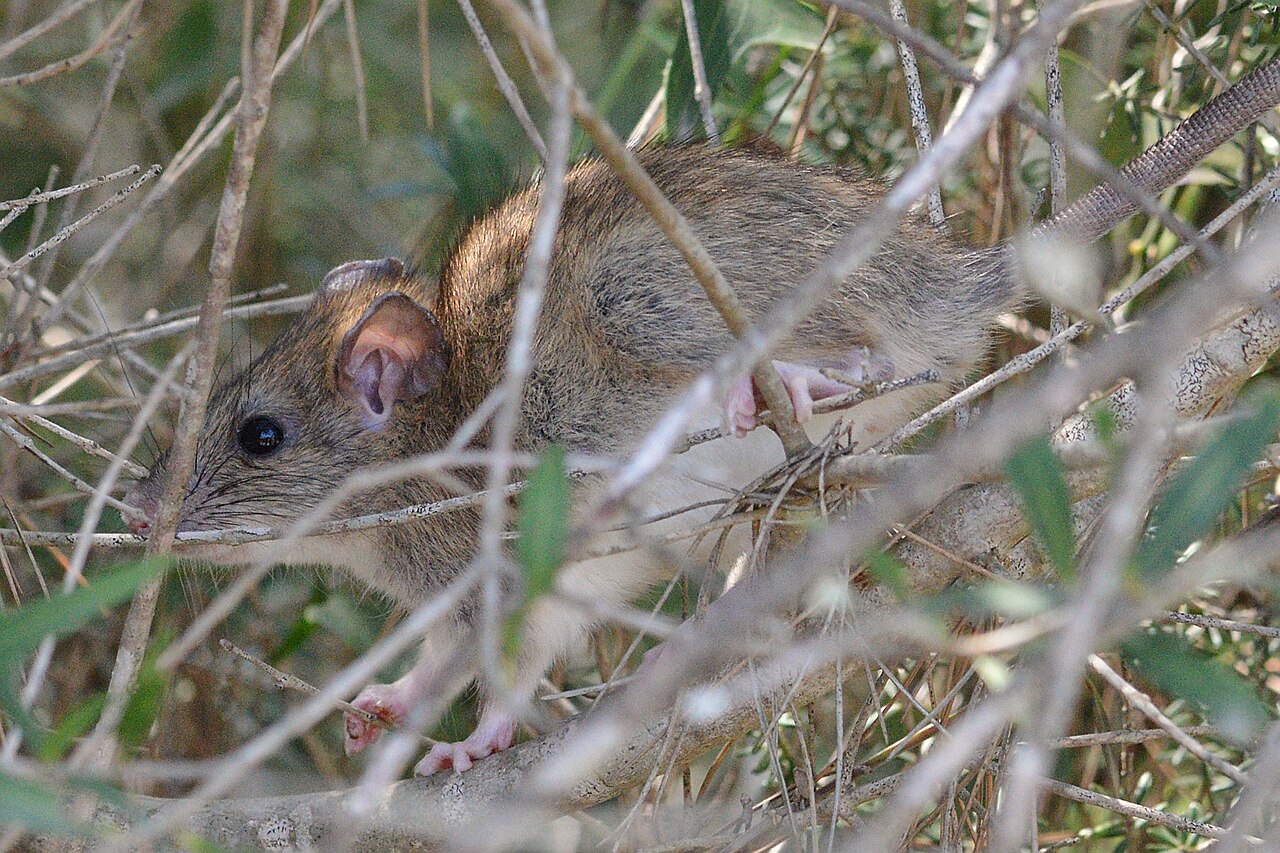
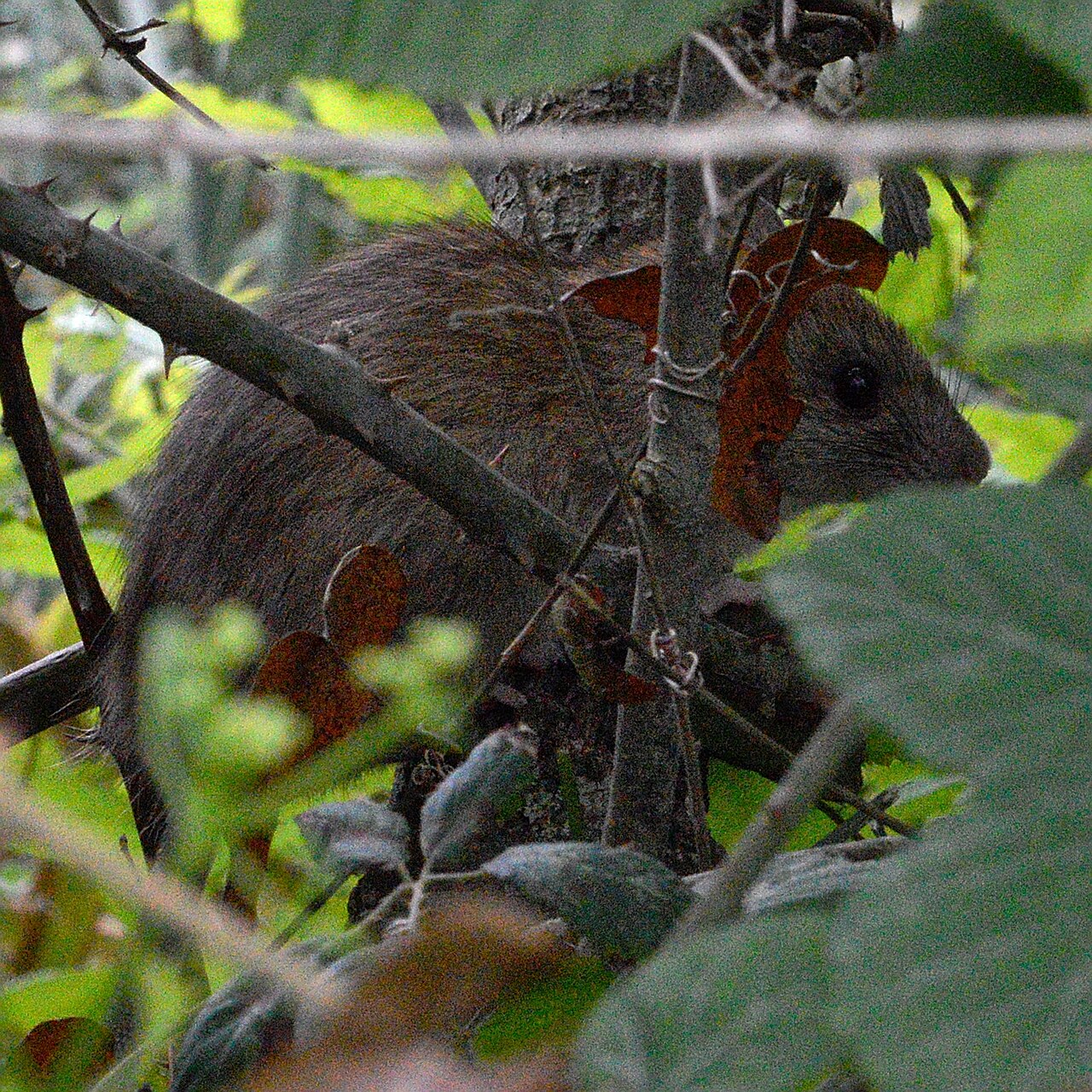
The black rat is slighter and lighter than a brown rat: head and body sixteen to twenty-four centimetres, tail eighteen to twenty-six, weight a hundred and thirty to two hundred and eighty grams. Three characters settle it. The tail is longer than head and body; this is the most reliable character. The ear is large, thin and nearly naked, and can be drawn forward over the eye. The muzzle is pointed and the eye large and dark. The coat is finer than a brown rat's, from grey-brown to jet black, the belly paler. Despite the name the species is not always black: there are three colour forms, the jet-black rattus with a grey belly, the grey-brown alexandrinus with a grey belly, and the brown frugivorus with a creamy to pure white belly, and the last is the commonest around the Mediterranean. It is above all a climber: it walks ropes, cables, branches and ledges, jumps up to a metre and a half, and moves more nimbly than a brown rat.
Similar species
The brown rat (Rattus norvegicus) is the only real confusion, and the comparison runs along the same three points: the brown rat has a tail shorter than head and body, small thick furred ears that will not reach the eye, and a blunt muzzle, and it is heavier and more thickset. Location is almost as informative: the black rat lives high and dry — roofs, lofts, beams, false ceilings, trees — and the brown rat low and wet: cellars, sewers, bank burrows. Black brown rats also exist, so colour is not decisive; tail length is. A young brown rat is the mistake most often made: it has large feet and a thick short tail. The wood mouse and the yellow-necked mouse are far smaller, russet, with pure white bellies and a bounding gait. In southern Europe a large squirrel climbing a tree can be confusing for a moment in the dark, but its brush and its daytime habits settle that at once.
Habitat
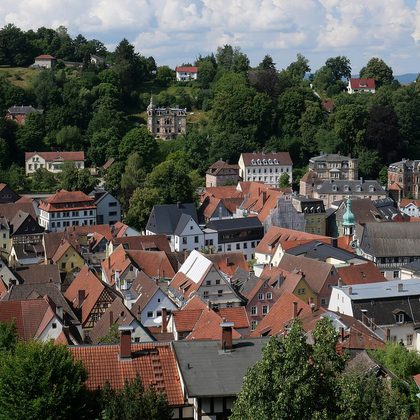
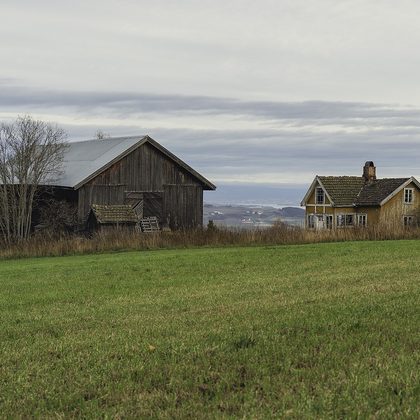
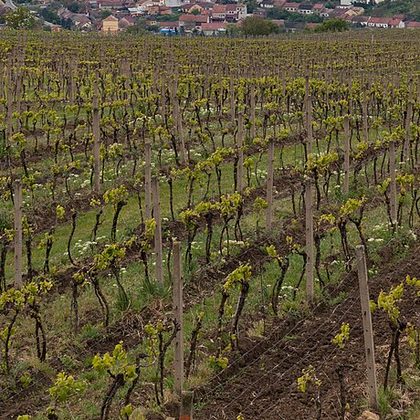
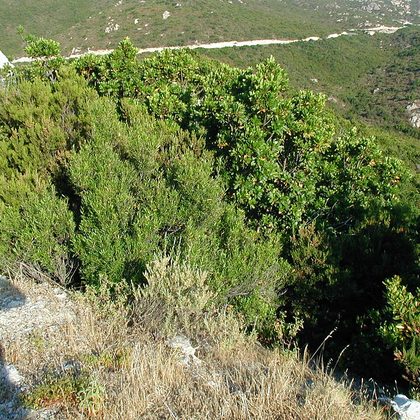
The way of life of the black rat differs between climate zones. In north-west Europe it is almost entirely confined to buildings and keeps to the dry, high places inside them: pig units, poultry and cattle houses, lofts, false ceilings, warehouses and old town centres. Around the Mediterranean it lives outdoors all year: in olive and almond groves, vineyards, citrus plantations, maquis, evergreen oak woodland, pine forest, reed beds, dune scrub, ruins and dry-stone walls, and on the cliffs and islets of seabird colonies. It lives there in the crown of a pine as well as in a gutter.
Where the animal is most at home, classified with EUNIS — the European standard for habitats.



Distribution
The black rat is originally an animal of the Indian subcontinent and South-East Asia; its closest relative is the Asian house rat Rattus tanezumi, from which it diverged about 120,000 years ago in south-western Asia. With trade it reached the Near East and Egypt and then the whole Roman Empire, with finds in Britain as early as the first century AD; around the sixth century that first population declined, and in the Middle Ages a genetically distinct lineage took its place. It is now worldwide. In Europe it is common around the Mediterranean and on virtually all the islands and scarce and local in the north, where it vanished from most cities after the brown rat arrived. In Spain it occurs throughout the mainland, on the Balearic and Canary Islands, in villages, farmsteads and stores and also in open country: olive groves, citrus plantations, Mediterranean scrub and above all coastal islets, where its presence determines the survival of storm petrels, shearwaters and gulls. In the Netherlands it occurs chiefly in North Brabant and Limburg, with isolated urban populations in Amsterdam and Rotterdam, and it is slowly spreading north. In Britain it has been reduced to a few ports and islets and is close to disappearing; it was eradicated from Lundy in 2006 and from the Shiant Isles in 2016.
- Native
- dark = core range, pale = thinly spread
Way of life
The black rat is nocturnal and a marked climber, moving far more at height than below ground. It is an omnivore preferring grain, grain products, seeds and fruit, with insects, snails, fish, eggs and nestlings besides; it eats about fifteen grams a day and drinks about fifteen millilitres. It lives in groups of twenty to sixty animals with one dominant male. In Europe breeding runs from mid-March to mid-November; after twenty-one to twenty-three days' gestation about seven young are born, with three to six litters a year, and a female is mature at around ninety grams. It does not hibernate. In the wild it lives about a year, in captivity up to four. It is shyer and more careful than the brown rat, and when threatened it climbs rather than takes to the water.
Where and when to look
The black rat is most easily found in southern Europe, and then at height. After dark, roof edges, gutters, creepers, cables and the branches of mulberries or plane trees in Spanish, Italian or Greek villages are suitable places to watch; a rat with a long tail and large ears crossing a telephone cable is this species. In olive and citrus groves the hollowed fruit and the droppings on the wall tops indicate its presence. In north-west Europe the chance is small and it lives in little-visited places: high in a pig house, in a false ceiling above a kitchen or in an old warehouse loft; people who work there and smear marks on the beams give the best clues. On Mediterranean islets where terns or storm petrels breed, a black rat record is a signal for immediate conservation action.
Conservation status
Least Concern (LC, 2016); one of the most numerous mammals in the world, and at the same time an animal on national red lists in north-west Europe. In the Netherlands the 2020 Red List rates it endangered, and in Britain it has been reduced to a few tens of animals. That situation deserves explaining. Its decline in the north was not planned by anyone but caused by the brown rat, which is larger and more aggressive, copes better with cold and with brick and concrete, and has a wider diet; where it arrived, the black rat left the cities. Its retreat, then, is not a conservation question but a shift between two introduced species. The species is treated as a wild species and not as a domestic form, for the same reason as the house mouse and the brown rat: Rattus rattus is a wild species with a natural range of its own in southern and south-eastern Asia, which has never been domesticated, and which around the Mediterranean lives wholly apart from people, in maquis, orchard and dune scrub. Its place in history is nonetheless that of a pest: it was the classic host of the rat flea and so long the chief suspect in the plague, although recent work indicates that other Asiatic rodents were the reservoir and that people themselves played a larger part in the spread than was thought. Where it does most harm today is on islands: it climbs trees and shrubs, robs nests a brown rat could never reach, and is responsible worldwide for the extinction of countless birds, reptiles and plants. The eradication campaigns on islands off the Scottish, Italian, Spanish and French coasts are aimed at it, and in this continent they are the single most important measure there is for seabirds.
Scientific name
Rattus rattus | (Linnaeus, 1758)
Linnaeus described the species in 1758 as Mus Rattus; because it was later moved to another genus, the author and year stand in brackets. Rattus is the medieval Latin word for 'rat'. Related forms stand side by side in Germanic, Romance and Celtic; how they hang together, and where the word ultimately came from, is unknown. The specific name repeats the genus name. The specimen the first description was based on came from Sweden.