All species › Carnivores › Cats › African Caracal
African Caracal | Caracal caracal
Caracal | Lince Africano
The caracal is a medium-sized, long-legged cat of dry, open country in Africa, the Middle East and south-west and Central Asia. Within the guide area it lives in North Africa, the Levant and Turkey; it is common in Israel and rare in North Africa. Despite its long ear tufts it is not a lynx: genetically it is closest to the African golden cat.
Tracks
Little has been recorded on caracal signs in the guide area. Hare-sized prey is killed with a bite to the nape, larger prey with a suffocating throat bite. Daytime rest sites are among bushes and rocks, and young are born in caves, tree hollows or burrows. In Israel the species has been studied by radio-tracking.
Identification
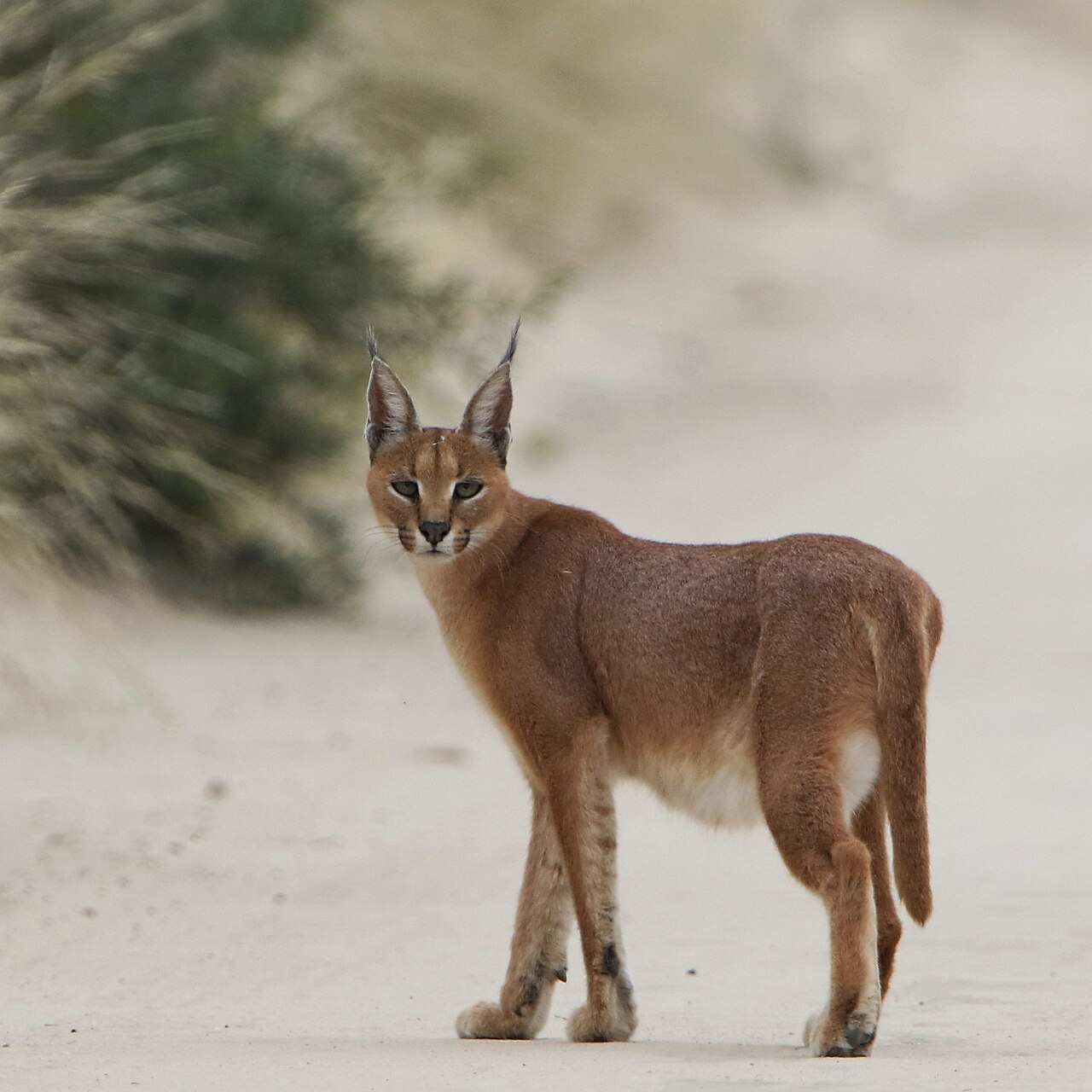
A slender, long-legged cat with powerful hind legs longer than the forelegs, so that it looks higher at the rump than at the shoulder. The tail is short and reaches the hocks. The coat is short and unspotted, uniform tawny grey to brick red; belly, chin and throat are whitish with pale spots. Striking are the large ears, black on the back, with black tufts 4 to 5 cm long. On the face a dark line runs from the centre of the forehead to the nose, and there are white patches above and below the eyes and beside the nose. Males weigh 8 to 20 kg, females 6.2 to 15.9 kg. Melanistic animals are known.
Similar species
The jungle cat occurs in the same area in the Levant and Egypt. It is also unspotted and also has ear tufts, but these are short, the backs of the ears are reddish brown rather than black, and the tail has a black tip. The African wildcat is smaller, has a long, thin tail with dark rings and often stripes or spots on the legs.
Habitat
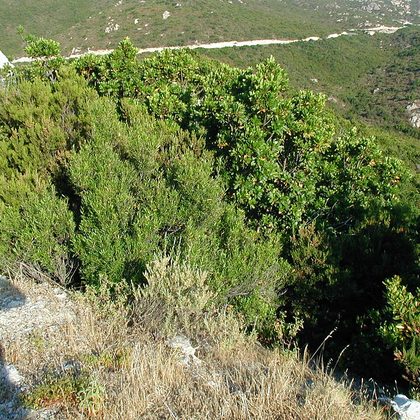
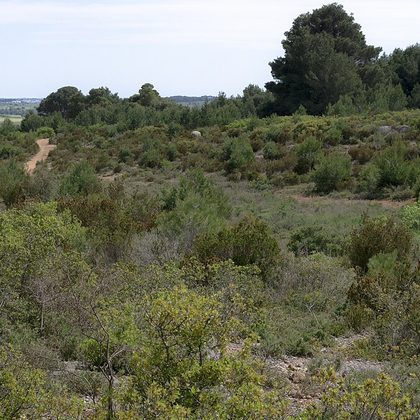
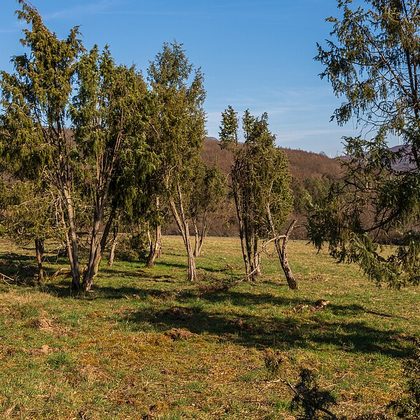
Dry woodland, savanna, acacia scrub, hilly steppe and arid mountains up to 2500 m. True desert and dense tropical rainforest are avoided. It is often associated with edges between woodland or scrub and grassland; open grassland is used at night, but bushes and rocks are needed for daytime rest.
Where the animal is most at home, classified with EUNIS — the European standard for habitats.

Distribution
Much of Africa, the Arabian Peninsula and the Middle East, and through Iran and Central Asia to India. North Africa holds the subspecies C. c. algira, Turkey and Palestine east to India C. c. schmitzi. Within the guide area the caracal is known from Morocco, Algeria, Tunisia, Libya, Egypt, Israel, the Palestinian territories, Jordan, Lebanon, Syria and Turkey; nearly all recent records come from Israel.
- Native
- dark = core range, pale = thinly spread
Way of life
Mainly nocturnal. In Israel animals were mostly active from dusk to dawn, sometimes into the early morning; how long they were active by day depended on temperature and prey activity. In hilly terrain with plenty of cover caracals also move by day. Prey usually weighs less than 5 kg: hares, hyraxes, rodents and birds. In Israel mammals were the main prey, hares above all; birds, mainly partridges, made up 24% of the diet, and mole rats, hedgehogs, Egyptian mongooses, reptiles and insects were also eaten. Birds are caught in the air with high leaps. Caracals are solitary. In Israel males travelled 10.4 km a day on average and females 6.6 km; male ranges averaged 220 km², female ranges 57 km². In Israel a female mated with several males in succession, in an order related to the males' age and weight. After a gestation of 68 to 81 days usually two kittens (1 to 6) are born, which disperse at 9 to 10 months.
Where and when to look
In the guide area Israel is by far the best place; most sightings are at dusk or at night. In cooler periods and on overcast days a caracal is also active by day.
Conservation status
Least Concern (LC, 2016) globally. Asian populations are on CITES Appendix I, the others on Appendix II. It is rare in North Africa, Turkmenistan, Pakistan and Arabia and common in Israel and much of southern Africa. In southern Africa it is killed as a pest because it takes livestock; in the east of its range habitat loss is the main threat.
Scientific name
Caracal caracal | (von Schreber, 1776)
Von Schreber described the species in 1776 as Felis caracal; because it was later moved to another genus, the author and year stand in brackets. Caracal goes back through Buffon to Turkish karakulak, 'black ear', from kara, 'black', and kulak, 'ear', after the black ear-tufts. The specific name repeats the genus name. The specimen the first description was based on came from South Africa, Table Mountain.