All species › Passerines › Weavers › Yellow Bishop
Yellow Bishop | Euplectes capensis
Fluweelwidavink | Obispo Culigualdo
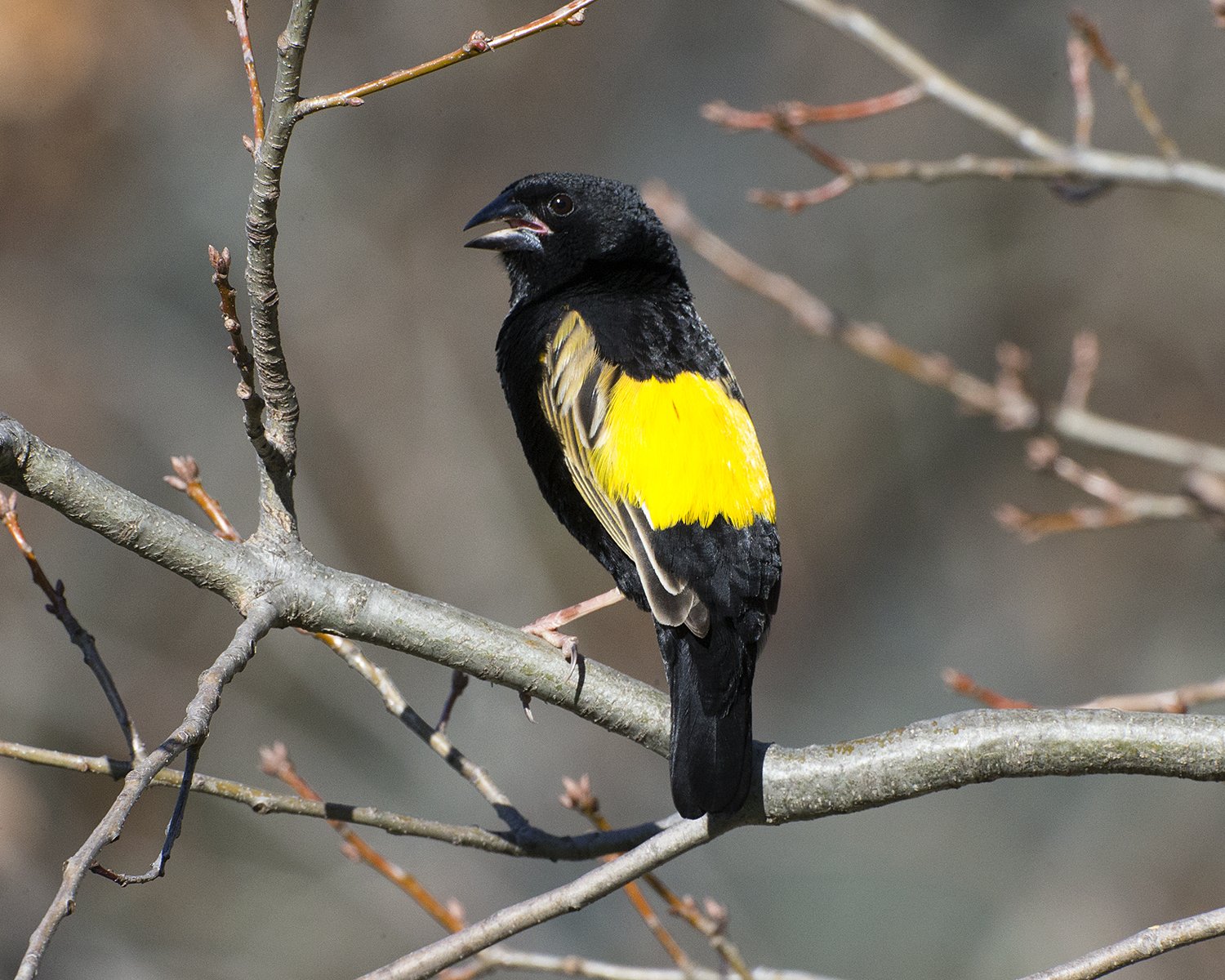
The Yellow Bishop is a black bishop with a bright yellow rump and yellow shoulders, which flashes its rump from the top of a bush in fynbos, mountain scrub and damp hollows. It is a bulky, short-tailed species that remains recognisable by the yellow shoulder even outside the breeding season.
Voice
A series of dry, grating and sizzling notes, zzeet-zzeet-zzeet-chrrr, often with the head drawn in and rump feathers fluffed, from the top of a bush or stem. The call is a hard chip. There is also a buzzing display flight low over the vegetation.
Recording: Bram Piot — CC BY-NC-SA 4.0 · converted to mono · xeno-canto
Identification
13–16 cm; the male is larger than the female, and the tail is short and not elongated even in breeding plumage. The breeding male is velvety black with a bright yellow rump, fluffed up in display, and yellow lesser wing coverts forming a shoulder patch; the flight feathers are brown with pale edges and the bill black and heavy. Outside the breeding season the male is brown and heavily streaked, but keeps the yellow shoulder and a yellow rump. The female is brown, densely dark-streaked, with an olive-yellow rump, a faint supercilium and a streaked breast; she is larger and darker than other female bishops.
Confusion species
White-Winged Widowbird (Euplectes albonotatus) has a white wing patch as well as a yellow shoulder, no yellow rump, a longer tail and a blue-grey bill. Yellow-Mantled Widowbird (Euplectes macroura) has a yellow mantle instead of a yellow rump and a longer tail. Long-Tailed Widowbird (Euplectes progne) has a red-and-white shoulder and a very long tail. Yellow-Crowned Bishop (Euplectes afer) is much smaller, with a yellow crown. Females can be identified by the olive-yellow rump and bulky size.
Habitat
Fynbos and renosterveld, rank grassland with bracken and bushes on mountain slopes, forest edges, damp hollows and vleis with reeds and sedges, and in the north of the region montane grasslands and tall grass near fields. It breeds polygynously; the nest is a small dome in low scrub or grass.
Where the bird is most at home, classified by the vegetation units of southern Africa.



Range and movements
In South Africa from the Western Cape along the south coast through the Eastern Cape and KwaZulu-Natal to Mpumalanga and Limpopo (Soutpansberg), with Eswatini and the margins of Lesotho; further in the eastern highlands and central plateau of Zimbabwe, the Mozambique highlands, Malawi, northern and eastern Zambia and western and highland Angola. It is absent from Botswana and almost all of Namibia. Beyond the region it ranges from Cameroon and DR Congo to East Africa and Ethiopia.
- Resident
- Summer visitor (c. Oct–Mar)
- Winter visitor (c. Apr–Sep)
- Passage (Mar–Apr, Oct–Nov)
- dark = core range, pale = thinly spread
How and when to look
In the fynbos of the Western Cape in late winter and spring, when males sing from the tops of proteas and restios and raise their yellow rump like a lamp. A black bird with a yellow rump that flies up briefly and drops again is almost always this species.
Conservation status
Not threatened; common in suitable habitat. It has declined locally through building and afforestation of fynbos and grassland, but also benefits from rank growth along fields.
Scientific name
Euplectes capensis | (Linnaeus, 1766)
Linnaeus described the species in 1766 as Loxia capensis; because it was later moved to another genus, the author and year stand in brackets. The genus Euplectes was introduced in 1829 by Swainson. Euplectes joins Greek eu 'fine, good' to New Latin plectes 'weaver'. capensis is Latin for 'of the Cape' — for the origin of the first specimen at the Cape of Good Hope. The specimen the first description was based on came from Cape of Good Hope.