All species › Pelicans, herons and ibises › Herons and bitterns › Yellow-Billed Egret
Yellow-Billed Egret | Ardea brachyrhyncha
Geelsnavelzilverreiger | Garceta Piquicorta
The Yellow-Billed Egret is a medium-sized, all-white egret, falling neatly between Little and Great Egret in size and build. It is less tied to open water than its relatives and often feeds in flooded grass and vleis, hunting slowly with a slightly bent neck.

Voice
Mostly silent. When disturbed and at colonies it gives a hoarse, rough kwark and soft retching sounds.
No recording with a suitable Creative Commons licence is available for this species yet.
Identification
About 66 cm, wholly white. The bill is relatively short and yellow; the gape line ends below the eye, not behind it. The neck is shorter and less strongly kinked than in Great Egret, and the head rounder. The legs are black, but the upper tibia is yellow to greenish. In breeding plumage it has long plumes on the back and breast, the bill turns red with a yellow tip, the lores pale green and the upper leg red or orange. The sexes are alike; juveniles lack plumes. In flight the neck is retracted and the feet project less far than in Great Egret.
Confusion species
Great Egret Ardea alba is larger, with a longer, distinctly kinked neck, a longer bill with the gape line extending behind the eye, and all-black legs. Little Egret Egretta garzetta is slimmer, with a thin black bill and yellow toes. Western Cattle Egret Ardea ibis is much smaller and stockier, with a short thick bill and a jowl.
Habitat
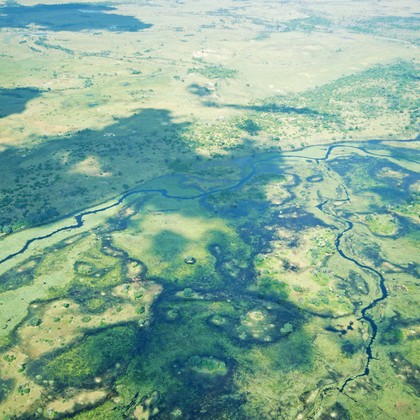
Vleis, flooded grassland, shallow margins of dams and pans, rice fields and marshy pasture; less often on open shores or at the coast. It walks slowly and takes fish, frogs and large insects, often among tall grass. It breeds in mixed colonies with other herons in reedbeds or in trees over water.
Where the bird is most at home, classified by the vegetation units of southern Africa.

Range and movements
Widespread but nowhere very common in the north and east of the region: Angola, Zambia, Malawi, Mozambique, Zimbabwe, northern Botswana (Okavango, Chobe) and northern Namibia (Caprivi). In South Africa mainly in the east, from KwaZulu-Natal and Mpumalanga to the Highveld, with scattered birds in the Cape provinces; scarce in the dry western half. Beyond the region throughout sub-Saharan Africa and on Madagascar.
- Resident
- Summer visitor (c. Oct–Mar)
- Winter visitor (c. Apr–Sep)
- Passage (Mar–Apr, Oct–Nov)
- dark = core range, pale = thinly spread
How and when to look
In a group of white egrets, focus on proportions: neck length, the extent of the gape line relative to the eye and the colour of the upper leg are the best features. In the rainy season flooded grassland rich in frogs is the best place to look; there the species often stands alone or in small groups in the grass.
Conservation status
Not threatened. It depends on freshwater marshes and seasonal flooding; locally declining where vleis are drained and ploughed, but it also uses dams and rice fields.
Scientific name
Ardea brachyrhyncha | (Brehm, 1854) (GBIF: Egretta intermedia)
Brehm described the species in 1854 as Herodias brachyrhynchus; because it was later moved to another genus, the author and year stand in brackets. The genus Ardea was introduced in 1758 by Linnaeus. Ardea is the Latin word for 'heron'. brachyrhyncha comes from the Greek brakhus, 'short', and rhunkhos, 'bill' — for the somewhat shorter bill than that of related egrets. The specimen the first description was based on came from Blue Nile, Sudan.