All species › Waders, gulls and terns › Gulls and terns › White-Winged Tern
White-Winged Tern | Chlidonias leucopterus
Witvleugelstern | Fumarel Aliblanco
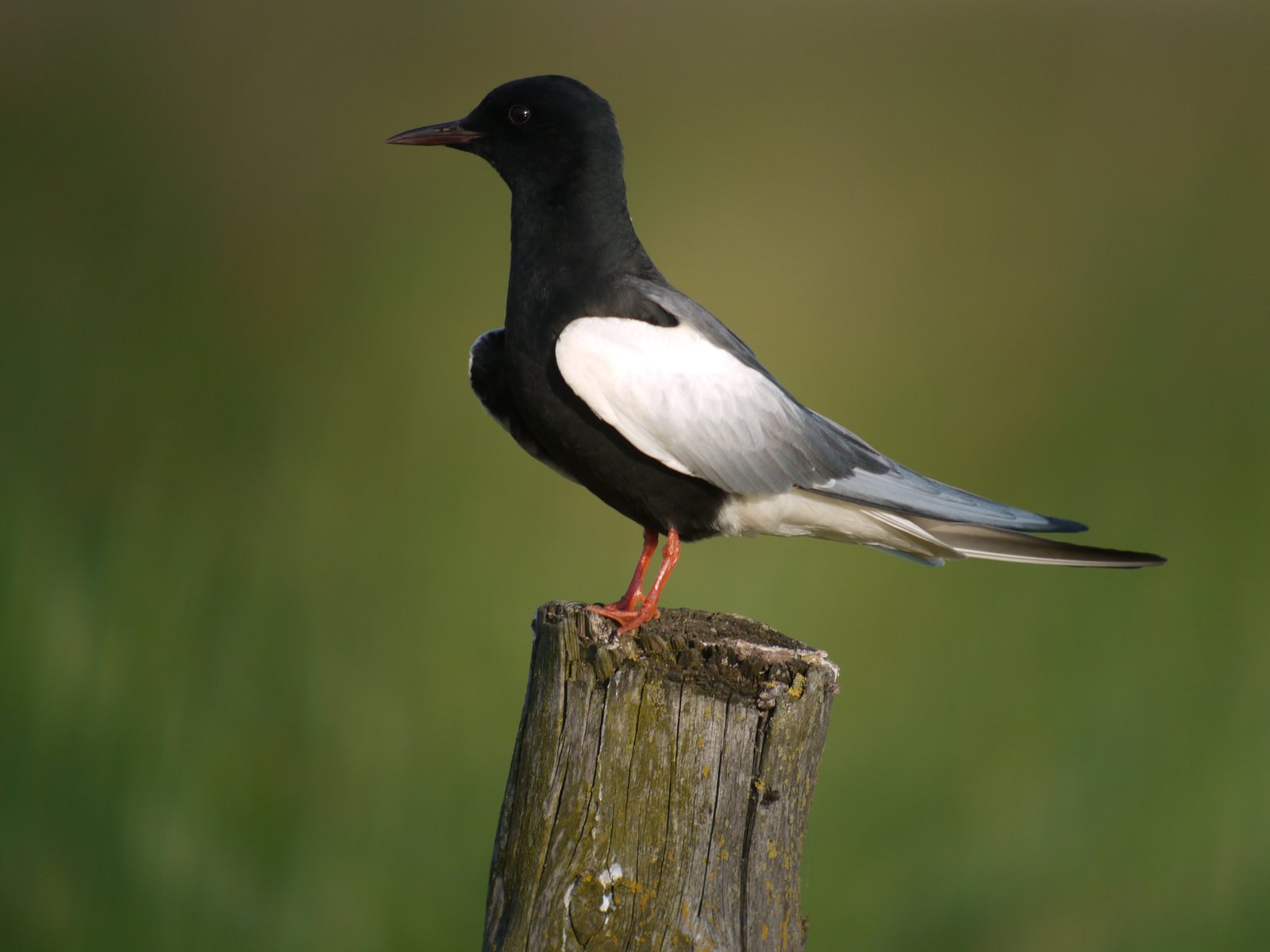
The White-Winged Tern is the most numerous marsh tern in the region: a small tern that in summer hunts in flocks of hundreds to thousands over pans, lakes and flooded grasslands. It breeds in eastern Europe and Asia and is seen here mainly in non-breeding plumage, but in March and April the first birds appear in the striking black-and-white breeding plumage.
Voice
A dry, rasping kesh or kerr, shorter and higher than in Whiskered Tern, and a rapidly repeated kek-kek. Large flocks keep up a constant murmur.
Recording: Paul Kelly — CC BY-NC-SA 4.0 · converted to mono · xeno-canto
Identification
About 22 cm, with a short, fine bill, fairly broad wings and a short, barely forked tail. In non-breeding plumage the head and underparts are white, with an isolated dark patch behind the eye like a headphone and a finely speckled rear crown that does not merge into a cap. The back is pale grey, the rump white and clearly paler than the back and tail. In breeding plumage the head, body and underwing coverts are jet black and contrast strongly with the white forewing, white rump and tail and silvery grey primaries; the bill and legs are then red. Moulting birds are irregularly blotched with black. Juveniles have a dark brown saddle contrasting with the grey wings.
Confusion species
Whiskered Tern Chlidonias hybrida in non-breeding plumage is larger, with a longer and heavier bill, a grey rump matching the back and tail, and a dark ear patch that merges with the streaked rear crown. Black Tern Chlidonias niger in non-breeding plumage has a dark patch on the breast sides, a grey rump, a darker back and a dark cap extending well over the crown; in breeding plumage it has grey, not black, underwings.
Habitat
Pans, lakes, dams, marshes, flooded grasslands, sewage works and rice fields. It hunts in loose flocks low over water and wet flats, picking insects, especially flying ants and termites, from the water surface or the air; it sometimes follows thunderstorms to catch emerging termites. It rests on posts, dam walls and mudbanks.
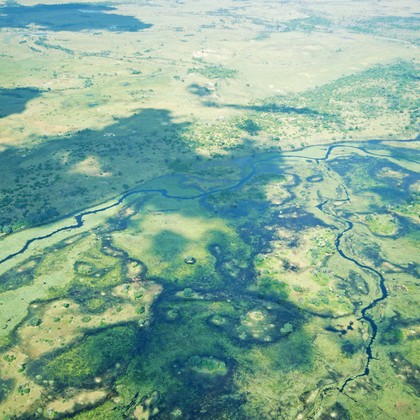
Where the bird is most at home, classified by the vegetation units of southern Africa.

Range and movements
Across almost the whole region, with the largest numbers in the north and east: Zambia, Malawi, Zimbabwe, northern Botswana with the Okavango and the Makgadikgadi Pans, Mozambique and northern Namibia; in South Africa common on the Highveld and in KwaZulu-Natal, scarcer in the arid west. It breeds from eastern Europe to central and eastern Asia and winters in sub-Saharan Africa, southern Asia and Australia.
- Resident
- Summer visitor (c. Oct–Mar)
- Passage (Mar–Apr, Oct–Nov)
- dark = core range, pale = thinly spread
How and when to look
From November to March often seen over sewage works, pans and dams, sometimes in flocks of thousands. In March and April it is worth scanning flocks for birds in breeding plumage, when the species is unmistakable. In non-breeding plumage, look for the white rump and the detached ear patch.
Conservation status
Not threatened, with a very large world population. Numbers in the region fluctuate strongly from year to year with rainfall and the amount of water.
Scientific name
Chlidonias leucopterus | (Temminck, 1815)
Temminck described the species in 1815 as Sterna leucoptera; because it was later moved to another genus, the author and year stand in brackets. The genus Chlidonias was introduced in 1822 by Rafinesque. Chlidonias is from Ancient Greek khelidonios 'swallow-like', from khelidon 'swallow'. leucopterus is Greek, from leukos 'white' and -pteros '-winged'. The specimen the first description was based on came from the Mediterranean coast.