All species › Passerines › Chats and flycatchers › White-Throated Robin-Chat
White-Throated Robin-Chat | Dessonornis humeralis
Witkeellawaaimaker | Cosifa Gorjiblanca
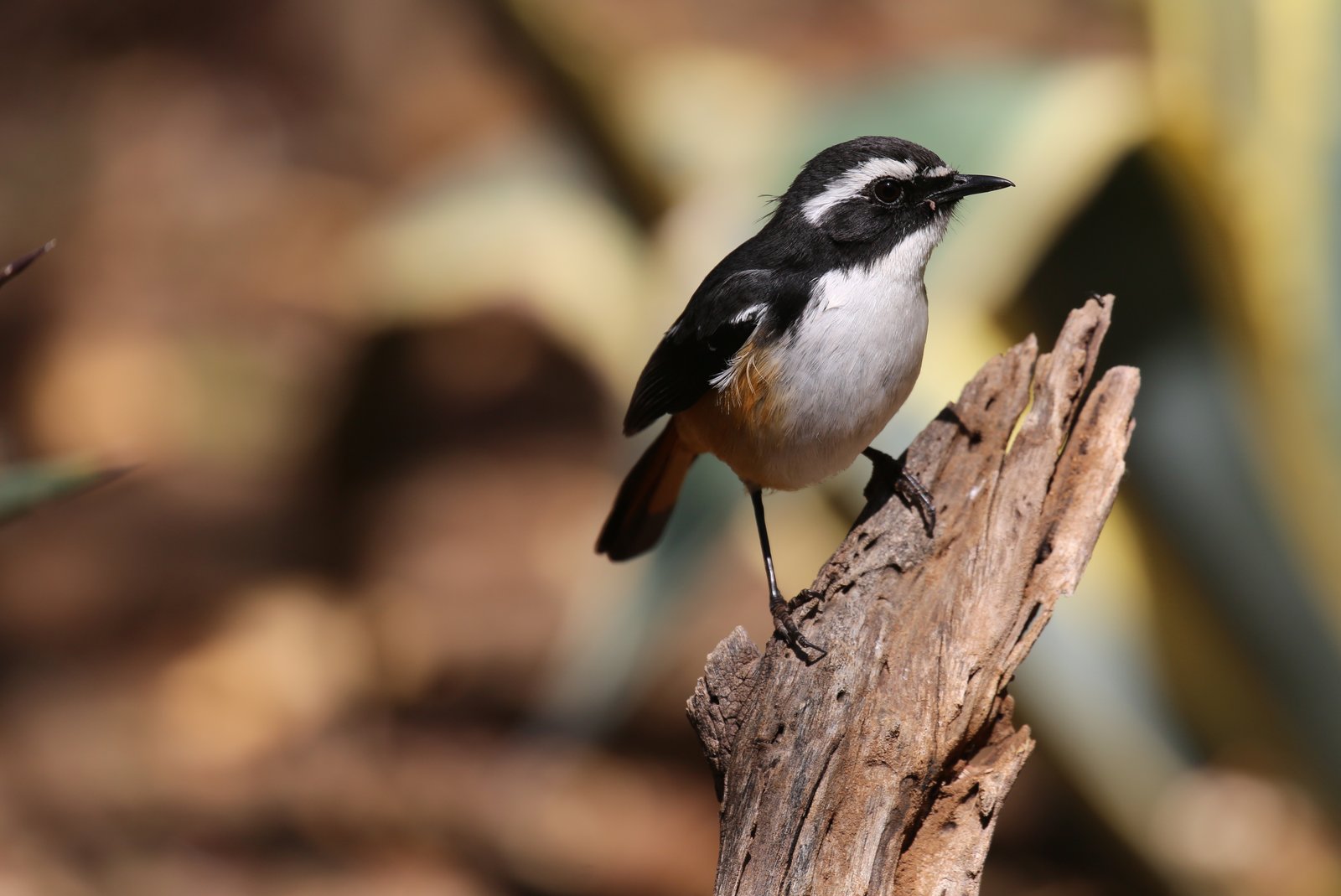
The White-Throated Robin-Chat is a near-endemic robin-chat of southern Africa, living in dense bushes in dry woodland and along rivers. It stands out by its white throat and white wing bar, and its song includes extensive mimicry of other species.
Voice
A mimic: the song is a long, unhurried series of whistles interspersed with imitations of cuckoos, shrikes, bulbuls and many other species. It often switches to a different fragment, so that each phrase sounds different. Its own call is a soft, repeated tseep-tseep or chew-chew, the alarm a harsh chrrr.
No recording with a suitable Creative Commons licence is available for this species yet.
Identification
A slim robin-chat of 16 to 18 cm. The head is dark grey with a crisp white supercilium and black cheeks; the back is grey-brown, the rump orange. Throat and centre of the breast white, breast sides and flanks bright orange, belly white. A narrow white bar runs across the upperwing coverts of the closed wing and also shows in flight. The tail is orange with black central feathers and a black terminal band. Sexes alike. Juveniles are brown with buff spots but already show the white wing bar.
Confusion species
Cape Robin-Chat (Dessonornis caffer) has an orange throat, grey flanks and no white wing bar, and mainly inhabits cooler, moister areas. White-Browed Robin-Chat (Cossypha heuglini) is entirely orange from throat to belly and larger. White-Browed Scrub Robin (Cercotrichas leucophrys) also has a white supercilium and wing bars, but a streaked breast and a rufous tail with white tips, and sits more in the open. In the field the mimicry and the white throat with orange flanks are key.
Habitat
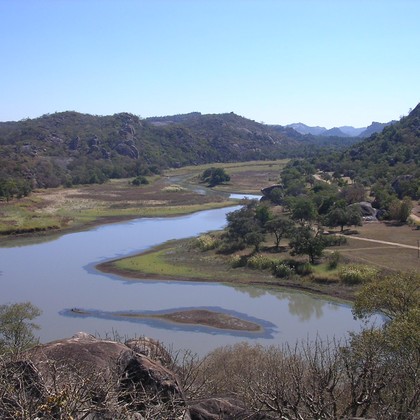
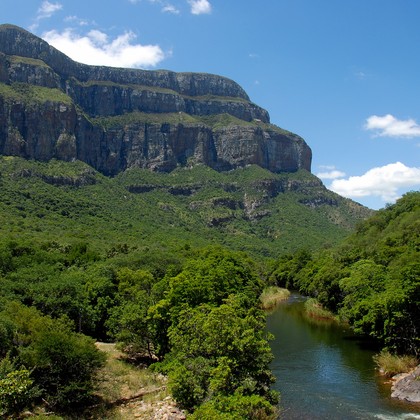
Dense thickets and undergrowth in dry and mixed woodland, bushy rocky hills, riverine forest and the edges of dry lowland forest, often around thicket-covered termite mounds. Also in large gardens in the lowveld. Forages on the ground in the shade of cover for insects and small fruits, and seldom ventures far into the open.
Where the bird is most at home, classified by the vegetation units of southern Africa.

Range and movements
In South Africa in Limpopo, Mpumalanga and north-eastern KwaZulu-Natal, south to about Durban, and in Eswatini; also in eastern Botswana, much of Zimbabwe (except the driest west and the highest mountains), southern and central Mozambique, southern Malawi and the adjacent Zambezi Valley in Zambia. It occurs nowhere outside this region.
- Resident
- Summer visitor (c. Oct–Mar)
- Winter visitor (c. Apr–Sep)
- Passage (Mar–Apr, Oct–Nov)
- dark = core range, pale = thinly spread
How and when to look
Walk slowly through lowveld thickets, for example in Kruger National Park or eastern Zimbabwe, and listen for a familiar species that sounds slightly too soft or too fragmented: that is often this mimic. Wait at waterholes in the dry season; it comes down cautiously to drink and then shows its throat and wing bar.
Conservation status
Not threatened. The species is fairly common and numbers appear stable. Loss of dense undergrowth through overgrazing, fire and conversion to cropland has local effects, but it remains well represented in protected areas and rural gardens.
Scientific name
Dessonornis humeralis | Smith, 1836 (GBIF: Cossypha humeralis)
Smith described the species in 1836 and placed it straight away in the genus where it still stands. He introduced the genus Dessonornis in that same work. Dessonornis is a misprint for Bessonornis, from the Greek bēssa, 'wooded glen', and ornis, 'bird'; its author Andrew Smith later corrected the spelling himself, but the original form stands. humeralis comes from the Latin humerus, 'shoulder' — for the white wing stripe starting at the shoulder. The specimen the first description was based on came from Marico River, North West, South Africa.