All species › Passerines › Batises and wattle-eyes › White-Fronted Wattle-Eye
White-Fronted Wattle-Eye | Platysteira albifrons
Angolese lelvliegenvanger | Batis Carunculado Frentiblanco
The White-Fronted Wattle-Eye is endemic to western Angola, a little-known wattle-eye of dry forest and thicket on the coastal plain and at the foot of the escarpment. It resembles Brown-Throated Wattle-Eye but has a conspicuous white forehead.

Voice
Clear whistled notes in short series, similar to those of Brown-Throated Wattle-Eye, and hard clicking chik calls. The repertoire is poorly described.
Recording: Niall Perrins — CC BY-NC-SA 4.0 · converted to mono · xeno-canto
Identification
12–13 cm. The male is glossy black above with a white forehead, a greyish crown and a white wing stripe, and white below with a black breast band. The female resembles the male but is duller and greyer on the head and back. Both sexes have a red wattle above the eye. Juveniles are browner above, with a faint rusty breast.
Confusion species
Brown-Throated Wattle-Eye Platysteira cyanea of northern Angola lacks the white forehead, and the female has a chestnut throat. Black-Throated Wattle-Eye Platysteira peltata has a black forehead, and the female a wholly black throat. Angola Batis Batis minulla is smaller, with a yellow eye and no wattle and a grey back.
Habitat
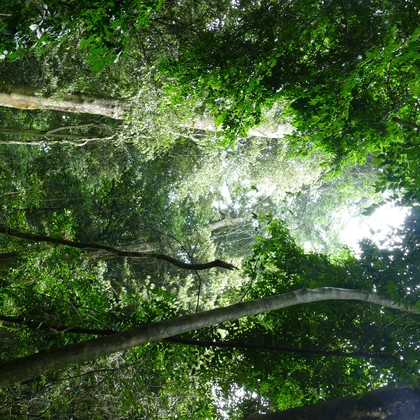
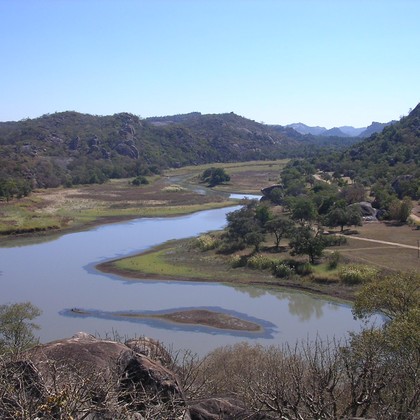
Dry forest, gallery forest and dense thicket on the coastal lowlands and the lower slopes of the escarpment, often along dry riverbeds and in baobab and euphorbia woodland. It forages in pairs in the middle and lower strata for insects.
Where the bird is most at home, classified by the vegetation units of southern Africa.
Range and movements
Endemic to western Angola, from Cuanza Norte and the area around Luanda and Kissama south through Cuanza Sul to Benguela. It does not occur outside Angola.
- Resident
- dark = core range, pale = thinly spread
How and when to look
Year-round. Kissama National Park and the dry forests at the foot of the escarpment near Gabela and Sumbe are the best-known sites. Search dense thicket along dry riverbeds and listen for the whistles; the white forehead is the best feature.
Conservation status
Near Threatened. The range is small and dry forest on the coastal plain is being lost to clearance for charcoal and farming. The species occurs partly in protected areas, but enforcement there is limited.
Scientific name
Platysteira albifrons | Sharpe, 1873
Sharpe described the species in 1873 and placed it straight away in the genus where it still stands. The genus Platysteira was introduced in 1830 by Jardine & Selby. Platysteira comes from the Greek platus, 'broad', and steira, 'ship's keel' — for the broad, flattened bill. albifrons comes from the Latin albus, 'white', and frons, 'forehead' — for the white forehead. The specimen the first description was based on came from Loge River, Angola.