All species › Passerines › Batises and wattle-eyes › Black-Throated Wattle-Eye
Black-Throated Wattle-Eye | Platysteira peltata
Zwartkeellelvliegenvanger | Batis Carunculado Gorginegro
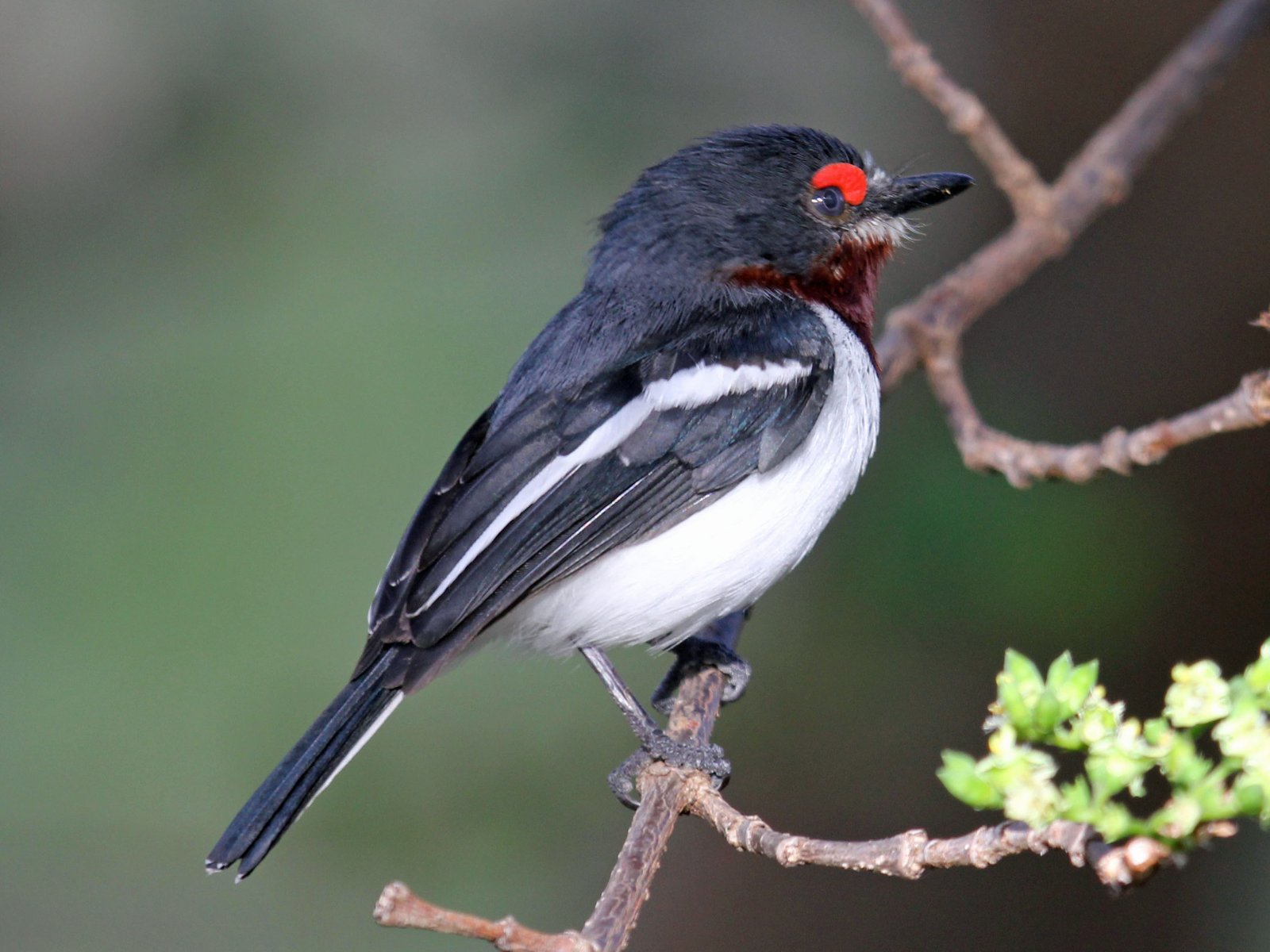
The Black-Throated Wattle-Eye is the only wattle-eye that reaches South Africa. It is a slim black-and-white bird of moist forest along rivers and the coast, with a bright red wattle above the eye; the female has a wholly black throat and breast, the male only a narrow breast band.
Voice
A clear whistled series, wee-chee-chee or tew-tew-tew, often in duet, and a harsh, grating chak-chak when agitated. It makes a clapping sound with its wings in flight.
Recording: isaac kilusu — CC BY-NC-SA 4.0 · converted to mono · xeno-canto
Identification
13 cm. The male is glossy blue-black above with no white wing stripe, and white below with a narrow black breast band. The female has the same upperparts but a wholly black throat and breast, sharply contrasting with the white belly. Both sexes have a large, bright red eye wattle. Juveniles are grey-brown above, with a rusty wash on the wings and breast and a small, dull wattle.
Confusion species
Brown-Throated Wattle-Eye Platysteira cyanea of northern Angola has a white wing stripe, and the female a chestnut throat. Cape Batis Batis capensis and Chinspot Batis Batis molitor have a yellow eye without a wattle, a grey back and a white supercilium. Black-and-White Shrike-Flycatcher Bias musicus is larger, with a crest and a yellow eye.
Habitat
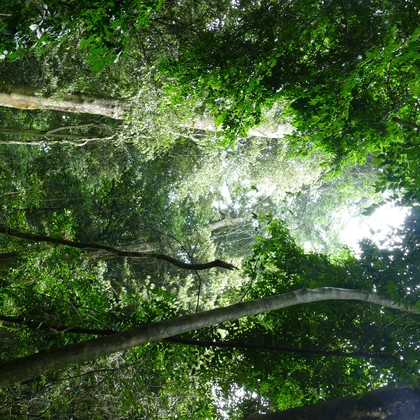
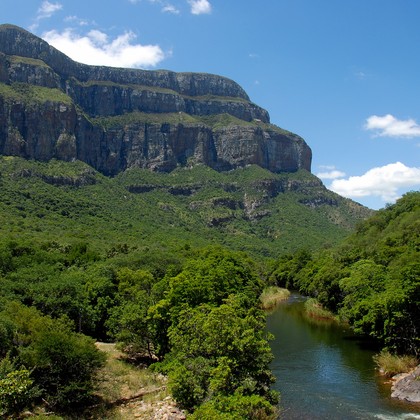
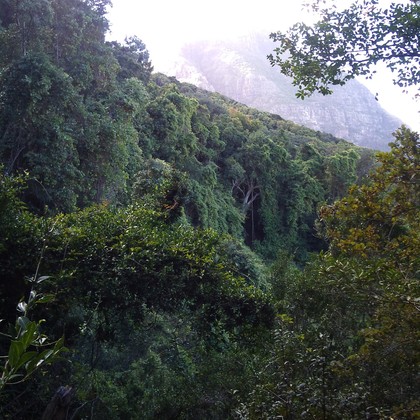
Moist forest along rivers and streams, coastal forest, dune forest, mangroves and Afromontane forest, especially where branches overhang water. Also wooded gardens and tall trees with dense undergrowth. It catches most insects in the air in short sallies and also gleans prey from leaves; lives in pairs.
Where the bird is most at home, classified by the vegetation units of southern Africa.
Range and movements
In South Africa mainly in northern KwaZulu-Natal, south to around Durban and the northern Eastern Cape, and in eastern Mpumalanga and Limpopo, including Pafuri. Further in eastern Zimbabwe, through Mozambique, in Malawi, northern and eastern Zambia and locally in Angola. Beyond the region from Tanzania and Kenya to southern Somalia and eastern Congo.
- Resident
- Summer visitor (c. Oct–Mar)
- Winter visitor (c. Apr–Sep)
- Passage (Mar–Apr, Oct–Nov)
- dark = core range, pale = thinly spread
How and when to look
Year-round. Good sites are the St Lucia area, Mkhuze and the riverine forest at Pafuri in the Kruger National Park. Walk along wooded banks and listen for the whistled duet; the bird often perches on a low branch over the water.
Conservation status
Not globally threatened. In South Africa the species is considered vulnerable to the loss of coastal and riverine forest, although it occurs in several protected areas. Locally common elsewhere in its range.
Scientific name
Platysteira peltata | Sundevall, 1850
Sundevall described the species in 1850 and placed it straight away in the genus where it still stands. The genus Platysteira was introduced in 1830 by Jardine & Selby. Platysteira comes from the Greek platus, 'broad', and steira, 'ship's keel' — for the broad, flattened bill. peltata is Latin for 'shielded', from pelta, 'small shield' — for the black breast band. The specimen the first description was based on came from Umlalazi River, KwaZulu-Natal, South Africa.