All species › Passerines › Cisticolas › White-Chinned Prinia
White-Chinned Prinia | Schistolais leucopogon
Witkeelprinia | Prinia Gorjiblanca
The White-Chinned Prinia is a dark, slate-grey prinia with a long tail and a white chin and throat, which moves in noisy parties through rank growth at forest edges. Unlike most prinias it is not a grassland bird but one of dense scrub and overgrown clearings in forest. Within the region it occurs only in Angola and northern Zambia.

Voice
Loud and busy: parties give a high, penetrating duet or chorus, tchew-tchew-tchew alternating with rattling chrrr-chrrr, the birds answering each other at great speed. The contact call is a sharp tchip. The sound is often all you pick up from a party in dense scrub.
Recording: Bram Piot — CC BY-NC-SA 4.0 · converted to mono · xeno-canto
Identification
13–14 cm, more than half of which is tail. The upperparts are plain dark slate-grey, the long graduated tail slightly darker with faint pale tips. Chin and throat are clean white, sharply set off against a grey breast and flanks; the belly is paler grey to off-white with a buff wash on the lower belly and undertail coverts. There is no supercilium. The iris is pale orange to reddish-brown, the bill black, the legs pale pink. The sexes are alike; juveniles are browner grey with a less pure white throat. It moves busily through the scrub, the tail often cocked and swung from side to side.
Confusion species
Tawny-Flanked Prinia Prinia subflava often occurs in the same rank growth but is brown above, has a distinct pale supercilium and tawny flanks, and lives more in grass and low vegetation. Bleating Camaroptera Camaroptera brachyura is also grey, but has a short tail and green wings and gives a nasal bleat. Grey Apalis Apalis cinerea of Angolan highland forest is paler grey, with white underparts and white outer tail feathers, and lives higher in the trees. The absence of a supercilium, the white throat on an otherwise dark grey bird and the group behaviour are characteristic of White-Chinned Prinia.
Habitat
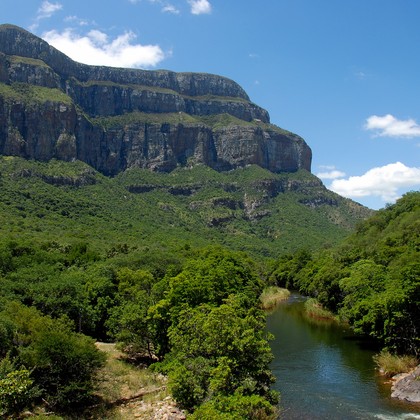
Rank growth and dense thicket at the edges of forest and gallery forest, overgrown clearings, abandoned fields with regrowth, creepers and scrub along streams and roads through forest, up into the hills. It forages in parties of three to eight birds for insects in low and mid-level vegetation.
Where the bird is most at home, classified by the vegetation units of southern Africa.

Range and movements
Within the region in northern and central Angola, from Cabinda and Uíge south through the scarp forests to the central plateau and east to the Lunda provinces, and in northern and north-western Zambia (Mwinilunga and the northern plateau). Beyond the region from Nigeria and Cameroon east through Central Africa to Uganda, western Kenya and western Tanzania.
- Resident
- dark = core range, pale = thinly spread
How and when to look
Year-round; in Angola try the scarp at Kumbira and Kalandula or forest edges in Uíge, and in Zambia the rank edges of gallery forest around Mwinilunga. The chorus gives the party away; stand where the birds have to cross a road or track and they often come briefly into view, tail fanned.
Conservation status
Not threatened. Common over a large range, and one of the few forest birds that benefit from logging and secondary growth, since rank growth and thicket in clearings form suitable habitat.
Scientific name
Schistolais leucopogon | (Cabanis, 1875)
Cabanis described the species in 1875 as Drymoeca leucopogon; because it was later moved to another genus, the author and year stand in brackets. The genus Schistolais was introduced in 1980 by Wolters. Schistolais comes from the Late Latin schistus, 'slate' (from the Greek skhistos, 'cloven'), and laïs, 'warbler', from the Greek hupolais, an unidentified small ground-nesting bird. leucopogon comes from the Greek leukos, 'white', and pōgōn, 'beard' — for the white chin and throat. The specimen the first description was based on came from Chinchoxo, Cabinda (Angola).