All species › Passerines › Crows and jays › Cape Crow
Cape Crow | Corvus capensis
Kaapse roek | Cuervo del Cabo
The Cape Crow is the all-black crow of the open farmland and grassland of southern Africa. With its long, slender bill it looks more like a rook than a raven, and pairs often sit on telephone poles and fences along the roads of the Highveld and the Karoo. It is less tied to people than Pied Crow.

Voice
A harsh, hoarse kraah or krah-krah, often with the throat feathers raised and a bowing movement. It also has a varied repertoire of bubbling, liquid and clucking notes, such as a clear kwollop, especially between the members of a pair.
Recording: Walter Wallner — CC BY-NC-SA 4.0 · shortened to the first 60 s, mono · xeno-canto
Identification
48–53 cm. The entire plumage is black with a purplish-blue gloss, browner in worn birds. The bill is long, slender and slightly curved, clearly narrower than in other crows of the region. The throat feathers are shaggy and are raised when calling. In flight the long wings and fairly short, rounded tail stand out. The sexes are alike. Juveniles are duller, brownish-black and less glossy.
Confusion species
Pied Crow Corvus albus has a white breast and a white collar. White-Necked Raven Corvus albicollis is bulkier, with a very heavy, white-tipped bill, a white patch on the nape and a short tail. House Crow Corvus splendens is smaller, with a grey neck and breast. Fork-Tailed Drongo Dicrurus adsimilis is all black but much smaller, with a forked tail.
Habitat
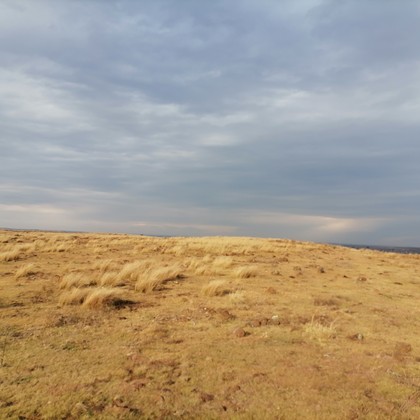
Open country: Highveld grassland, fields and pastures, the Karoo, dry savanna with few trees and the edges of wetlands. It forages on the ground for insects, larvae, seeds, grain and scraps, and also takes eggs, young birds and carrion. It nests in tall trees, on electricity pylons and on telephone poles.
Where the bird is most at home, classified by the vegetation units of southern Africa.


Range and movements
Common in South Africa away from the densely wooded east coast, in Lesotho and in the Eswatini highlands; further in central and southern Namibia, southern and central Botswana, locally in western Zimbabwe, and in south-western Angola. Scarce or absent in the north and east of the region. A separate population lives in East Africa, from Sudan, Ethiopia and Somalia to Uganda, Kenya and Tanzania.
- Resident
- Summer visitor (c. Oct–Mar)
- Winter visitor (c. Apr–Sep)
- Passage (Mar–Apr, Oct–Nov)
- dark = core range, pale = thinly spread
How and when to look
Year-round. Drive through farmland in the Free State, the Highveld or the Karoo and look for pairs on poles and fences along the road. In winter groups gather on stubble fields, often together with Pied Crows.
Conservation status
Not threatened. The species is widespread and benefits from cultivation and from pylons as nest sites. Because it damages maize, sunflowers and fruit and is said to attack lambs at times, it is persecuted and poisoned locally. In parts of western South Africa it appears to be losing ground to Pied Crow.
Scientific name
Corvus capensis | Lichtenstein, 1823
Lichtenstein described the species in 1823 and placed it straight away in the genus where it still stands. The genus Corvus was introduced in 1758 by Linnaeus. Corvus is the Latin word for 'raven'. capensis is Latin for 'of the Cape' — for the Cape of Good Hope, where the first specimen came from. The specimen the first description was based on came from Cape of Good Hope.