All species › Passerines › Waxbills › White-Breasted Nigrita
White-Breasted Nigrita | Nigrita fusconotus
Witborstnigrita | Negrita Pechiblanca
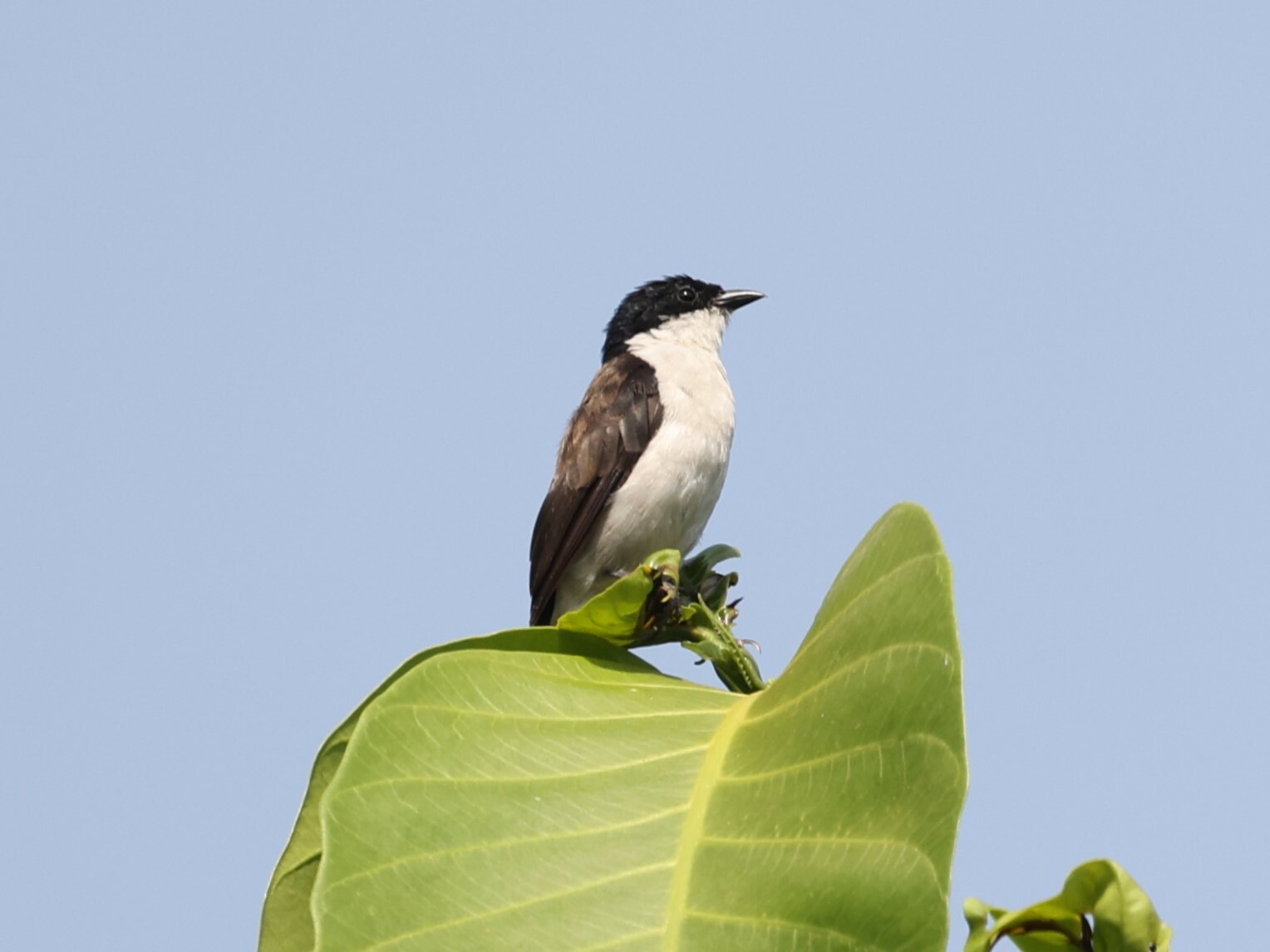
The White-Breasted Nigrita is the smallest nigrita: a slender black, brown and white waxbill of the lowland forest canopy. Nigritas eat fewer seeds than other waxbills and live mainly on insects, fruit and the pulp of oil-palm fruits.
Voice
A thin, high tsee-tsee as a contact call. The song is a series of high, pure whistles rising and falling in pitch, tsee-tsoo-tsee-tsooo.
Recording: Jaap van der Waarde — CC BY-NC-SA 4.0 · shortened to the first 60 s, mono · xeno-canto
Identification
10 to 11 cm, slim and long-tailed for a waxbill, with a fairly pointed black bill. Crown, nape and lores are glossy blue-black, the mantle and back warm dark brown, the rump and tail black. Throat, breast and belly are pure white, the flanks pale grey. The sexes are alike. Juveniles are duller, with a brownish-black cap and greyish-white underparts.
Confusion species
The Chestnut-Breasted Nigrita (Nigrita bicolor) has the same build, but a slate-grey back and deep chestnut underparts. The Black-and-White Mannikin (Spermestes bicolor) also has a black head and white belly, but a black throat and breast, a thick blue-grey bill, and lives in flocks in open scrub and gardens, not in the canopy. The combination of black cap, brown back and white underparts is unique within the region.
Habitat
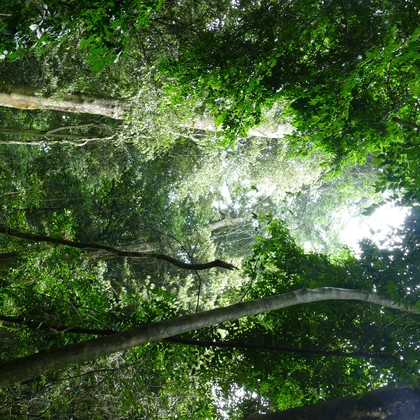
The canopy and edges of evergreen lowland forest, gallery forest, older secondary forest and plantations with oil palms. It forages in pairs or small groups, often with other species, high in the foliage and in flowering and fruiting trees.
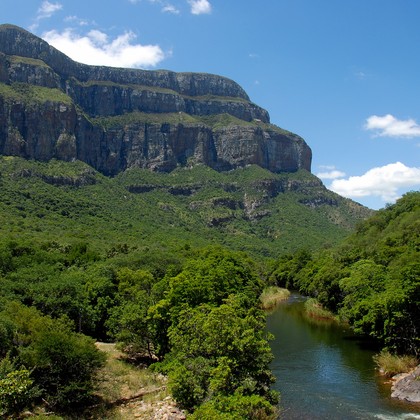
Where the bird is most at home, classified by the vegetation units of southern Africa.
Range and movements
Within the region only in northern Angola: Cabinda and the forests of Uíge, Cuanza Norte and Bengo, south to the escarpment forests of Cuanza Sul. Beyond the region from Guinea and Sierra Leone through West and Central Africa to Uganda and western Kenya.
- Resident
- dark = core range, pale = thinly spread
How and when to look
At forest edges in Uíge and Cuanza Norte check flowering and fruiting trees and oil palms; the white underparts stand out well against the dark foliage. Because it feeds high in the canopy it is often first taken for a tit or a warbler.
Conservation status
Not threatened. Fairly common across its large West and Central African range; in Angola restricted to the northern forest zone, where forest loss is the main threat.
Scientific name
Nigrita fusconotus | Fraser, 1843
Fraser described the species in 1843 and placed it straight away in the genus where it still stands. The genus Nigrita was introduced in 1843 by Strickland. Nigrita comes from the Modern Latin nigritus, 'black' (related to niger) — for the largely dark plumage of these nigritas. fusconotus comes from the Latin fuscus, 'dusky brown', and the Greek nōtos, 'back' — for the brown back. The specimen the first description was based on came from Malabo (formerly Clarence), Bioko, Equatorial Guinea.