All species › Passerines › Waxbills › Green Twinspot
Green Twinspot | Mandingoa nitidula
Groene druppelastrild | Estrilda Verde
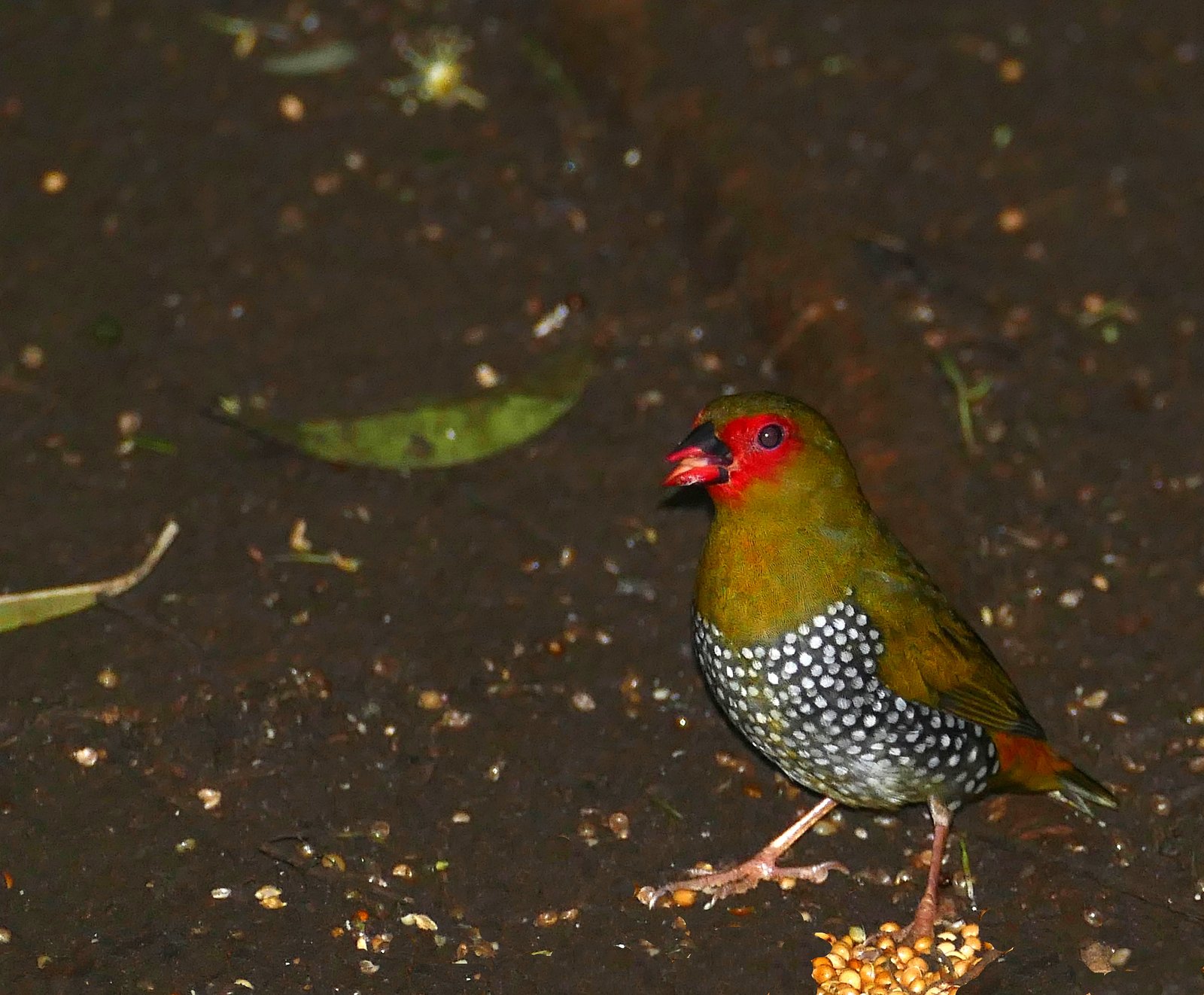
The Green Twinspot is a small, secretive waxbill of the forest floor, green above and black with white spots below. It feeds on paths and in clearings inside forest and vanishes silently into the undergrowth at the slightest disturbance.
Voice
Usually silent. The contact call is a soft, insect-like tseet or tzip, often the first sign of its presence. The song is a quiet, buzzy and creaky twittering with a few high whistled notes.
Recording: Josh Engel — CC BY-NC-SA 3.0 · converted to mono · xeno-canto
Identification
About 10 cm, compact with a short tail. Male: crown, back and wings bright olive-green, face and throat scarlet to orange-red, the breast green with a golden wash. Belly and flanks are black with round white spots. The rump is orange-red. The bill is black with a red tip. Female: face and throat paler, ochre to orange-buff instead of red, the spots slightly less contrasting. Juveniles are plain olive-green with grey, unspotted underparts, recognised by shape and the orange rump.
Confusion species
The Red-Throated Twinspot (Hypargos niveoguttatus) and the Pink-Throated Twinspot (Hypargos margaritatus) also have spotted black underparts, but a brown back and a pink to red throat and breast, and they live in lowland and coastal thicket rather than on the forest floor. The Swee Waxbill (Coccopygia melanotis) and the Yellow-Bellied Waxbill (Coccopygia quartinia) have a green back and a red rump, but a grey head and a plain yellowish belly without spots. The Red-Faced Crimsonwing (Cryptospiza reichenovii) has a red face, but a dark red back and plain olive underparts.
Habitat
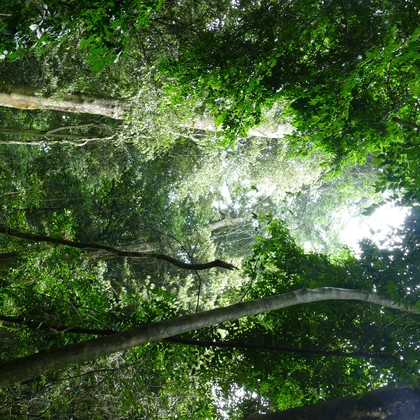
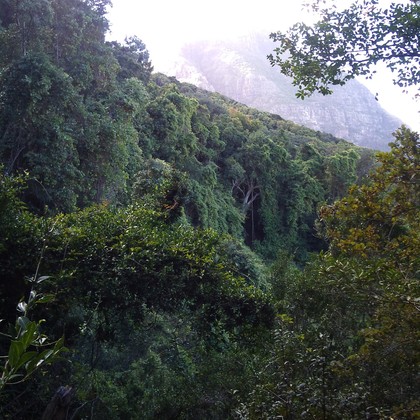
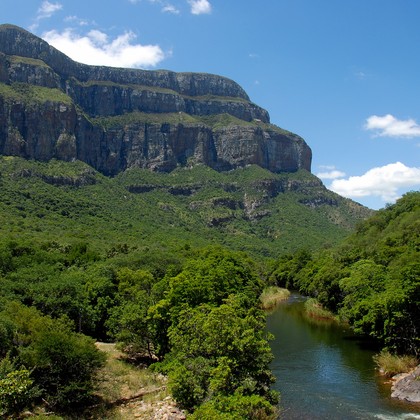
Evergreen lowland, coastal, riverine and mid-altitude forest, especially where the undergrowth is open with paths, sunny patches or grassy edges; also in dense gardens and plantations bordering forest. It takes grass and herb seeds on the ground, in pairs or small groups, sometimes with other waxbills.
Where the bird is most at home, classified by the vegetation units of southern Africa.
Range and movements
Within the region from the eastern Eastern Cape north through KwaZulu-Natal, Eswatini and the eastern escarpment forests of Mpumalanga and Limpopo; further in eastern Zimbabwe (Eastern Highlands), central and southern Mozambique, Malawi and northern and north-eastern Zambia, and in north-western Angola. Beyond the region it is patchily distributed across West, Central and East Africa, from Sierra Leone to Ethiopia and Tanzania, and on Bioko.
- Resident
- Summer visitor (c. Oct–Mar)
- Winter visitor (c. Apr–Sep)
- Passage (Mar–Apr, Oct–Nov)
- dark = core range, pale = thinly spread
How and when to look
Best early in the morning along quiet forest paths, where the birds pick up seeds on the ground; stand still and wait, as they often return quickly after being flushed. Listen for the high tseet from the undergrowth. In KwaZulu-Natal and the Eastern Highlands of Zimbabwe they sometimes visit seed feeders in forest gardens.
Conservation status
Not threatened. Fairly common, but probably under-recorded because of its hidden habits. Vulnerable to the loss of indigenous forest, especially in the coastal belt of KwaZulu-Natal and Mozambique.
Scientific name
Mandingoa nitidula | (Hartlaub, 1865)
Hartlaub described the species in 1865 as Estrelda nitidula; because it was later moved to another genus, the author and year stand in brackets. The genus Mandingoa was introduced in 1919 by Hartert. Mandingoa refers to the Mandingo or Mandinka, a people and former kingdom of the Niger and upper Senegal valleys; the bird was formerly known as the Green Mandingo or Mandingo Twinspot. nitidula is a Latin diminutive of nitidus, 'shining, neat' — for the bright green plumage with white spots. The specimen the first description was based on came from KwaZulu-Natal, South Africa.