All species › Passerines › Sunbirds › White-Bellied Sunbird
White-Bellied Sunbird | Cinnyris talatala
Witbuikhoningzuiger | Suimanga Pechiblanco
The White-Bellied Sunbird is the common small sunbird of the bushveld, the male showing a metallic green head and throat, a narrow purple breast band and a bright white belly. Across much of the region it is a regular garden visitor.

Click a thumbnail to switch the photo above.
Voice
A sharp tchik and a nasal tcheep. The song is loud and varied: a series of repeated disyllabic notes, tchiwi-tchiwi-tchiwi, followed by a rapid twittering trill; often from a high lookout.
Recording: African Bioacoustics Community — CC BY-NC-SA 4.0 · converted to mono · xeno-canto
Identification
11 to 12 cm, with a short, decurved bill. The male has a metallic green head, back and throat, a narrow, glossy blue-purple breast band and a pure white belly; yellow pectoral tufts show in display. The tail is dark blue-black. The female is plain grey-brown above and dirty white below, unstreaked, sometimes with a faint yellow wash. Young males are blotched green on the throat.
Confusion species
Oustalet's Sunbird (Cinnyris oustaleti) is smaller and has orange as well as yellow pectoral tufts; it occurs only in Angola and north-eastern Zambia and Malawi. Dusky Sunbird (Cinnyris fuscus) of the arid west has a black head and breast with a white belly. Variable Sunbird (Cinnyris venustus) usually has a yellow belly. The unstreaked dirty-white female stands out among the streaked females of Marico and Purple-Banded Sunbirds.
Habitat
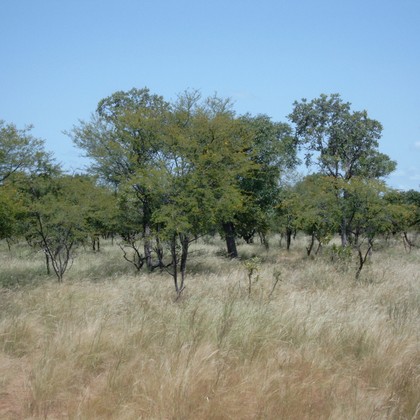
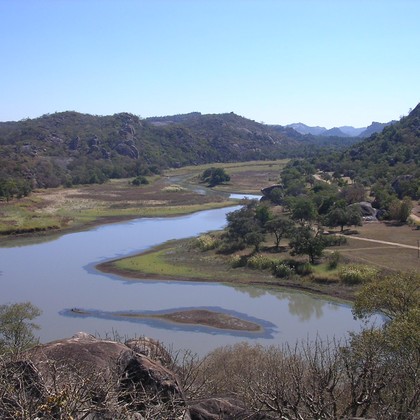
Acacia savanna, mixed and dry woodland, thornveld, riverine woodland, also parks, gardens and farmyards. It feeds at aloes, Erythrina, Schotia and mistletoe, and hawks insects.
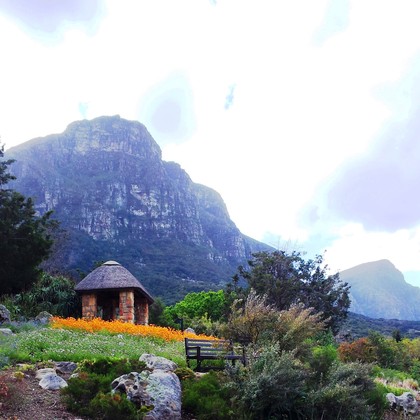
Where the bird is most at home, classified by the vegetation units of southern Africa.
Range and movements
Southern Angola, northern and north-eastern Namibia (including the Zambezi Region), northern and eastern Botswana, Zambia, southern and central Malawi, Mozambique, Zimbabwe, Eswatini and in South Africa Limpopo, Mpumalanga, Gauteng, North West and KwaZulu-Natal, with outliers towards the Eastern Cape. Beyond the region in south-eastern DR Congo and southern Tanzania.
- Resident
- Summer visitor (c. Oct–Mar)
- Winter visitor (c. Apr–Sep)
- Passage (Mar–Apr, Oct–Nov)
- dark = core range, pale = thinly spread
How and when to look
Seen everywhere in Gauteng, Kruger and Lowveld gardens, especially at flowering aloes in winter. The loud, repeated tchiwi-tchiwi often gives the male away before its plumage does. In north-eastern Zambia and Malawi check every white-bellied male for the orange pectoral tufts of Oustalet's Sunbird.
Conservation status
Not threatened. Common and increasing in parts of the region, helped by gardens and planted nectar sources; the species is spreading southwards.
Scientific name
Cinnyris talatala | Smith, 1836
Smith described the species in 1836 and placed it straight away in the genus where it still stands. The genus Cinnyris was introduced in 1816 by Cuvier, GLCFD. Cinnyris derives from the Greek kinnuris, the name of a small bird mentioned by the lexicographer Hesychius that cannot be identified further. talatala comes from the Tswana name tàlátàlá, 'very green (bird)' (from tàlá, 'green'), used for various sunbirds. Andrew Smith (1836) deliberately adopted native names as specific names. The specimen the first description was based on came from between the Orange River and Kurrichaine, South Africa.