All species › Passerines › Sunbirds › Variable Sunbird
Variable Sunbird | Cinnyris venustus
Ornaathoningzuiger | Suimanga Variable
The Variable Sunbird is a small, short-billed sunbird of forest edges, rank growth and gardens on the uplands of the north and east of the region. The male combines metallic green upperparts with a purple-blue breast and a bright yellow belly, a pattern shared by no other sunbird in the region.

Click a thumbnail to switch the photo above.
Voice
The call is a sharp tsip or a dry tcherr. The song is a fast, high, somewhat scratchy series, opening with repeated notes, tsiu-tsiu-tsiu, and running into a twittering trill, often delivered from the top of a bush.
Recording: Kileo Jumah — CC0 · converted to mono · xeno-canto
Identification
Small, 10 to 11 cm, with a short, slightly decurved bill and a fairly short tail. The male has head, throat and upperparts metallic green with a blue sheen, a purple-blue breast band merging into the throat, and a yellow to orange-yellow belly; the pectoral tufts are orange-yellow and mostly visible in display. Wings and tail are blackish, the tail glossed blue. The female is grey-olive above with a faint pale supercilium and pale yellow below, yellowest on the belly. Young males first acquire patchy green on throat and back. An eclipse plumage is virtually lacking.
Confusion species
White-Bellied Sunbird (Cinnyris talatala) and Oustalet's Sunbird (Cinnyris oustaleti) have similar green upperparts and a purple breast band, but a white belly. Purple-Banded Sunbird (Cinnyris bifasciatus) has a dark, blackish belly and a longer, more strongly curved bill. Females are more alike: the female White-bellied is dirty white below with no yellow tone, whereas the female Variable is clearly yellowish with a pale supercilium. Habitat helps too: Variable Sunbird favours moist rank growth and forest edge at altitude, White-bellied the drier savanna woodland.
Habitat
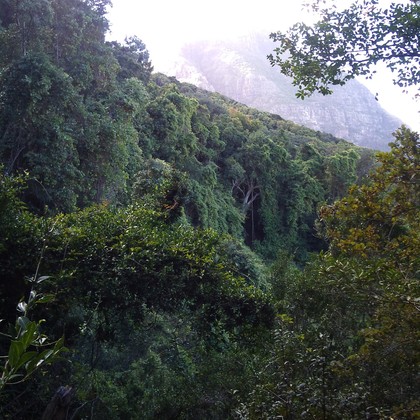
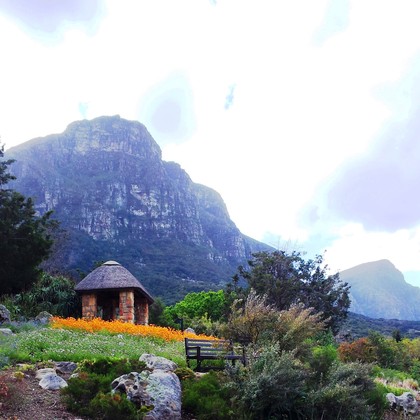
Forest edges, clearings in Afromontane forest, bracken and scrub on mountain slopes, moist miombo, riverine growth and gardens. Mostly between 500 and 2500 m. It feeds at flowering shrubs, Leonotis, aloes and mistletoe, and takes many small insects and spiders among the foliage.
Where the bird is most at home, classified by the vegetation units of southern Africa.

Range and movements
Within the region in the north and east: almost all of Malawi, the north, east and centre of Zambia, the Angolan highlands, central and western Mozambique (including Gorongosa and the border mountains) and the Eastern Highlands of Zimbabwe. Absent from Botswana, Namibia and South Africa. Beyond the region it spans a broad belt from West Africa to Ethiopia and south through East Africa.
- Resident
- Summer visitor (c. Oct–Mar)
- Winter visitor (c. Apr–Sep)
- Passage (Mar–Apr, Oct–Nov)
- dark = core range, pale = thinly spread
How and when to look
Search the Nyanga and Chimanimani highlands and the Zomba and Nyika plateaux along forest edges with flowering shrubs, especially early in the morning when the males sing. A male with a yellow belly and a purple breast is unmistakable in the region; with a white-bellied bird always consider White-bellied or Oustalet's Sunbird.
Conservation status
Not threatened. The species is locally common and benefits from rank growth, gardens and forest edges created by human use. There is no evidence of decline in the region.
Scientific name
Cinnyris venustus | (Shaw, 1799)
Shaw described the species in 1799 as Certhia venusta; because it was later moved to another genus, the author and year stand in brackets. The genus Cinnyris was introduced in 1816 by Cuvier, GLCFD. Cinnyris derives from the Greek kinnuris, the name of a small bird mentioned by the lexicographer Hesychius that cannot be identified further. venustus is Latin for 'charming, lovely', for the attractively coloured male. The specimen the first description was based on came from Sierra Leone.