All species › Mousebirds › Mousebirds › White-Backed Mousebird
White-Backed Mousebird | Colius colius
Witrugmuisvogel | Pájaro Ratón Dorsiblanco
The White-Backed Mousebird is the mousebird of the dry west: a pale grey, crested bird of the Karoo, the fynbos and the Namibian interior. Perched it looks plain grey, but as soon as it takes off a white stripe appears down the back, with a maroon rump below it.

Voice
A whistled, slightly husky zwee-wee or wee-eeh, and a dry, fast chirping chuk-chuk as a contact call in flight. Less clear than Red-Faced Mousebird, less rasping than Speckled Mousebird.
Recording: Walter Wallner — CC BY-NC-SA 4.0 · shortened to the first 60 s, mono · xeno-canto
Identification
30–34 cm, of which the graduated tail is well over half. Upperparts, head and crest are soft pale grey, the underparts buffish, slightly warmer on the breast. A white stripe, edged black on each side, runs down the middle of the back and passes into a deep maroon rump patch; both are often hidden by the wings when perched. The bill is bluish white with a black tip, the legs coral red. The sexes are alike; juveniles are duller, with a shorter tail and a greenish bill. The flight is a series of rapid beats alternating with glides, low from bush to bush.
Confusion species
Speckled Mousebird Colius striatus is darker brownish grey, finely barred, with a dark mask, a black-and-white bill and dark legs, and lacks the white back stripe. Red-Faced Mousebird Urocolius indicus has a bare red face, a red bill, a blue-grey rump and a clear whistled call, and flies faster and higher. The combination of pale grey plumage, bluish-white bill and red legs marks the White-Backed Mousebird.
Habitat
Dry scrub in the Karoo, fynbos and renosterveld, dry watercourses with trees, thornveld on the western edge of the Kalahari, and increasingly gardens, orchards and vineyards in towns and suburbs. It eats fruit, leaves, buds and flowers, including those of succulents, and is almost independent of drinking water. Groups of three to ten roost in tight clusters and sun themselves in the morning.
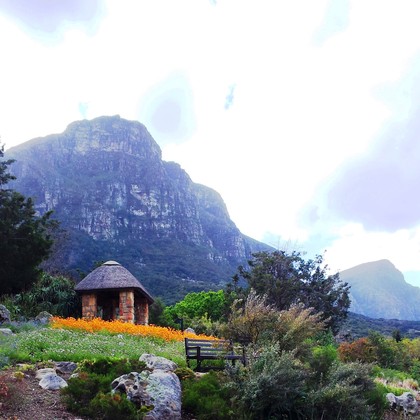
Where the bird is most at home, classified by the vegetation units of southern Africa.


Range and movements
Endemic to southern Africa: from the Cape Peninsula and the Western Cape through the whole Karoo and the western Free State to the Northern Cape, south-western Botswana and Namibia, north to southern Angola (Namibe). Absent from the moist east and north-east of the region; reaches western Lesotho and North West locally.
- Resident
- Summer visitor (c. Oct–Mar)
- Winter visitor (c. Apr–Sep)
- Passage (Mar–Apr, Oct–Nov)
- dark = core range, pale = thinly spread
How and when to look
In Karoo scrub and in gardens in Cape Town or Karoo towns, early in the morning when the group sits sunning on a bush top. Wait for the birds to fly to see the white back and maroon rump. A fruiting shrub or an apple orchard attracts them.
Conservation status
Not threatened and common within its range. It has benefited from gardens, orchards and planted fruit trees in the dry west, where it is locally regarded as a fruit pest. There is no evidence of declines.
Scientific name
Colius colius | (Linnaeus, 1766)
Linnaeus described the species in 1766 as Loxia Colius; because it was later moved to another genus, the author and year stand in brackets. The genus Colius was introduced in 1760 by Brisson. The origin of Colius is uncertain; it may go back to the Greek koloios, a name for a jackdaw-like bird, here applied to the quite different mousebirds. colius goes back to the Greek kolios, a bird mentioned by Aristotle that cannot be identified with certainty. The specimen the first description was based on came from Cape of Good Hope.