All species › Mousebirds › Mousebirds › Red-Backed Mousebird
Red-Backed Mousebird | Colius castanotus
Roodrugmuisvogel | Pájaro Ratón Dorsirrojo
The Red-Backed Mousebird is an Angolan endemic and the western counterpart of the White-Backed Mousebird: a grey-brown mousebird with a striking chestnut-red rump. Within the region it occurs only in western Angola, where small groups move through dry scrub and gardens.

Voice
A harsh, repeated chee-chee-chee as a contact call, especially in flight, and a high, continuous twittering while foraging.
Recording: Ken Behrens — CC BY-NC-SA 4.0 · converted to mono · xeno-canto
Identification
30–35 cm, of which the tail is well over half. The plumage is warmer grey-brown than in White-Backed Mousebird, with a short crest and buff-brown underparts. The best feature is a large chestnut-red to dark red patch on the lower back and rump, with no white back stripe above it; when perched it is often partly hidden by the wings. The bill is pale blue-grey with a dark tip, the legs reddish. The sexes are alike; juveniles are duller with a smaller, browner rump patch. The flight is fast fluttering alternating with glides, low between bushes.
Confusion species
Speckled Mousebird Colius striatus, which occurs in Angola in moister scrub and forest edges, is finely barred, with a dark mask, a black-and-white bill and dark legs, and no red rump. Red-Faced Mousebird Urocolius indicus in southern Angola has a bare red face and a blue-grey rump. White-Backed Mousebird Colius colius is paler grey and has a white, black-edged back stripe above the maroon rump; the two species replace each other geographically.
Habitat
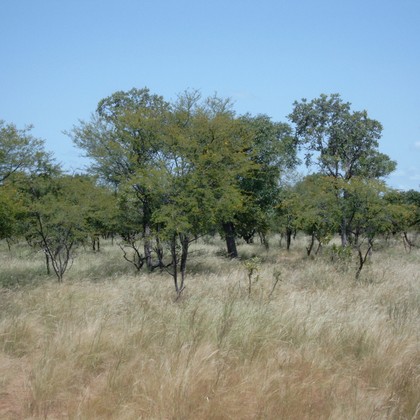
Dry savanna, scrub and thorn thicket in the coastal lowlands and at the foot of the escarpment, forest edges, abandoned plantations, orchards and gardens, including in and around towns. It avoids closed forest. It eats fruit, leaves and flowers, and lives in small groups that roost and sun together.
Where the bird is most at home, classified by the vegetation units of southern Africa.

Range and movements
Endemic to western Angola: the coastal lowlands and western escarpment from about Cabinda and Zaire south through Luanda, Cuanza Norte and Cuanza Sul to Benguela and western Huíla. Outside Angola only a few reports from the far west of DR Congo. It is absent from the rest of the region.
- Resident
- Summer visitor (c. Oct–Mar)
- Winter visitor (c. Apr–Sep)
- dark = core range, pale = thinly spread
How and when to look
Most often recorded around Luanda and along the road to the escarpment near Kumbira and Gabela, where it is often seen in gardens and scrub. A first sighting is most convincing as the bird takes off and the red rump shows.
Conservation status
Not threatened; although the range is small, the species is locally common and adapts well to farmland and gardens. There is no evidence of decline.
Scientific name
Colius castanotus | Verreaux & Verreaux, 1855
Verreaux & Verreaux described the species in 1855 and placed it straight away in the genus where it still stands. The genus Colius was introduced in 1760 by Brisson. The origin of Colius is uncertain; it may go back to the Greek koloios, a name for a jackdaw-like bird, here applied to the quite different mousebirds. castanotus comes from the Greek kastanon, 'chestnut', and nōton, 'back' — for the chestnut lower back. The specimen the first description was based on came from no locality stated; according to Sharpe (1892) Gabon.