All species › Passerines › Swallows and martins › Western House Martin
Western House Martin | Delichon urbicum
Huiszwaluw | Avión Común
The Western House Martin is a compact black-and-white Palearctic migrant with a striking white rump. In southern Africa it is seen from October to April mainly as flocks hunting high in the sky, often with swifts, and far less around buildings than in its European breeding range.

Voice
The call is a dry, short prrrt or trrit, often heard from a high-flying flock and a good aid to picking out the species among swifts. The song, a soft twittering chatter, is seldom heard in Africa.
Recording: Beatrix Saadi-Varchmin — CC BY-NC-SA 4.0 · converted to mono · xeno-canto
Identification
13–14 cm, compact, with a short, shallowly forked tail without streamers and fairly broad, triangular wings. The upperparts are glossy blue-black, the rump and uppertail coverts bright white and sharply demarcated. The underparts are pure white, washed grey-brown on the breast and flanks in young birds and fresh plumage. The underwing is greyish. The legs and toes are covered in white feathers. Juveniles are duller and browner above, with a less clean rump and pale fringes to the tertials. It flies with alternating fluttering beats and short glides, often high and in circles.
Confusion species
The Grey-Rumped Swallow Pseudhirundo griseopyga is slimmer, with a grey-brown crown, a grey rather than white rump and a more deeply forked tail. The Little Swift Apus affinis also has a white rump, but is otherwise wholly blackish-brown with a white throat, a square-cut tail and sickle-shaped wings. The White-Rumped Swift Apus caffer and the Horus Swift Apus horus are dark below. The Sand Martin Riparia riparia is brown above with a breast band and no white rump. Short-tailed young Barn Swallows Hirundo rustica have a dark rump.
Habitat
Over almost any landscape, from grassland and mountain ranges to woodland and coast; often high above montane grassland, escarpments and storm fronts. It feeds on small flying insects, sometimes hundreds of metres up, and comes low in bad weather. It sometimes rests on cliffs or in trees. The rare breeding records in the region involve closed mud nests under eaves or rock overhangs.
Where the bird is most at home, classified by the vegetation units of southern Africa.
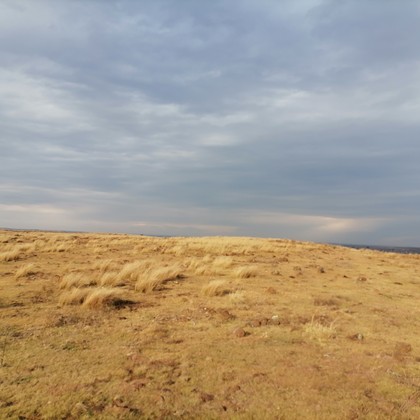

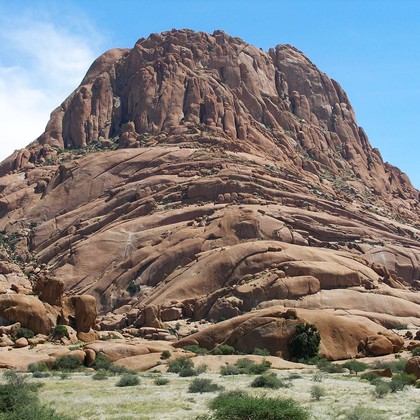
Range and movements
Distributed across the whole region, but patchily and often wandering; most numerous in the east, from Zimbabwe and Mozambique through Eswatini and KwaZulu-Natal to the Eastern Cape, and in Zambia and Malawi; scarcer in the arid west and in Namibia. A few breeding records are known from South Africa. It breeds in Europe, North Africa and western and central Asia and winters in Africa south of the Sahara.
- Resident
- Summer visitor (c. Oct–Mar)
- Passage (Mar–Apr, Oct–Nov)
- dark = core range, pale = thinly spread
How and when to look
Between October and April; look up when a thunderstorm approaches or in the late afternoon over mountains such as the Drakensberg, the Mpumalanga escarpment or the Eastern Highlands of Zimbabwe, where flocks of house martins hunt with swifts. Look for the short forked tail, the white rump and the wholly white underparts: a black-and-white bird with a white rump and a white belly is a house martin, not a swift.
Conservation status
Not threatened, but numbers have fallen over large parts of Europe through reduced availability of insects and mud and the removal of nests. In the African wintering range numbers are poorly known because the species feeds high and wanders widely.
Scientific name
Delichon urbicum | (Linnaeus, 1758)
Linnaeus described the species in 1758 as Hirundo urbica; because it was later moved to another genus, the author and year stand in brackets. The genus Delichon was introduced in 1854 by Moore. Delichon is an anagram of Greek chelidon 'swallow'. urbicum is Latin for 'of the town', for the habit of nesting against buildings. The specimen the first description was based on came from Sweden.