All species › Passerines › Swallows and martins › Blue Swallow
Blue Swallow | Hirundo atrocaerulea
Blauwe zwaluw | Golondrina Azul
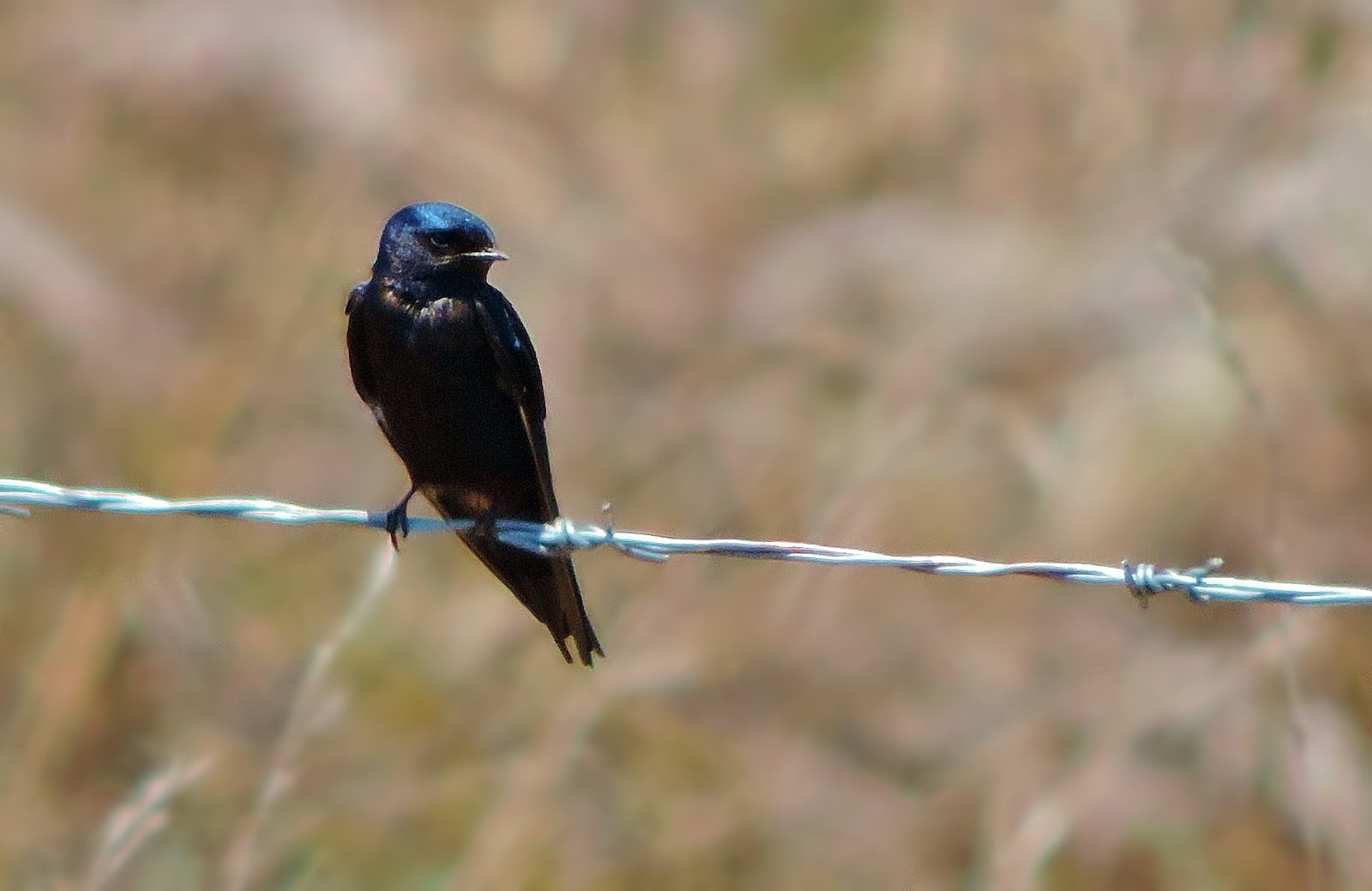
The Blue Swallow is an all-dark steel-blue swallow with very long, thin outer tail feathers, and one of the most threatened birds in the region. It breeds in summer in pristine, misty montane grassland and migrates in winter to the Lake Victoria basin.
Voice
A soft, high chip or tswit, and in flight or at the nest a soft, fine twitter; quieter than most other swallows.
Recording: Derek Solomon — CC BY-NC-SA 4.0 · converted to mono · xeno-canto
Identification
18–25 cm including the tail streamers, the male having the longest. The whole plumage is deep glossy steel- to ultramarine-blue, looking black in poor light; a few white feathers are sometimes visible on the flanks or rump. The tail is deeply forked, with very long, thin outer feathers in the male; in the female these are clearly shorter. There are no white spots in the tail. Juveniles are duller, brownish black and short-tailed. The flight is light and often low over the grass, with easy, supple beats.
Confusion species
Black Saw-Wing Psalidoprocne pristoptera is dull black without blue gloss, lacks long streamers and flies more slowly and flutteringly, often along forest edges. Barn Swallow Hirundo rustica has white or buff underparts, a rufous throat and white tail spots. African Black Swift Apus barbatus and other swifts have sickle-shaped wings, a short tail and a much faster flight. Juvenile Blue Swallows can resemble a saw-wing; note the grassland habitat and the accompanying adults.
Habitat
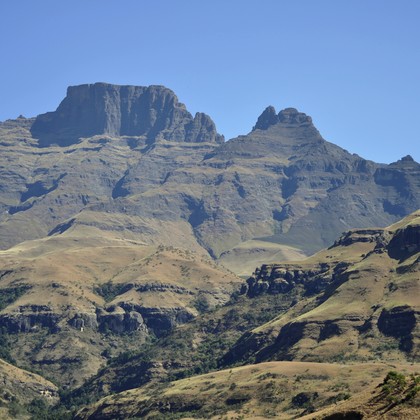
Pristine, moist, diverse montane grassland above about 1,200 m, often on misty slopes with vleis and forest edges. It nests underground, in sinkholes, old aardvark burrows and eroded holes in grassland, where it builds a mud nest cup against the wall. It hunts low over the grass for small insects. It avoids afforested land and heavily grazed grassland.
Where the bird is most at home, classified by the vegetation units of southern Africa.
Range and movements
Breeds patchily in the eastern mountains: in South Africa at a few sites in Mpumalanga and KwaZulu-Natal, and further in Eswatini, the Eastern Highlands of Zimbabwe (including Nyanga), adjacent Mozambique, the Nyika Plateau in Malawi and Zambia and elsewhere in north-eastern Zambia; beyond the region in the Southern Highlands of Tanzania and south-eastern DR Congo. It winters around Lake Victoria in Uganda, western Kenya and north-western Tanzania.
- Resident
- Summer visitor (c. Oct–Mar)
- Passage (Mar–Apr, Oct–Nov)
- dark = core range, pale = thinly spread
How and when to look
From October to March; the Nyika Plateau in Malawi and the Blue Swallow Natural Heritage Site near Kaapsehoop in Mpumalanga are the best-known sites. Visit breeding sites only with a guide and keep away from nest holes; the birds are most often seen in the morning, hunting low over the grass.
Conservation status
Endangered (EN) according to the IUCN; in South Africa its regional status is Critically Endangered, with only a few dozen pairs left. The world population is estimated at about 2,000 mature birds. Threats are afforestation with exotic trees, agriculture, overgrazing, mining, invasive trees and the loss of grassland in the wintering range.
Scientific name
Hirundo atrocaerulea | Sundevall, 1850
Sundevall described the species in 1850 and placed it straight away in the genus where it still stands. The genus Hirundo was introduced in 1758 by Linnaeus. Hirundo is the ordinary Latin word for 'swallow'. atrocaerulea comes from the Latin ater, 'black', and caeruleus, 'blue' — for the dark, steel-blue glossed plumage. The specimen the first description was based on came from Umvoti, KwaZulu-Natal, South Africa.