All species › Waders, gulls and terns › Stone-curlews › Water Thick-Knee
Water Thick-Knee | Burhinus vermiculatus
Watergriel | Alcaraván Acuático
The Water Thick-Knee is a grey-brown thick-knee of river and lake shores, hidden by day in the shade of bankside bushes and active at night. Its wistful, dying fall of whistles is a familiar night sound along the Zambezi, the Okavango and the rivers of the Kruger.

Voice
A melancholy, descending series of whistles, ti-ti-ti-tee-tee-teeu-teeu-teeuw, slower and sadder than in Spotted Thick-Knee, mainly in the evening and at night, often alternating between the birds of a pair. When alarmed a sharp kiew.
Recording: Bernard BOUSQUET — CC BY-NC-SA 4.0 · converted to mono · xeno-canto
Identification
38–41 cm. The upperparts are grey-brown, finely streaked and vermiculated dark, not spotted. The closed wing shows a broad grey wing panel with a narrow white bar and a black edge above it. The yellow eye has a pale supercilium. The thick bill is black with a greenish-yellow base; the legs are long and greenish-grey to dull yellow. In flight the black primaries show white patches. The sexes are alike.
Confusion species
Spotted Thick-Knee Burhinus capensis is clearly spotted above, lacks the grey wing panel with white bar, has bright yellow legs and a yellow bill base, and lives in dry, open country. Where both species meet, for example at waterholes, the wing pattern settles it.
Habitat
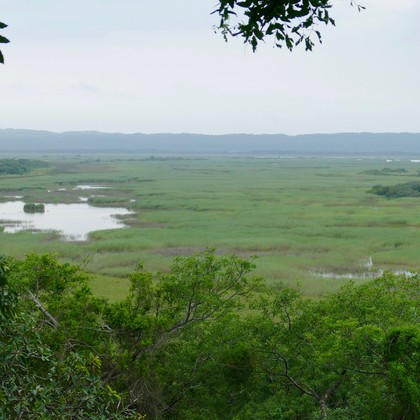
Shores of rivers, lakes, dams and lagoons, with sandbanks, bare mud and bankside bushes in which the bird rests by day; also estuaries, mangrove edges and river sandbars, often alongside crocodiles. It feeds at night on insects, crustaceans, molluscs and small frogs. The nest is a scrape in sand or gravel close to water, sometimes beside a crocodile nest.
Where the bird is most at home, classified by the vegetation units of southern Africa.

Range and movements
In the east and north of the region along the large rivers and lakes: South Africa (mainly KwaZulu-Natal, Mpumalanga, Limpopo and the Eastern Cape, locally west along the Orange), Eswatini, Mozambique, Zimbabwe, Botswana (Okavango and Chobe), north-eastern Namibia (Caprivi and Kunene), Zambia, Malawi and Angola. Absent from the arid west and the Lesotho highlands. Beyond the region eastern Africa north to Ethiopia and Somalia, and west to Gabon and Liberia.
- Resident
- Summer visitor (c. Oct–Mar)
- Winter visitor (c. Apr–Sep)
- Passage (Mar–Apr, Oct–Nov)
- dark = core range, pale = thinly spread
How and when to look
Boat or walk along a riverbank in the early morning in the Okavango, at Kasane or in the Kruger National Park and scan the shade beneath bankside bushes; the bird often stands still among stones or on a sandbar. After sunset its call carries far over the water.
Conservation status
Not threatened and widespread throughout its range. Locally affected by disturbance of riverbanks, recreation and fluctuating water levels below dams, which can flood nests on sandbanks.
Scientific name
Burhinus vermiculatus | (Cabanis, 1868)
Cabanis described the species in 1868 as Oedicnemus vermiculatus; because it was later moved to another genus, the author and year stand in brackets. The genus Burhinus was introduced in 1811 by Illiger. Burhinus is Greek, from bous 'ox' and rhis 'nose', after the heavy, broad base of the bill. vermiculatus is Latin for 'vermiculated' — for the fine, wavy markings on the feathers. The specimen the first description was based on came from Lake Jipe near Taita, Kenya.