All species › Passerines › Cisticolas › Wailing Cisticola
Wailing Cisticola | Cisticola lais
Jammergraszanger | Cistícola Plañidero
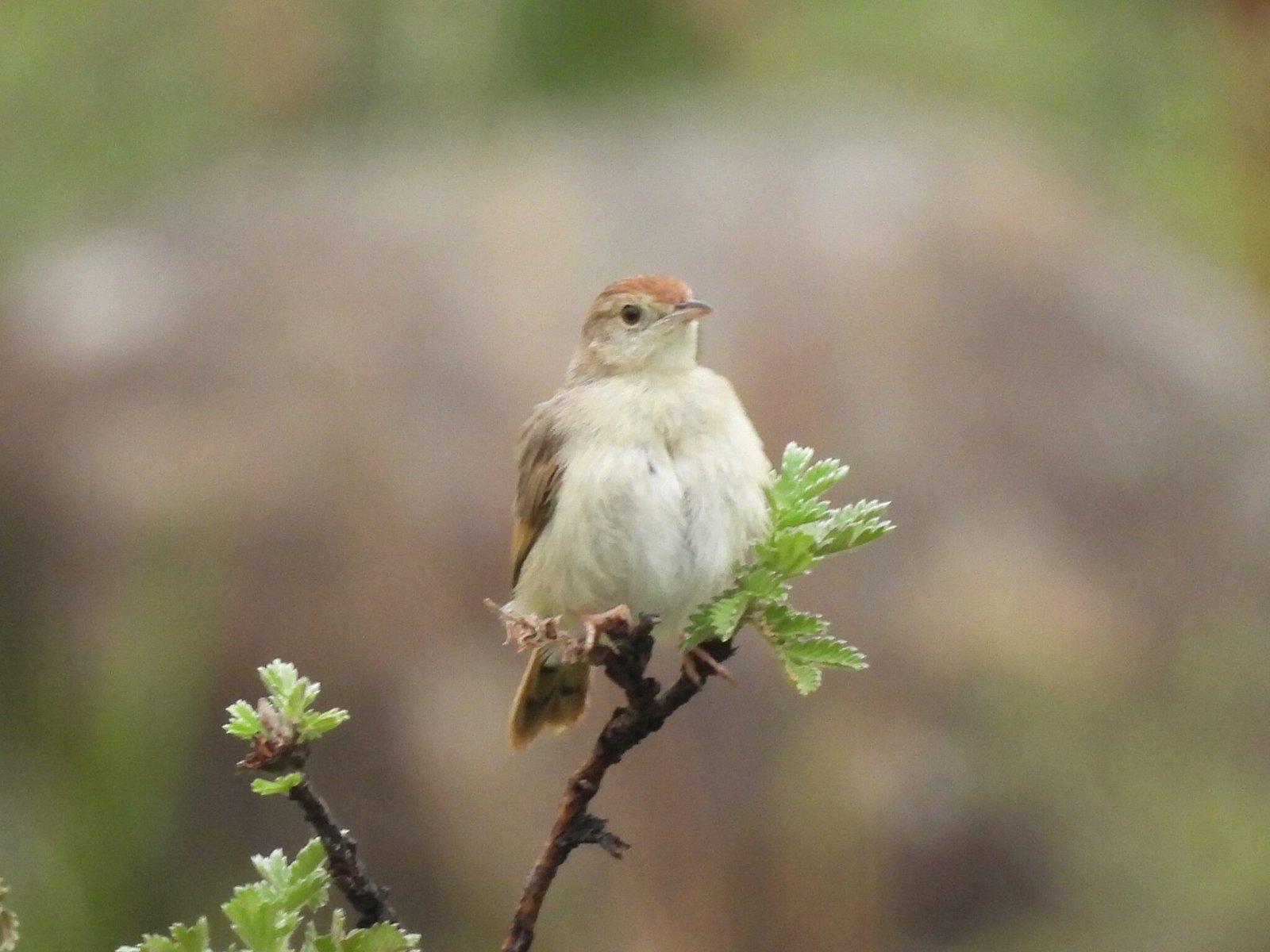
The Wailing Cisticola is a fairly large, heavily streaked cisticola of grassy, rocky hillsides in the east of the region. It owes its name to the plaintive, drawn-out whistle that it repeats over and over and that most quickly betrays the species in the field.
Voice
The best-known call is a plaintive, drawn-out, descending wheeeeuu, repeated from a rock or grass stem. The song alternates quick high notes and trills, tee-tee-tee-trrrrrr, often in short song flight or from a lookout. The alarm is a sharp tsweet and a scolding rattle.
Recording: Murray Christian — CC BY-NC-SA 4.0 · converted to mono · xeno-canto
Identification
13–16 cm, the male clearly larger than the female. The crown is rufous with fine dark streaks, the nape rufous-tinged. The back is pale buff with broad black streaks, and the flight feathers are edged bright rufous-brown. The face is pale brown with a faint pale supercilium. The underparts are pale buff, warmer on the breast and flanks. The tail is fairly long, brown with a black band before the pale tip. In the dry winter the plumage is somewhat duller and more heavily streaked and the tail slightly longer than in summer. Juveniles are yellower below.
Confusion species
Rock-Loving Cisticola Cisticola aberrans also lives among rocks on grassy slopes, but has a plain, unstreaked brown back and a long, often cocked tail, and gives a mewing call. Grey-Backed Cisticola Cisticola subruficapilla in the west is smaller, greyer on the back and greyish white below; the two meet in the Eastern Cape. Levaillant's Cisticola Cisticola tinniens has a blacker back, bright rufous wings and tail and lives in wet vleis, not on dry slopes. Croaking Cisticola Cisticola natalensis is larger and heavier, with a stout bill, a less contrasting back and a croaking song. Rattling Cisticola Cisticola chiniana lives in bushveld and rattles. On the Nyika, Churring Cisticola Cisticola njombe replaces it at higher altitude. The plaintive call and the habitat on rocky grassland slopes are the best features.
Habitat
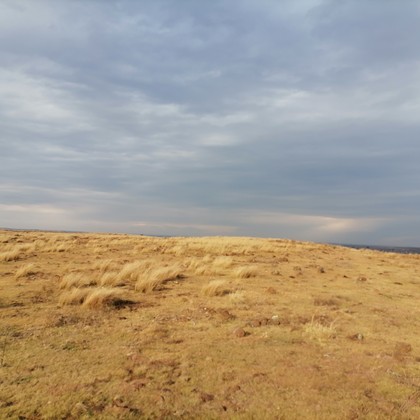
Grassy slopes of hills and mountains with boulders, scattered shrubs and bracken, upland grassland along forest edges and rocky gorge rims. In the south it ranges fairly low, further north mainly in the highlands. It forages low in the grass and among rocks, usually in pairs or family groups.
Where the bird is most at home, classified by the vegetation units of southern Africa.


Range and movements
Within the region in eastern South Africa: the interior of the Eastern Cape, the hills and Drakensberg of KwaZulu-Natal, Lesotho, the eastern Free State, Mpumalanga and the mountains of Limpopo and Gauteng; further in the highlands of Eswatini, the Eastern Highlands and highveld of Zimbabwe, the adjacent highlands of Mozambique, the highlands of Malawi and eastern Zambia, and the central highlands of Angola. Beyond the region in southern Tanzania.
- Resident
- Summer visitor (c. Oct–Mar)
- Winter visitor (c. Apr–Sep)
- Passage (Mar–Apr, Oct–Nov)
- dark = core range, pale = thinly spread
How and when to look
Present all year; most vocal in summer. Good sites are the lower Sani Pass, Golden Gate Highlands NP, Wakkerstroom and Verloren Vallei, and in Zimbabwe the Nyanga mountains. Walk along a grassy, rocky slope and listen for the plaintive call; the bird usually perches on a boulder or tall grass stem, where the streaked back and rufous cap show well.
Conservation status
Not threatened. Common in suitable montane grassland. Locally it suffers from afforestation with exotic trees, from over-frequent burning and from heavy grazing.
Scientific name
Cisticola lais | (Hartlaub & Finsch, 1870)
Hartlaub & Finsch described the species in 1870 as Drymoica lais; because it was later moved to another genus, the author and year stand in brackets. The genus Cisticola was introduced in 1829 by Kaup. Cisticola combines the Ancient Greek kisthos 'rock-rose' with the Latin colere 'to dwell'. lais is Modern Latin for 'warbler', from Greek names for small birds: elaios, a small bird of olive groves (perhaps a tit or warbler), and elea or elaia, identified in Aristotle as a reed warbler. The specimen the first description was based on came from Natal (KwaZulu-Natal), South Africa.