All species › Passerines › Cisticolas › Churring Cisticola
Churring Cisticola | Cisticola njombe
Snorgraszanger | Cistícola de Njombé
The Churring Cisticola is a small, streaked cisticola of high-altitude grassland in southern Tanzania and on the Nyika Plateau. Within the region it occurs only on the Nyika, on the border of Malawi and Zambia. It was originally described as a subspecies of Rock-Loving Cisticola and in the field is recognised mainly by its churring song and its altitude.
Voice
The song, which gives the species its name, is a dry, churring or buzzing trrrrrrrr, often preceded by a few high, thin notes, tsi-tsi-trrrrrrr, delivered from a grass stem, bracken frond or small bush. Pairs sometimes duet. The alarm is a scolding tsik and rattling chatter.
Recording: Stein Ø. Nilsen — CC BY-NC-SA 4.0 · converted to mono · xeno-canto
Identification
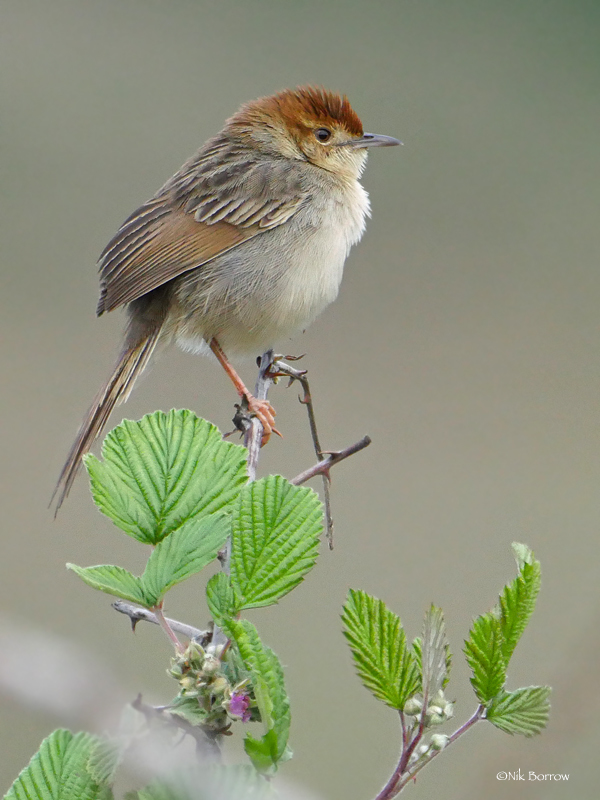
12–13 cm. A compact, medium-sized cisticola with a rufous-brown, finely streaked crown and a grey-brown back with distinct dark streaks. The flight feathers are edged warm brown. The face is greyish with an indistinct pale supercilium, and the underparts are dirty white to pale grey with a buff wash on the flanks. The tail is of medium length, brown with a dark band before the pale tip. The sexes are alike, the male slightly larger. In the dry season the plumage is somewhat duller and more heavily streaked.
Confusion species
Wailing Cisticola Cisticola lais lives at lower altitudes in the Malawi highlands, is larger, warmer buff and gives a plaintive wheeeuu. Black-Lored Cisticola Cisticola nigriloris of the same highlands is clearly larger and darker, with black lores and a loud duet, and keeps more to rank growth and forest edges. Rock-Loving Cisticola Cisticola aberrans has a plain, unstreaked back and a long, cocked tail. Singing Cisticola Cisticola cantans has a plain back, rufous wings and lives in scrub. Smaller, short-tailed cisticolas such as Wing-Snapping Cisticola Cisticola ayresii sing in high song flights. Altitude, a streaked back and the churring song point to Churring Cisticola.
Habitat
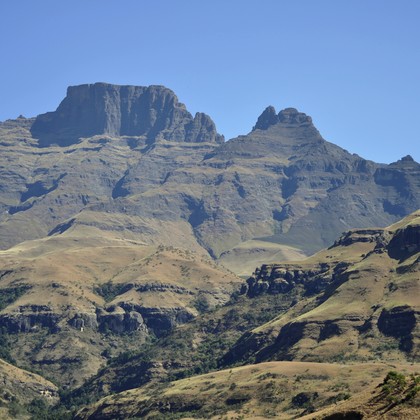
Montane grassland above about 1,800 m, especially where the grass is interspersed with bracken, bramble tangles, low shrubs and rock outcrops, and along the edges of forest patches. It forages low in the grass and bracken, usually in pairs.
Where the bird is most at home, classified by the vegetation units of southern Africa.
Range and movements
Within the region only on the Nyika Plateau on the border of Malawi and Zambia (subspecies mariae); most of the population lives on the Malawian side. Beyond the region in the highlands of southern Tanzania (including around Njombe), where the nominate form occurs.
- Resident
- Summer visitor (c. Oct–Mar)
- Passage (Mar–Apr, Oct–Nov)
- dark = core range, pale = thinly spread
How and when to look
Present all year; most often recorded in Nyika National Park, for example in the rolling grasslands around Chelinda. Search grassland with bracken and bramble in the morning and listen for the churring sound; the bird often sits on top of a bracken frond or grass tussock. Note size and lores to separate it from the larger Black-Lored Cisticola.
Conservation status
Not threatened. The range is small but largely protected on the Nyika. Over-frequent or over-hot fires, afforestation with exotic trees and conversion of highland grassland in Tanzania are the main threats.
Scientific name
Cisticola njombe | Lynes, 1933
Lynes described the species in 1933 and placed it straight away in the genus where it still stands. The genus Cisticola was introduced in 1829 by Kaup. Cisticola combines the Ancient Greek kisthos 'rock-rose' with the Latin colere 'to dwell'. njombe refers to Njombe in south-western Tanzania, where the first specimen was collected. The specimen the first description was based on came from Njombe, Tanzania.