All species › Passerines › Weavers › Village Weaver
Village Weaver | Ploceus cucullatus
Grote textorwever | Tejedor Común
The Village Weaver is the large, noisy colonial weaver of trees over water, villages and campsites in the north and east of the region. The breeding male is yellow with a black face, a red eye and a black-spotted back. Colonies may hold hundreds of nests and can be heard from afar.

Click a thumbnail to switch the photo above.
Voice
A continuous, grating and sizzling chatter of dozens of birds at once; the male's song is a rapid series of rasping notes ending in a buzzing zzzzzrrr, delivered with quivering wings beneath the nest. The call is a sharp chuk or chak.
Recording: JJSUN — CC BY-NC-SA 4.0 · converted to mono · xeno-canto
Identification
15–17 cm; a large, heavily built weaver with a stout black bill. The breeding male is yellow with a black face and a black throat ending in a point on the breast; the back is yellow with coarse black spots, the wings black with yellow edges, the eye red. In the south (South Africa, Eswatini, southern Mozambique) the crown and nape are yellow and the black reaches the forehead; further north, in Malawi, Zambia, northern Mozambique and Angola, males show more black on the head, up to a wholly black head, sometimes with a chestnut wash along the edge of the mask. The female is olive-green on the head and yellowish on throat and breast, with a whitish belly, a grey-olive streaked back, a horn-coloured bill and a red-brown eye. The non-breeding male resembles the female but keeps the red eye. Juveniles resemble the female with a brown eye.
Confusion species
Southern Masked Weaver (Ploceus velatus) is smaller, with a finely streaked rather than coarsely spotted back; the male's mask ends rounded on the throat. Lesser Masked Weaver (Ploceus intermedius) is smaller and has a pale eye, blue-grey legs and a mask extending over the crown. Cape Weaver (Ploceus capensis) lacks the black mask and has a pale eye. Eastern Golden Weaver (Ploceus subaureus) has no black on the head and breeds mainly in reeds. Females differ from female masked weavers in their larger size, heavy bill and greyer, coarsely streaked back.
Habitat
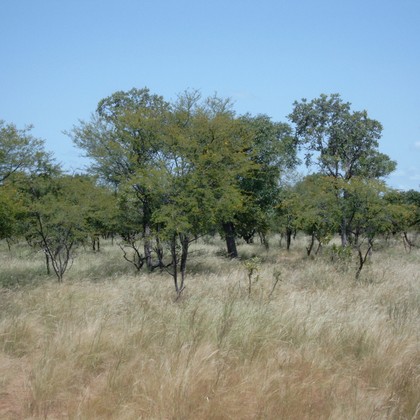
Riverine forest and trees over water, reeds, savanna with tall trees, farmland, villages, parks and campsites, into towns. It breeds in large, dense colonies in trees over water, in reeds, in palms or in trees near houses, sometimes alongside other weavers. The nest is coarsely woven from broad strips of grass or palm leaf, with an entrance below but no entrance tube. It eats seeds, grain and insects.
Where the bird is most at home, classified by the vegetation units of southern Africa.


Range and movements
Common in the north and east of the region: Angola, Zambia, Malawi, Mozambique, Zimbabwe (mainly lower-lying parts), northern Botswana (Okavango, Chobe), north-eastern Namibia (Kavango and Zambezi Region), Eswatini and eastern South Africa (Limpopo, Mpumalanga, KwaZulu-Natal into the Eastern Cape). It is absent from the arid west and the South African interior. Beyond the region across almost all of sub-Saharan Africa; introduced to Hispaniola, Mauritius and Réunion among other places.
- Resident
- Summer visitor (c. Oct–Mar)
- Winter visitor (c. Apr–Sep)
- Passage (Mar–Apr, Oct–Nov)
- dark = core range, pale = thinly spread
How and when to look
September to February at any riverside campsite or lodge in the lowveld, the Okavango or along the Zambezi. A colony in a tree over the water offers hours of spectacle: males building and singing, females inspecting and juveniles milling about. Compare a male directly with a Southern Masked Weaver when both are present: the size difference and the spotted back stand out at once.
Conservation status
Not threatened; very common and benefits from irrigation, dams, farmland and settlements. It is parasitised by the Diederik Cuckoo. In grain farming it is locally regarded as a pest.
Scientific name
Ploceus cucullatus | (Müller, 1776)
Müller described the species in 1776 as Oriolus cucullatus; because it was later moved to another genus, the author and year stand in brackets. The genus Ploceus was introduced in 1816 by Cuvier, GLCFD. Ploceus comes from the Greek plokeus, 'plaiter, weaver', for the tightly woven, ball-shaped nest that gives weavers their name. cucullatus is Latin for 'hooded', from cucullus, 'hood' — for the male's black head. The specimen the first description was based on came from Senegal.