All species › Passerines › Weavers › Chestnut Weaver
Chestnut Weaver | Ploceus rubiginosus
Kastanjewever | Tejedor Castaño
The Chestnut Weaver is a nomadic weaver of arid north-western Namibia and south-western Angola. The breeding male is chestnut with a black head, unmistakable among the weavers of the region. After good rains the birds appear suddenly in large numbers and build dense colonies in thorn trees.

Click a thumbnail to switch the photo above.
Voice
A dry, rapid chuk-chuk contact call, often in chorus in flight and around the colony. The male's song is a sizzling, grating chatter with buzzing final notes, chi-chi-zzwirrrr, delivered with quivering wings at the nest.
Recording: Bram Piot — CC BY-NC-SA 4.0 · converted to mono · xeno-canto
Identification
14–16 cm; a compact weaver with a heavy, conical bill. The breeding male has a black head and throat, deep chestnut back, breast and flanks, a paler belly and dark wings and tail with pale edges; the bill is black and the eye red-brown. The female is grey-brown above with dark streaking, with a faint yellow or buff supercilium, a buffy yellow breast band and a whitish throat and belly; the bill is horn-coloured. The non-breeding male resembles the female but often retains some chestnut on the back. Juveniles resemble the female.
Confusion species
The breeding male cannot be confused within the region. Females and non-breeding birds resemble female Southern Masked Weavers (Ploceus velatus) but are browner and less yellow, with a more distinct buff breast band and supercilium. Non-breeding Red-Billed Quelea (Quelea quelea) is smaller, with a red or pink bill. Female sparrows have a shorter bill and lack the streaked weaver back.
Habitat
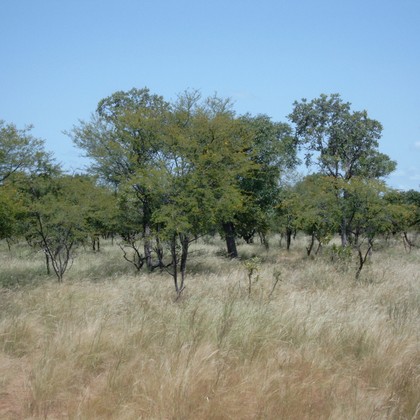
Dry thorn savanna, mopane woodland and scrub with scattered acacias, often near water after the rains. It breeds in dense colonies, sometimes with hundreds to thousands of nests, in acacias and other thorn trees. Outside the breeding season it forms flocks that search for grass seeds and at times wander widely.
Where the bird is most at home, classified by the vegetation units of southern Africa.

Range and movements
Within the region in north-western Namibia (Kaokoveld, Kunene, Etosha, northern Erongo and the northern interior) and south-western Angola; very rarely further east, into north-western Botswana. Beyond the region in a widely separated range in East Africa, from Ethiopia and Somalia to Tanzania.
- Resident
- Summer visitor (c. Oct–Mar)
- Winter visitor (c. Apr–Sep)
- Passage (Mar–Apr, Oct–Nov)
- dark = core range, pale = thinly spread
How and when to look
After good rains from January to April in the Kaokoveld and in and around Etosha; colonies in thorn trees along roads are then impossible to miss. In dry years the species may be largely absent, so ask about recent sightings. Around waterholes flocks often come to drink together with Red-Billed Quelea and sparrows.
Conservation status
Not threatened; locally common in the region but strongly fluctuating in number with rainfall. No clear threats are known.
Scientific name
Ploceus rubiginosus | Rüppell, 1840
Rüppell described the species in 1840 and placed it straight away in the genus where it still stands. The genus Ploceus was introduced in 1816 by Cuvier, GLCFD. Ploceus comes from the Greek plokeus, 'plaiter, weaver', for the tightly woven, ball-shaped nest that gives weavers their name. rubiginosus is Latin for 'rusty', from rubigo, 'rust' — for the male's chestnut body. The specimen the first description was based on came from Ethiopia (not specified).