All species › Owls › Typical owls › Verreaux's Eagle-Owl
Verreaux's Eagle-Owl | Ketupa lactea
Verreauxs oehoe | Búho Lechoso
Verreaux's Eagle-Owl is the largest owl in Africa. It is pale grey-brown and finely vermiculated, with dark brown eyes rather than yellow, and pink eyelids that show at every blink. By day it sits high in a large tree, pressed against the trunk.

Voice
A deep, resonant series of grunting hoots, hunk-hunk, low pitched and far-carrying; the series begins strongly and slowly fades. Pairs call in duet, the female higher pitched than the male. Young beg with a drawn-out, wheezing screech that can continue all night.
No recording with a suitable Creative Commons licence is available for this species yet.
Identification
58–66 cm, wingspan to well over one and a half metres. Pale grey-brown, finely vermiculated above and whitish grey below with fine grey barring. The facial disc is pale grey with a black rim; the eyelids are pink and the eyes dark brown. The ear tufts are broad and often held sideways or flat. The bill is horn-grey and the legs are feathered to the toes. The female is larger and heavier than the male, with identical plumage. Juveniles are whiter and downier, with a less sharply defined disc. Flight is heavy and slow, with deep wingbeats and long glides.
Confusion species
Spotted Eagle-Owl Bubo africanus is much smaller, with yellow eyes and coarser barring below. Cape Eagle-Owl Bubo capensis has orange eyes and coarse dark blotching on the breast. Pel's Fishing Owl Scotopelia peli is rufous and barred, without ear tufts. The combination of dark brown eyes and pink eyelids occurs in no other owl in the region.
Habitat
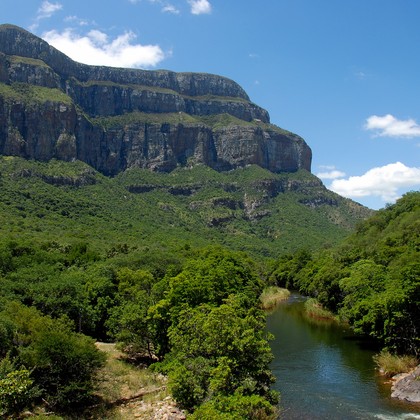
Savanna and broadleaved woodland, thornveld, riverine woodland and the edges of semi-desert wherever large trees stand; it avoids closed forest and bare desert. By day it roosts in a large shady tree, often on a thick horizontal branch against the trunk. It breeds in old nests of Hamerkop, Secretarybird, vultures and eagles, or in a thick tree fork.
Where the bird is most at home, classified by the vegetation units of southern Africa.
Range and movements
Widespread through the savanna belt of the region: northern and eastern South Africa, Eswatini, Mozambique, Zimbabwe, Botswana, northern Namibia, Zambia, Malawi and Angola. It is absent from the winter-rainfall south-west, the core Karoo and the driest Namib. Beyond the region it occurs across most of Africa south of the Sahara.
- Resident
- Summer visitor (c. Oct–Mar)
- Winter visitor (c. Apr–Sep)
- Passage (Mar–Apr, Oct–Nov)
- dark = core range, pale = thinly spread
How and when to look
The first hour after sunset at riverine woodland with large figs or thorn trees; listen for the low grunting hoots and then pick the bird out with a lamp on an open side branch. By day a roost gives itself away by pellets and white splashes under a large tree. On a night drive in a game reserve the bird often sits on a post or a bare branch beside the road.
Conservation status
Not threatened and widely distributed, but everywhere at low density. Collisions with vehicles and power lines, poisoning through rodenticides and agricultural chemicals, drowning in livestock water troughs, persecution rooted in traditional belief, and the loss of large nest trees are the reported causes of mortality.
Scientific name
Ketupa lactea | (Temminck, 1820) (GBIF: Bubo lacteus)
Temminck described the species in 1820 as Strix lactea; because it was later moved to another genus, the author and year stand in brackets. The genus Ketupa was introduced in 1830 by Lesson. Ketupa comes from the Malay ketupok, a name for the Buffy Fish Owl; the genus was later broadened to include the African eagle-owls, among them Verreaux's Eagle-Owl. lactea is Latin for 'milky', for the pale, greyish-white plumage colour, lighter than in most other African eagle-owls. The specimen the first description was based on came from Senegal.