All species › Passerines › Chats and flycatchers › Tractrac Chat
Tractrac Chat | Emarginata tractrac
Woestijnspekvreter | Colinegro Tractrac
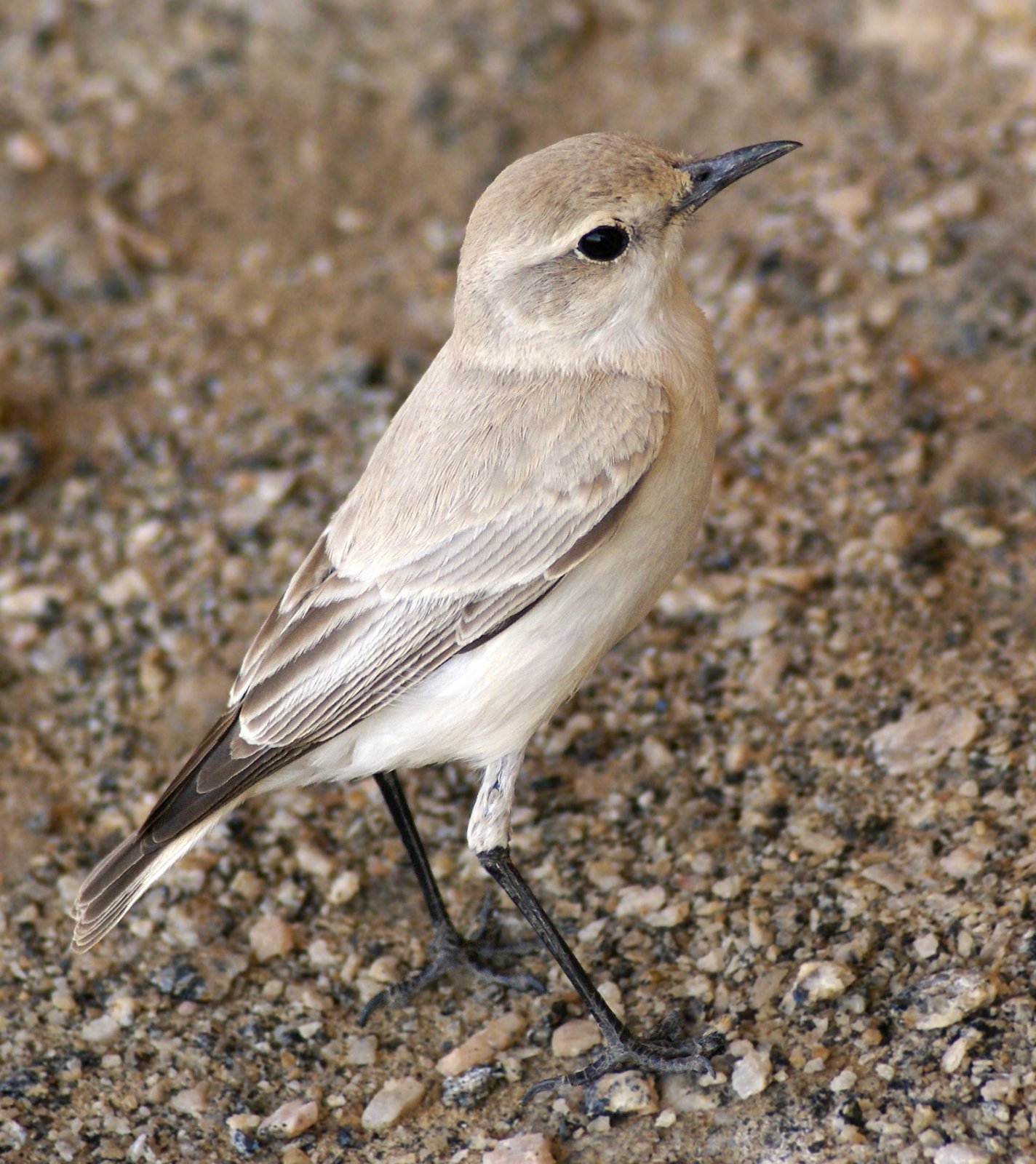
The Tractrac Chat is a small, pale and dumpy chat of the gravel plains and sand flats of the Namib and the arid western Karoo. It runs fast over bare ground, stops abruptly and perches low on a stone or tussock, and in flight it shows a white rump with a black tail tip.
Voice
The call is a soft, dry tak-tak or chak, which gives the species its name. The song is a fast, soft, bubbling run of chattering and whistled notes, often in a short song flight over the territory, the bird sometimes descending with audibly clapping wings.
No recording with a suitable Creative Commons licence is available for this species yet.
Identification
14–15 cm, a dumpy, short-tailed chat. The upperparts are pale grey-brown and the underparts dirty white; Namib birds are strikingly pale, almost sandy white, those of the southern Karoo darker grey-brown. The rump and tail base are white or whitish; the tail has black central feathers and a black terminal band, forming an inverted T. The face is fairly plain with a pale eye-ring. The sexes are alike; juveniles are lightly spotted. It runs fast and often stays on the ground, sometimes hovering briefly before dropping onto prey.
Confusion species
Karoo Chat (Emarginata schlegelii) is larger and greyer, with a grey rump and white tail sides, and perches higher on bushes. Sickle-Winged Chat (Emarginata sinuata) is browner, with an orange-buff rather than white rump and a longer tail. Familiar Chat (Oenanthe familiaris) has a rufous rump and tail. Female Mountain Chat (Myrmecocichla monticola) is much darker and larger.
Habitat
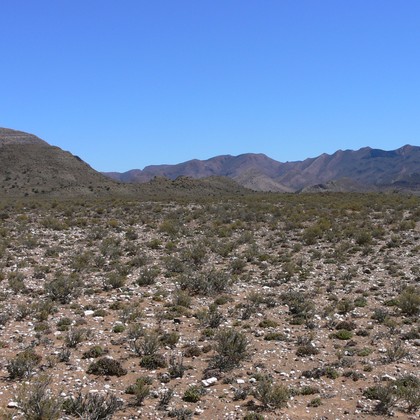
Open gravel plains, sand flats with scattered tussocks and low shrubs, the edges of dunes and bare succulent karoo, into the most inhospitable parts of the Namib. It forages on the ground for insects. The nest is a cup in a low shrub or tussock, often on a base of small pebbles.
Where the bird is most at home, classified by the vegetation units of southern Africa.


Range and movements
Near-endemic to the region: the Namib along the entire Namibian coast and adjacent interior, from south-western Angola (Namibe province) southwards, and southern Namibia, Namaqualand, Bushmanland and the western Karoo in the Northern and Western Cape. It occurs nowhere else.
- Resident
- Summer visitor (c. Oct–Mar)
- Winter visitor (c. Apr–Sep)
- Passage (Mar–Apr, Oct–Nov)
- dark = core range, pale = thinly spread
How and when to look
Drive the gravel plains of Namib-Naukluft Park or the road from Swakopmund inland and watch for small, pale birds running ahead of the car. In Namaqualand and Bushmanland it is found on open flats with low shrubs. The white rump in flight separates it from the larger Karoo Chat, which can occur in the same places.
Conservation status
Not threatened. The species is locally common and its habitat is sparsely populated and little threatened. Mining and off-road driving on the Namib gravel plains can cause local disturbance.
Scientific name
Emarginata tractrac | (Wilkes, 1817)
Wilkes described the species in 1817 as Motacilla tractrac; because it was later moved to another genus, the author and year stand in brackets. The genus Emarginata was introduced in 1896 by Shelley. Emarginata comes from the Latin emarginatus, 'emarginated, notched', for the greatly attenuated tip of the ninth primary of the Sickle-winged Chat, which in some specimens forms a small sickle. tractrac imitates the call, taken from the name 'Le Traquet tractrac' that the French naturalist François Levaillant gave the bird. The specimen the first description was based on came from probably Orange River, southern Africa.