All species › Passerines › Chats and flycatchers › Karoo Chat
Karoo Chat | Emarginata schlegelii
Karoospekvreter | Colinegro del Karoo
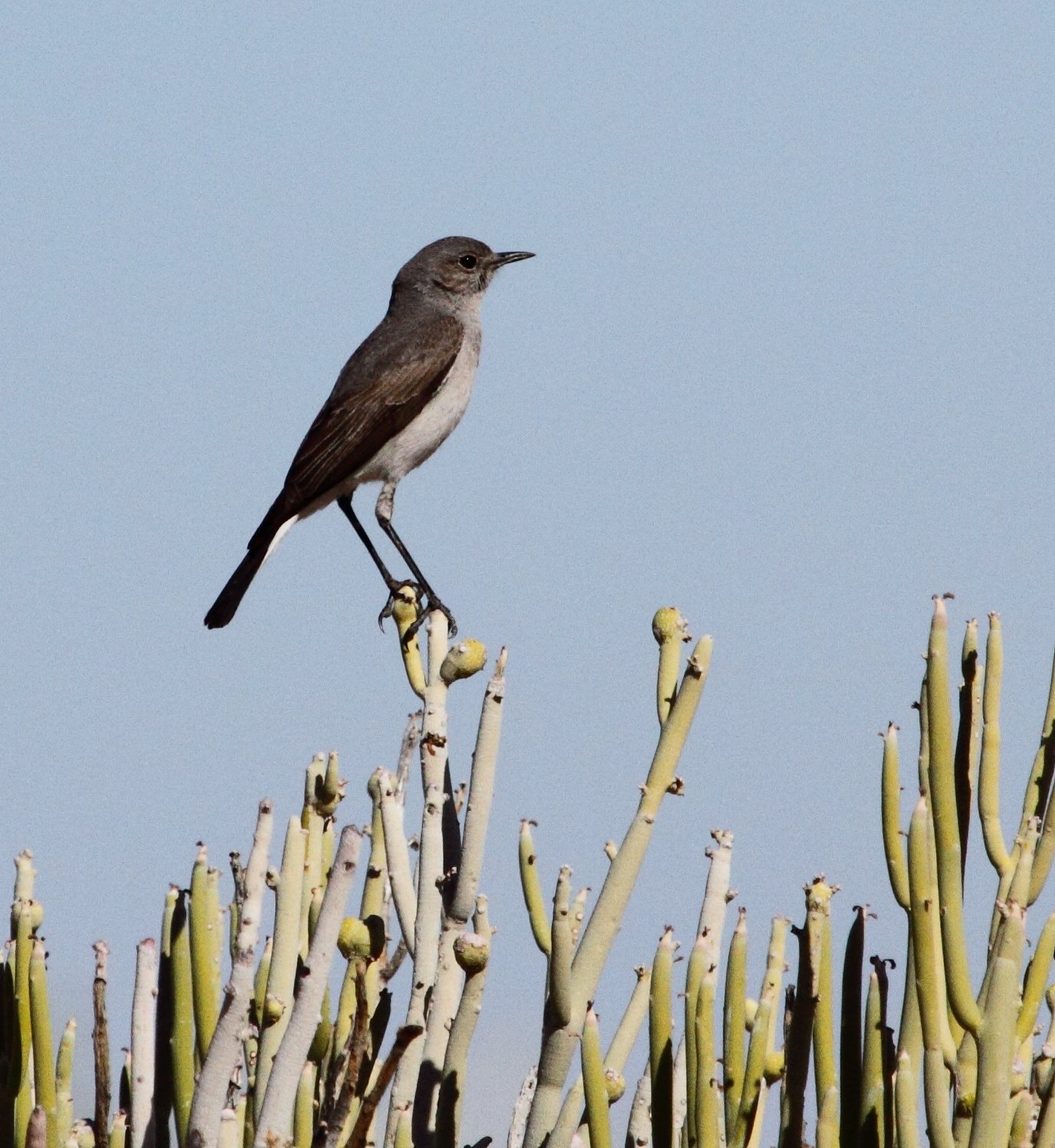
The Karoo Chat is the largest and greyest of this group of chats, a familiar sight on the bushes of the Karoo and Namaqualand. In flight the white tail sides stand out, the best feature against the other grey chats of the arid west.
Voice
The call is a dry, rattling trrrt-trrrt or chak, often repeated when disturbed. The song is a short, varied run of whistled and chattering notes, sometimes with mimicry, delivered from a bush top.
Recording: Faansie Peacock — CC BY-NC-SA 4.0 · converted to mono · xeno-canto
Identification
16–18 cm, a fairly large, long-tailed chat. The male is plain slate-grey above and paler grey below, with a whitish throat and belly and sometimes a hint of rusty buff on the undertail coverts. The rump is grey, not pale. The tail is black with white outer feathers, which flash especially on take-off and landing. The female is browner grey. There is a pale eye-ring and a faint pale supercilium. Juveniles are lightly spotted. It perches upright on a bush top, flicks its wings and drops to the ground to take insects.
Confusion species
Tractrac Chat (Emarginata tractrac) is smaller and paler, with a white rump and a black tail tip rather than white tail sides. Sickle-Winged Chat (Emarginata sinuata) is smaller and browner, with an orange-buff rump. Female Mountain Chat (Myrmecocichla monticola) is dark brown with a white rump and much white in the tail. Chat Flycatcher (Agricola infuscatus) is brown, lacks white in the tail and shows a pale wing panel.
Habitat
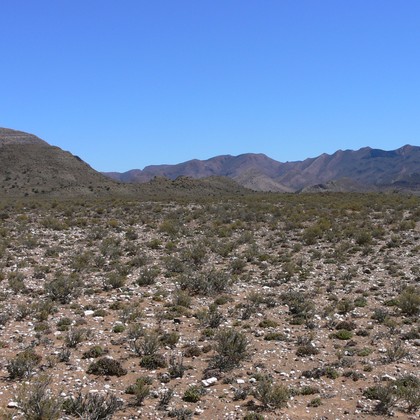
Dry, open karoo scrub plains, succulent karoo, rocky hill bases and the edges of dry riverbeds with scattered shrubs. It forages from a bush or stone for insects on the ground and also takes berries. The nest is a cup in a shrub or in a hollow among stones.
Where the bird is most at home, classified by the vegetation units of southern Africa.

Range and movements
Near-endemic to the region: the Nama and Succulent Karoo of the Western, Northern and Eastern Cape, including Namaqualand and Bushmanland, and north through southern and western Namibia to the Kaokoveld, with an isolated population in south-western Angola (Namibe province). It occurs nowhere else.
- Resident
- Winter visitor (c. Apr–Sep)
- dark = core range, pale = thinly spread
How and when to look
One of the first birds you see along roads through the Karoo: check grey birds on bush tops along the N1 and in Tankwa Karoo National Park. The white tail sides on take-off are the quickest feature. Where it occurs with Tractrac Chat, Karoo Chat perches higher and more often on bushes, Tractrac lower and more often on the ground.
Conservation status
Not threatened. The species is common within its range and numbers are stable. It tolerates moderate grazing well; only heavy overgrazing and land clearance degrade its habitat locally.
Scientific name
Emarginata schlegelii | (Wahlberg, 1855)
Wahlberg described the species in 1855 as Erithacus schlegelii; because it was later moved to another genus, the author and year stand in brackets. The genus Emarginata was introduced in 1896 by Shelley. Emarginata comes from the Latin emarginatus, 'emarginated, notched', for the greatly attenuated tip of the ninth primary of the Sickle-winged Chat, which in some specimens forms a small sickle. schlegelii honours the German zoologist Hermann Schlegel (1804–1884), director of the National Museum of Natural History in Leiden. The specimen the first description was based on came from Damaraland, Namibia.