All species › Passerines › Ground babblers › Spotted Thrush-Babbler
Spotted Thrush-Babbler | Illadopsis turdina
Witbuiklijstertimalia | Tordina Moteada
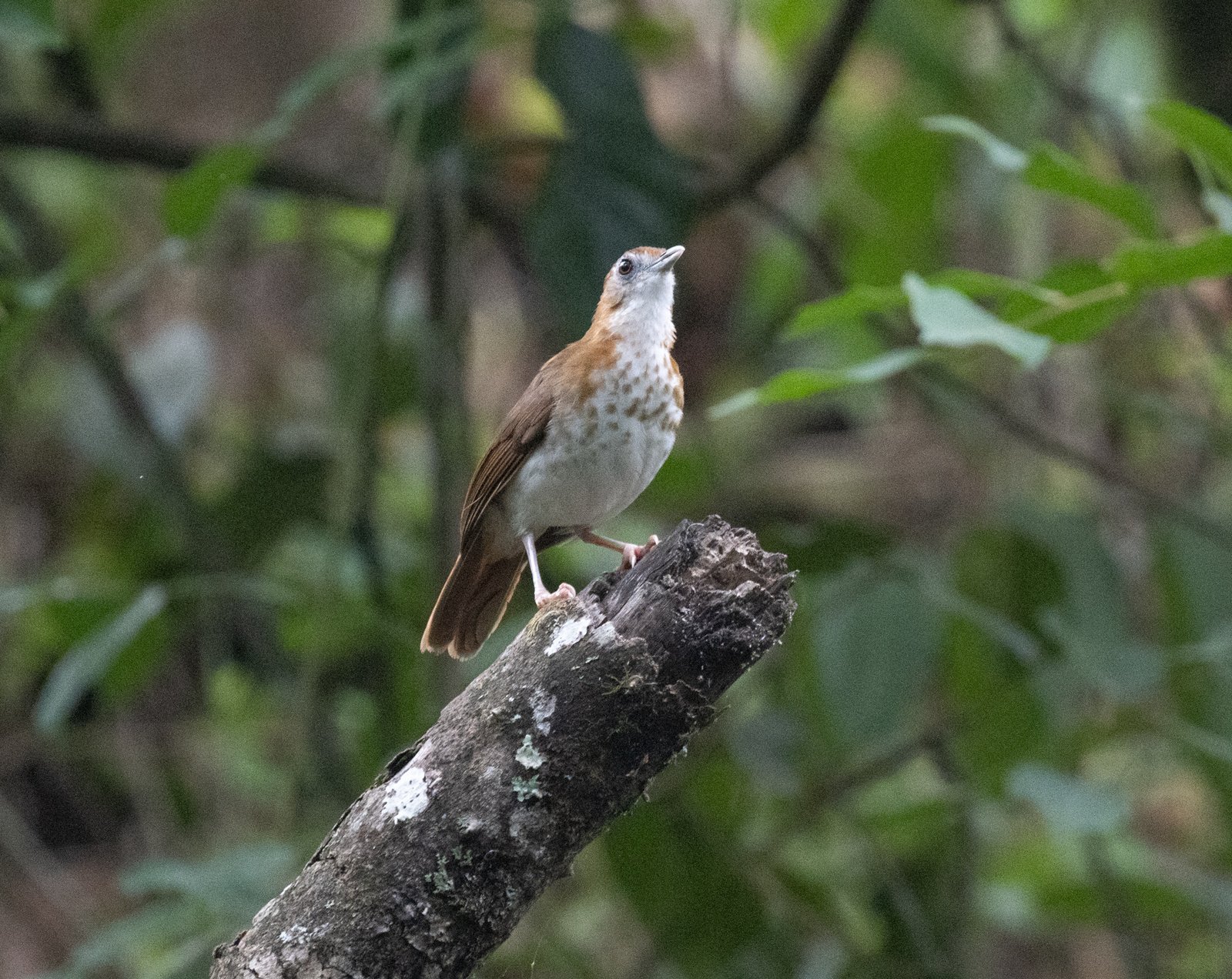
The Spotted Thrush-Babbler is a scarce, thrush-like babbler of dense gallery forest in the far north-west of Zambia. It lives hidden in the undergrowth, but gives itself away with a rich, fluid, oriole-like song, often as a duet.
Voice
The song is a rich, fluid, oriole-like phrase of three to four whistles, whoh-tyaw-lee, often repeated from cover. The female regularly joins in a duet. Also harsh, grating alarm calls and soft contact notes.
Recording: Mathias D'haen — CC BY-NC-SA 4.0 · converted to mono · xeno-canto
Identification
16–18 cm. A fairly large, sturdy babbler with a long, straight bill and a medium-length tail, in build more a small thrush than an illadopsis. Forehead, crown, mantle and flanks are warm rufous-brown, wings and tail darker brown. Chin, throat and lores are white, the ear-coverts white mottled with rufous. The breast is white with bold rufous to dark brown drop-shaped spots, the belly and undertail-coverts pure white. The legs are pink. The sexes are alike; juveniles have more diffusely spotted breasts.
Confusion species
Fraser's Rufous Thrush Stizorhina fraseri occurs in the same forests of Mwinilunga, but is plain rufous below, without spots, and sits upright in the mid-stratum, constantly quivering its wings. Groundscraper Thrush Turdus litsitsirupa is also white with black spots, but is greyer, has a black-and-white face pattern and lives in open woodland, not gallery forest. African Thrush Turdus pelios has a brownish-grey breast without clear spots and a yellow bill.
Habitat
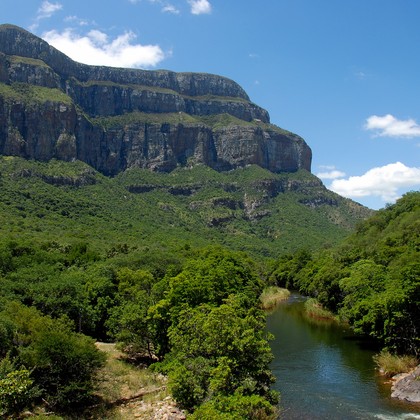
Dense, damp undergrowth of evergreen gallery forest and swamp forest (mushitu) along streams and springs, also dense bush and grass thickets at forest edges near water. It forages on and just above the ground among dead leaves for insects and other invertebrates, usually in pairs.
Where the bird is most at home, classified by the vegetation units of southern Africa.
Range and movements
Within the region known only from north-western Zambia, in Mwinilunga District, including Nyachisala Forest, around Kalwelwa and in the gallery forests of the Jimbe area; the subspecies here is upembae. It has been listed for extreme eastern Angola, but there are no recent data from there. Beyond the region very fragmented in Central Africa: south-eastern and north-eastern DR Congo, South Sudan, the Central African Republic and Cameroon.
- Resident
- dark = core range, pale = thinly spread
How and when to look
All year; the birds sing most at the start of the rains. Look for it at dawn in the gallery forests of Mwinilunga, where local guides at the bush camps know the territories. Follow the melodious duets and wait along a forest trail or stream until the bird shuffles over the ground; the spotted white breast stands out in the gloom.
Conservation status
Not threatened according to the IUCN, but within the region very local and rare, and therefore vulnerable. The gallery forests of Mwinilunga suffer from clearing for farming, charcoal production and fires that penetrate into the stream valleys.
Scientific name
Illadopsis turdina | (Hartlaub, 1883) (GBIF: Ptyrticus turdinus)
Hartlaub described the species in 1883 as Ptyrticus turdinus; because it was later moved to another genus, the author and year stand in brackets. The genus Illadopsis was introduced in 1860 by Heine. Illadopsis combines the Greek illas, genitive illados, 'thrush', with opsis, 'appearance' — for the thrush-like look of these forest birds. turdina is Latin for 'thrush-like', from turdus, 'thrush' — for its thrush-like build. The specimen the first description was based on came from Tomaya, South Sudan.