All species › Passerines › Pittas › African Pitta
African Pitta | Pitta angolensis
Angolapitta | Pita Angoleña
The African Pitta is a stocky, short-tailed forest-floor bird with an almost improbable palette: green back, turquoise-blue wing spots and a crimson belly. It lives hidden in dense thicket and is noticed mainly at the start of the rains, when the male performs its display jump with a frog-like call at dawn.

Voice
In display a short, deep, frog-like frrrup or prrrt, given as the male jumps up from a branch with whirring wings and drops back; at dawn and dusk, sometimes also on overcast days. Also a soft, subdued kwee as a contact call.
Recording: Dries Van de Loock — CC BY-NC-SA 4.0 · converted to mono · xeno-canto
Identification
18–20 cm, rotund, with a very short tail, a stout bill and long flesh-coloured legs. The crown and a broad eye-stripe are black, separated by a broad golden-buff supercilium. The throat is white washed pink, the breast warm buff and the belly and undertail coverts bright crimson. Back and scapulars are grass-green; the wing coverts and rump carry glossy turquoise-blue spots. In flight a white patch at the base of the black primaries stands out. The sexes are alike; juveniles are duller, with a pink rather than red belly.
Confusion species
No other pitta is known within the region, and confusion is ruled out with a good view. A bird flushing through the thicket can briefly suggest a thrush or Eastern Nicator Nicator gularis, but the dumpy tailless shape, the white wing patch and the red under the tail are distinctive.
Habitat
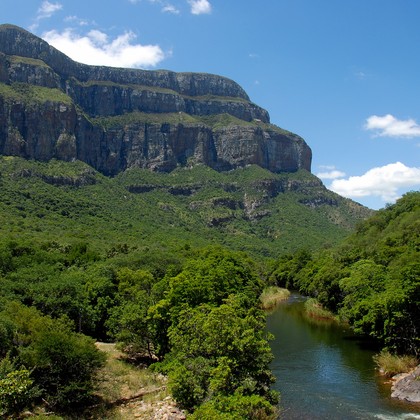
Dense lowland forest, dry thicket and riverine forest with a low canopy and plenty of leaf litter, such as the thickets of the Zambezi and Luangwa valleys and coastal forest in Mozambique. It forages on the ground by tossing leaves, taking mainly snails, earthworms, termites and beetle larvae. It nests in the rains in an untidy dome of twigs in a bush or low tree fork.
Where the bird is most at home, classified by the vegetation units of southern Africa.

Range and movements
A breeding bird in the north and east of the region: Zambia (mainly the Luangwa and Zambezi valleys), Malawi, central and northern Mozambique, the Zambezi Valley in Zimbabwe and north-western Angola, where a resident population also occurs. Rare and irregular further south in Zimbabwe and Mozambique; known as a vagrant from north-eastern South Africa and even the Eastern Cape. Beyond the region from West Africa to East Africa; southern breeders move to Tanzania and eastern Congo in the dry season.
- Summer visitor (c. Oct–Mar)
- Passage (Mar–Apr, Oct–Nov)
- dark = core range, pale = thinly spread
How and when to look
Look for it from November to January, just after the first heavy rains, in the Zambezi Valley (Mana Pools, lower Zambezi) or the Luangwa Valley. Listen at first light for the display call and then for rustling leaves; sit still, as the bird often stays on one low branch for minutes. Outside the display season it is almost impossible to find.
Conservation status
Not threatened, but scarce in the region and heavily dependent on undisturbed dense thicket. Clearing and burning of thickets in the river valleys are the main local threats. Migrants travel at night and are sometimes killed against lit buildings.
Scientific name
Pitta angolensis | Vieillot, 1816
Vieillot described the species in 1816 and placed it straight away in the genus where it still stands. He introduced the genus Pitta in that same work. Pitta is a word from Telugu (southern India) meaning 'small bird'. angolensis means 'of Angola', where the first specimen came from. The specimen the first description was based on came from Angola.