All species › Passerines › Shrikes › Souza's Shrike
Souza's Shrike | Lanius souzae
Souza's klauwier | Alcaudón de Souza
Souza's Shrike is a small, inconspicuous shrike of miombo woodland, much less obvious than its relatives. It sits quietly and low in the shade of the trees and is often overlooked. For anyone birding the miombo of Zambia or Angola it is one of the specialities of this woodland type.
Voice
Not very vocal. A soft, scratchy chrrp, thin whistles and occasionally a soft, grating song.
Recording: Dries Van de Loock — CC BY-NC-SA 4.0 · converted to mono · xeno-canto
Identification
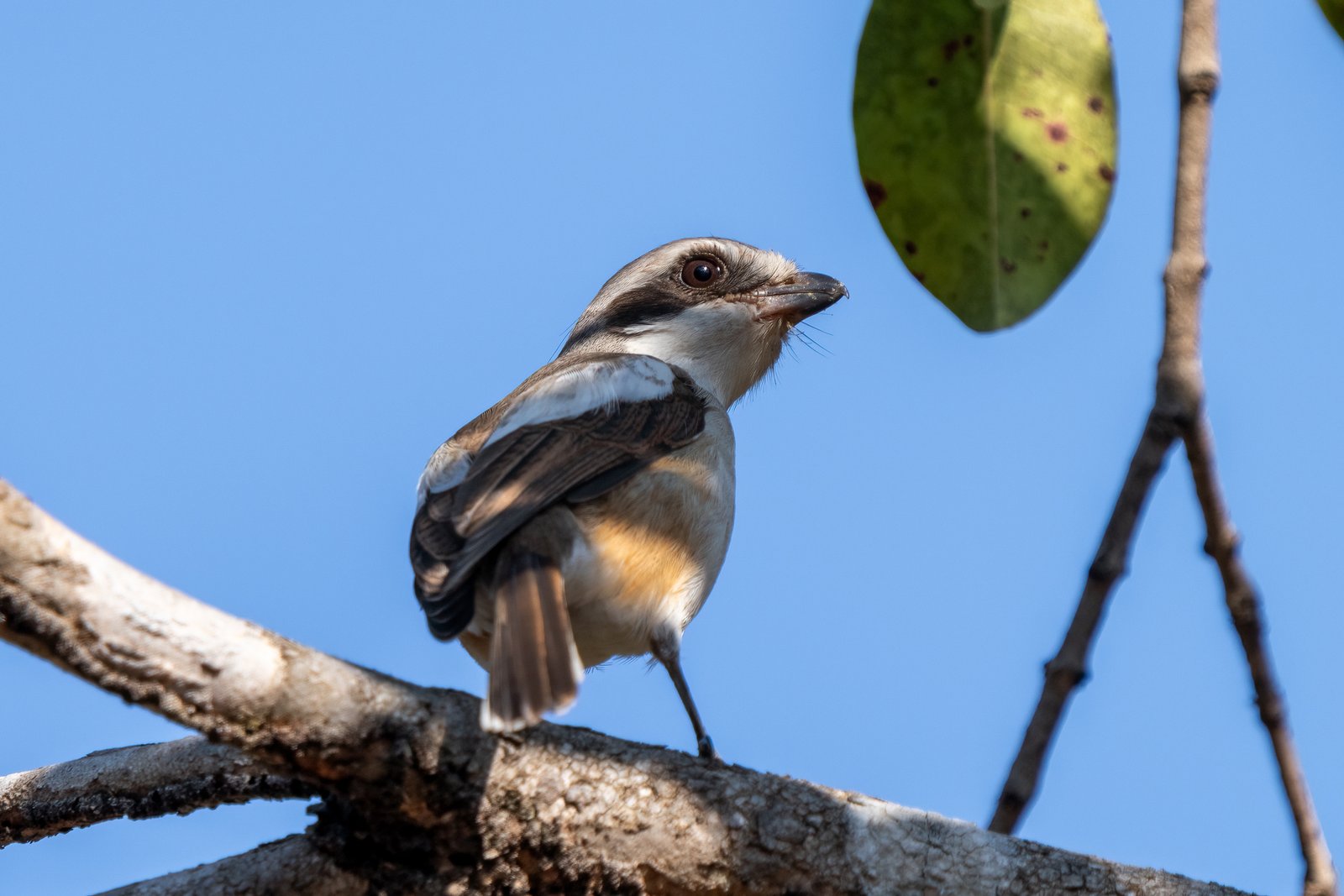
17–18 cm. Crown and nape are grey, with a short white supercilium above a black mask. The mantle is grey-brown with fine dark barring, the wings warm rufous-brown. White scapulars form a V on the back. The tail is long and narrow, brown with white outer feathers. Throat white, the rest of the underparts pale grey-buff to ochre, unbarred. The female has a rufous patch on the flanks. Juveniles are more densely barred, including below. The bill is relatively small and slender for a shrike.
Confusion species
Female and juvenile Red-Backed Shrike Lanius collurio have a rufous tail and scaled underparts, with no white V on the back. Juvenile Northern Fiscal Lanius humeralis is larger and greyer, with dense barring below and a white wing patch. Brown-Crowned Tchagra Tchagra australis has a brown crown, a broad white supercilium and a long, black, white-tipped tail. Brubru Nilaus afer is black and white above with a rufous flank stripe.
Habitat
Open miombo woodland with a grassy understorey and clearings, also the edges of dambos and lightly wooded grassland. It hunts from a low, shaded branch for insects on the ground.
Where the bird is most at home, classified by the vegetation units of southern Africa.

Range and movements
In the region in Angola (central plateau and the east), over much of Zambia (mainly the west, north and east), in the miombo of Malawi and in western and north-western Mozambique (Tete and Niassa). Rare in the Zambezi Region of Namibia and the extreme north of Botswana. Beyond the region from south-eastern Gabon and Congo through southern Democratic Republic of the Congo to Tanzania, Rwanda and Burundi.
- Resident
- dark = core range, pale = thinly spread
How and when to look
Year-round, best in the breeding season (September–November), when the birds are more active and visible. Walk slowly through open miombo and check low branches in the shade; the bird sits still for long periods and only draws attention when it drops to the ground.
Conservation status
Not threatened; fairly common but unobtrusive over much of its range. Clearing for charcoal and farming degrades miombo woodland locally.
Scientific name
Lanius souzae | Bocage, 1878
Bocage described the species in 1878 and placed it straight away in the genus where it still stands. The genus Lanius was introduced in 1758 by Linnaeus. Lanius is Latin for 'butcher', from shrikes' habit of impaling prey on thorns and barbed wire. souzae honours the Portuguese zoologist José Augusto de Sousa (1837–1889), curator at the natural history museum in Lisbon. The specimen the first description was based on came from Caconda, Angola.