All species › Passerines › Shrikes › Northern Fiscal
Northern Fiscal | Lanius humeralis
Noordelijke gekraagde klauwier | Alcaudón Fiscal Norteño
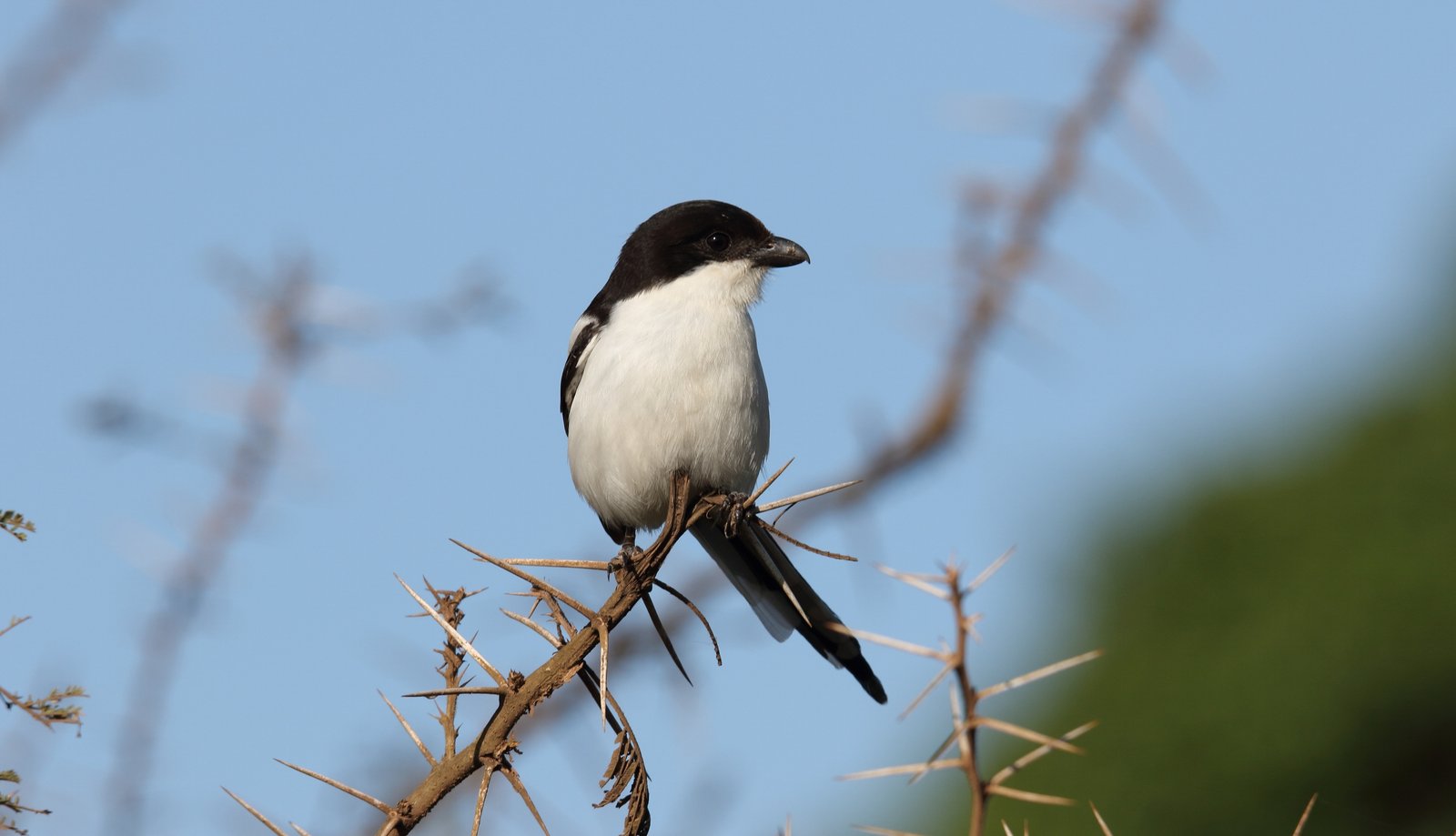
The Northern Fiscal is the northern counterpart of the Southern Fiscal, with which it was long treated as a single species. It is a bold black-and-white shrike that sits on wires, posts and treetops in open country and villages, and in the region occurs mainly in Angola and the northern countries.
Voice
A harsh, rasping chrrr or chaa as an alarm. The song is a varied series of whistles, grating notes and imitations of other birds, often sustained for a long time.
Recording: isaac kilusu — CC BY-NC-SA 4.0 · converted to mono · xeno-canto
Identification
21–23 cm. The upperparts are black, with white scapulars forming a clear V on the back and a white patch at the base of the primaries. The rump is pale grey to greyish-white. The underparts are bright white. The tail is long, black with white outer feathers and white tips. There is no white supercilium. The bill is heavy, black and hooked. The female has a rufous patch on the flanks. Juveniles are grey-brown with dense dark barring, including below.
Confusion species
Southern Fiscal Lanius collaris is very similar and is best separated by range; it usually has a greyer rump and, in the west, a white supercilium. Mackinnon's Shrike Lanius mackinnoni is grey above with a white eyebrow and lacks the white wing patch. Fiscal Flycatcher Sigelus silens has a thin, straight bill, white patches at the tail base and a white bar on the secondaries, but no white V on the back.
Habitat
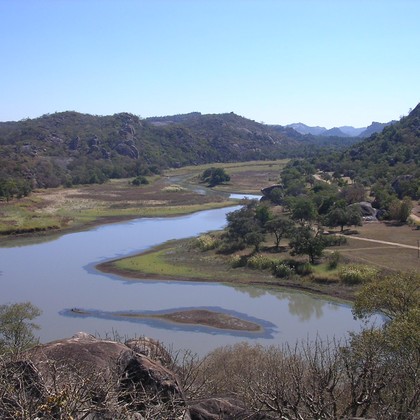
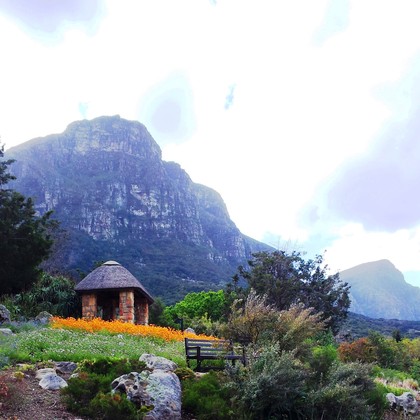
Open and semi-open country: grassy savanna, mixed woodland with clearings, fields, roadsides, villages and towns. It hunts from a lookout for insects, lizards, small birds and rodents, and impales prey on thorns or barbed wire.
Where the bird is most at home, classified by the vegetation units of southern Africa.

Range and movements
In the region mainly in Angola (subspecies capelli), where it is common on the plateau, and locally in northern and eastern Zambia, Malawi and northern Mozambique (subspecies humeralis). The boundary with Southern Fiscal is still poorly known. Beyond the region it is widespread from West Africa to Eritrea and Ethiopia and south to Tanzania, the Democratic Republic of the Congo and Gabon.
- Resident
- dark = core range, pale = thinly spread
How and when to look
Year-round; along roads, in villages and around fields on the Angolan plateau it is common and frequently recorded. For records in Zambia, Malawi and Mozambique, note the colour of the rump and the presence of a supercilium, as the range boundary with Southern Fiscal is still poorly known.
Conservation status
Not assessed separately by the IUCN; it is included in Common Fiscal (Lanius collaris, Least Concern). The species is common over much of its range and benefits from the clearing of forest for farming and settlement.
Scientific name
Lanius humeralis | Stanley, 1814
Stanley described the species in 1814 and placed it straight away in the genus where it still stands. The genus Lanius was introduced in 1758 by Linnaeus. Lanius is Latin for 'butcher', from shrikes' habit of impaling prey on thorns and barbed wire. humeralis is Latin for 'of the shoulder', from humerus — for the white shoulder stripe. The specimen the first description was based on came from Chelicut, Tigray, Ethiopia.