All species › Passerines › Bushshrikes › Southern Tchagra
Southern Tchagra | Tchagra tchagra
Kaapse tsjagra | Chagra del Cabo
The Southern Tchagra is the tchagra of dense coastal forest and valley thicket along the south-east coast, almost endemic to the region. It resembles Brown-Crowned Tchagra, but is larger and darker, with a strikingly long, heavy bill.

Voice
In display flight the bird rises on rattling wings and gives a series of clear, descending whistles, tieuw-tieuw-tieuw-tieuw. Pairs sing in duet, the partner adding a whirring chrrrr. Also harsh, rasping alarm calls.
Recording: Walter Wallner — CC BY-NC-SA 4.0 · converted to mono · xeno-canto
Identification
20–22 cm. The crown is brown and not sharply defined, with a dull white to pale grey supercilium and a black eye-stripe. The back is warm grey-brown and the wing bright rufous. The underparts are grey, browner on the flanks. The tail is black with white tips. The bill is black, long and heavy with a small hook, clearly longer than in the other tchagras. The eye is dark. The sexes are alike; juveniles have a horn-coloured bill. It lives low and hidden in dense scrub.
Confusion species
Brown-Crowned Tchagra Tchagra australis is smaller, with a shorter bill, paler underparts and a brown crown set off from the white supercilium by narrow black lines; it lives in drier woodland further north. Black-Crowned Tchagra Tchagra senegalus has an all-black crown and a more contrasting head.
Habitat
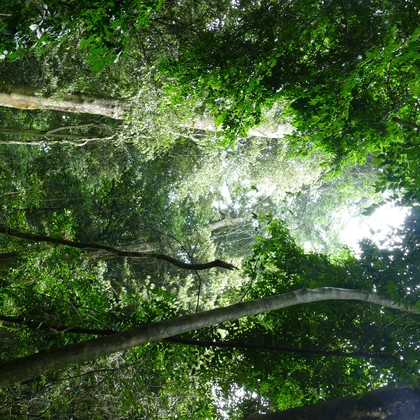
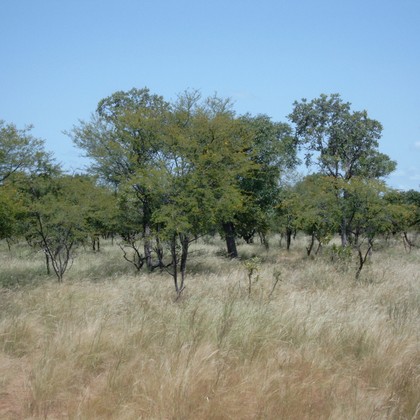
Dense thicket and forest edge: coastal forest and dune thicket, valley bushveld and dense thorn scrub in river valleys, as well as rank gardens close to natural thicket. It forages on and just above the ground for insects and other invertebrates.
Where the bird is most at home, classified by the vegetation units of southern Africa.
Range and movements
Almost endemic to the region: from around Mossel Bay and the Garden Route east through the Eastern Cape and KwaZulu-Natal to Eswatini and southern Mozambique around Maputo; inland to eastern Mpumalanga. Not known beyond the region.
- Resident
- Summer visitor (c. Oct–Mar)
- Passage (Mar–Apr, Oct–Nov)
- dark = core range, pale = thinly spread
How and when to look
Year-round. Best seen in the Eastern Cape and along the KwaZulu-Natal coast, early in the morning at the edge of dense thicket. Listen for the whistled series in spring and watch for a bird that rises briefly above the scrub. In dry valley thicket it sometimes forages in open patches between the bushes.
Conservation status
Not threatened, but with a restricted range. It has declined locally through clearance of coastal forest and thicket for agriculture, housing and tourism development; common in protected areas and rank margins.
Scientific name
Tchagra tchagra | (Vieillot, 1816)
Vieillot described the species in 1816 as Thamnophilus tchagra; because it was later moved to another genus, the author and year stand in brackets. The genus Tchagra was introduced in 1831 by Lesson. Tchagra goes back to Levaillant's 'Tchagra' (1800), an imitation of the Southern Tchagra's incessant 'tch tcha tcha gra' calls. tchagra goes back to Levaillant's 'Le Tchagra', an imitation of the bird's call. The specimen the first description was based on came from Gamtoos River, Eastern Cape, South Africa.