All species › Passerines › Bushshrikes › Brown-Crowned Tchagra
Brown-Crowned Tchagra | Tchagra australis
Bruinkoptsjagra | Chagra Coroniparda
The Brown-Crowned Tchagra is the smaller, less conspicuous counterpart of the Black-Crowned Tchagra: a grey-brown bush bird with rufous wings and a brown crown set off from the white supercilium by black lines. It lives hidden in dense scrub and is most noticeable during its display flight.

Voice
In display flight the bird rises steeply on audibly rattling wings and then glides down with its tail spread, giving a series of descending whistled notes, tee-tee-tee-teeoo-teeoo-teeoo. Also a whirring chrrrr and harsh alarm calls from cover.
Recording: Jaap van der Waarde — CC BY-NC-SA 4.0 · converted to mono · xeno-canto
Identification
18–19 cm. The crown is plain brown and bordered on either side by a narrow black line, with a white supercilium and a black eye-stripe below it. The back is grey-brown and the wing bright rufous. The underparts are pale grey with a pale buff wash on the flanks. The tail is black with white tips. The bill is black and heavy and the eye dark. The sexes are alike; juveniles have a horn-coloured bill and a duller head. It forages low and hidden, often on the ground beneath shrubs.
Confusion species
Black-Crowned Tchagra Tchagra senegalus is larger, with an all-black crown. Southern Tchagra Tchagra tchagra of the east coast has a longer, heavier bill, a less sharply defined crown without clear black border lines and greyer underparts. Marsh Tchagra Bocagia minuta of wet grassland has a black cap and a rufous-brown back.
Habitat
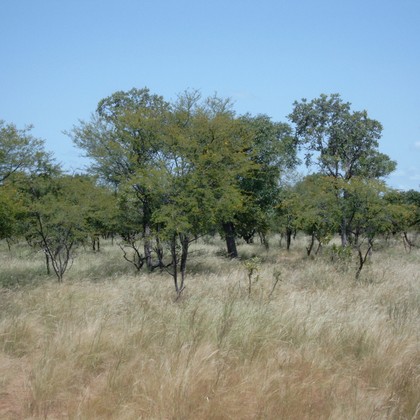
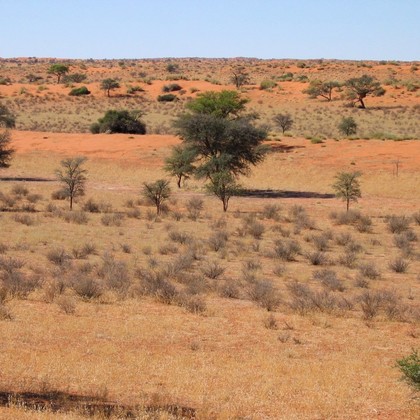
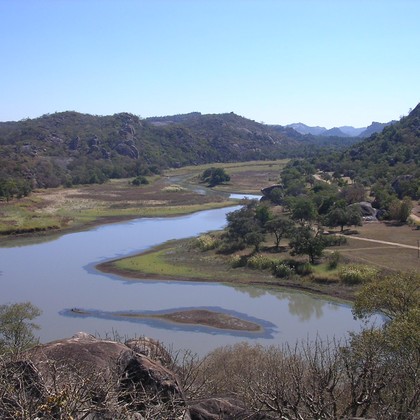
Dry to semi-arid woodland with dense scrub: acacia savanna and thornveld, Kalahari thornveld, mopane and mixed woodland, and thickets along rivers. It forages on the ground and in low shrubs for grasshoppers, beetles, caterpillars and other insects.
Where the bird is most at home, classified by the vegetation units of southern Africa.
Range and movements
Widespread in the north of the region: Angola, Zambia, Malawi, Mozambique, Zimbabwe, Botswana, northern and central Namibia, and in South Africa in Limpopo, Mpumalanga, North West, the north of the Northern Cape and northern KwaZulu-Natal; also in Eswatini. Absent from the Karoo, Lesotho and the Western and Eastern Cape. Beyond the region it ranges from Tanzania and Kenya west into central Africa.
- Resident
- Summer visitor (c. Oct–Mar)
- Winter visitor (c. Apr–Sep)
- Passage (Mar–Apr, Oct–Nov)
- dark = core range, pale = thinly spread
How and when to look
Year-round. Best seen in spring and early summer (September–December), when males make display flights above the scrub. Watch for the wing rattle and the descending whistles; afterwards the bird often dives into a bush, where it can be found on the ground with patience.
Conservation status
Not threatened; common over a large range and tolerant of moderately grazed and disturbed woodland. No large-scale threats are known.
Scientific name
Tchagra australis | (Smith, 1836)
Smith described the species in 1836 as Melaconotus australis; because it was later moved to another genus, the author and year stand in brackets. The genus Tchagra was introduced in 1831 by Lesson. Tchagra goes back to Levaillant's 'Tchagra' (1800), an imitation of the Southern Tchagra's incessant 'tch tcha tcha gra' calls. australis is Latin for 'southern'. The specimen the first description was based on came from north of Kurrichane (near Zeerust), North West, South Africa.