All species › Tubenoses › Petrels and shearwaters › Southern Giant Petrel
Southern Giant Petrel | Macronectes giganteus
Zuidelijke reuzenstormvogel | Abanto Marino Antártico
The Southern Giant Petrel is a petrel the size of a small albatross with the habits of a vulture: it scavenges on beaches and in penguin colonies and itself kills penguin chicks and other seabirds. With a huge, pale bill and a hunchbacked flight it is the largest petrel.
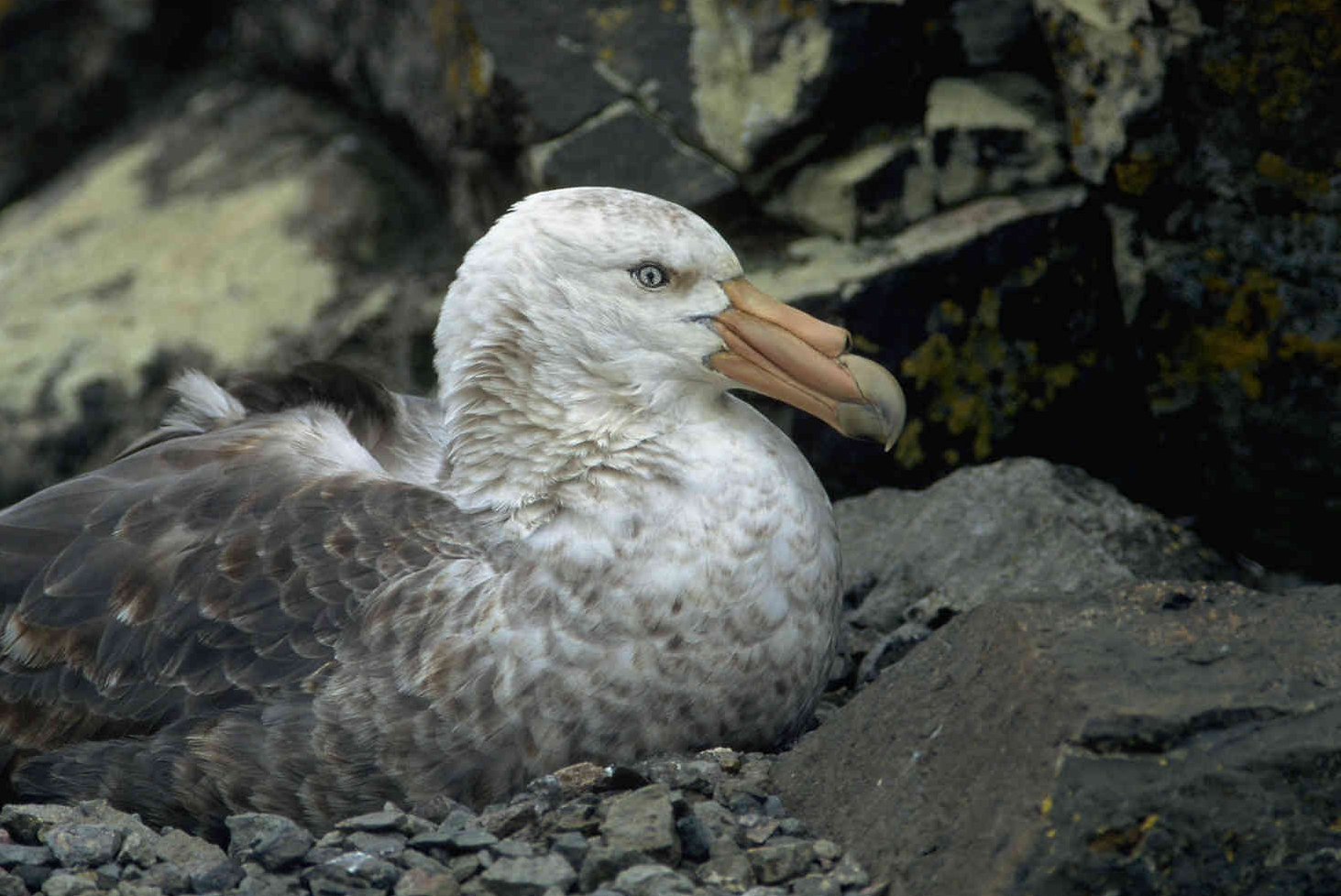
Colour forms

Voice
Largely silent at sea, but at carrion and offal a harsh braying croak and guttural grunts. Threatening birds spread the wings, thrust the head forward and give a raw, gurgling sound. At the colony cackling and whinnying calls.
No recording with a suitable Creative Commons licence is available for this species yet.
Identification
80–95 cm, wingspan over 2 m; males are markedly heavier than females. Adults of the normal morph are grey-brown with a pale, greyish-white head, neck and breast. The bill is massive, horn-yellow, with long tubed nostrils and a pale green tip. The eyes of adults are usually pale. A rare white morph is wholly white with a few dark flecks. Juveniles are uniform glossy blackish-brown and become paler with age. It flies on stiff, somewhat jerky wingbeats and long glides, with a humped back and drooping head; on the water it sits high.
Confusion species
The Northern Giant Petrel (Macronectes halli) is very similar; the best feature is the bill tip, which is pale green in Southern Giant Petrel and reddish-brown in Northern. Adult Southern birds also have a paler, greyish-white head and breast that contrasts more sharply, and only the southern species has a white morph. Juveniles of both species are uniform blackish-brown and often inseparable in the field. Dark young birds resemble a White-Chinned Petrel Procellaria aequinoctialis or a Sooty Albatross Phoebetria fusca, but those are slimmer and lack the heavy, pale tubenosed bill.
Habitat
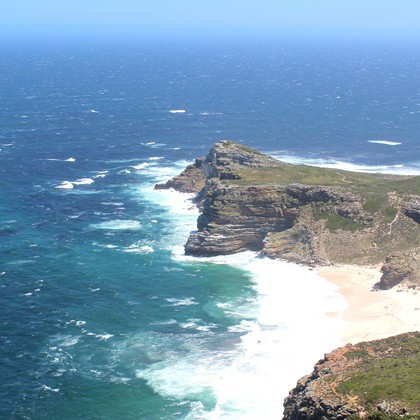
Open ocean, inshore waters and harbours; it also comes ashore on beaches, at seal colonies and in penguin colonies to scavenge. It follows fishing vessels for offal. It breeds in loose groups on open, flat ground on subantarctic and Antarctic islands.
Where the bird is most at home, classified by the vegetation units of southern Africa.
Range and movements
Breeds on Marion and Prince Edward Islands. Off the mainland mainly from May to October, commonest off the Western Cape, with mostly young birds moving along the west coast to Namibia and Angola and along the east coast to Mozambique. It also breeds circumpolarly, from the Antarctic Peninsula and the Falklands to South Georgia, Crozet, Kerguelen, Heard and Macquarie, and wanders over the whole Southern Ocean well into the subtropics.
- Resident
- dark = core range, pale = thinly spread
How and when to look
Most often seen from a pelagic boat out of Cape Town or Simon's Town, where both giant petrels appear behind trawlers in winter. Check the bill tip: in good light green versus reddish-brown can be seen at a few tens of metres. Also in harbours such as Hout Bay and along the Cape coast at seal colonies.
Conservation status
Not threatened, after an earlier listing as Vulnerable; the world population has increased, especially on the Falklands and South Georgia, while parts of Antarctica and some Indian Ocean islands declined. Bycatch in longline fisheries and disturbance of colonies are the main threats.
Scientific name
Macronectes giganteus | (Gmelin, 1789)
Gmelin described the species in 1789 as Procellaria gigantea; because it was later moved to another genus, the author and year stand in brackets. The genus Macronectes was introduced in 1905 by Richmond. Macronectes comes from the Greek makros, 'great', and nēktēs, 'swimmer' — 'great swimmer', for these huge petrels. giganteus is Latin for 'gigantic' — this petrel is the size of a small albatross. The specimen the first description was based on came from Staten Island (Isla de los Estados), Argentina.