All species › Passerines › Starlings › Slender-Billed Starling
Slender-Billed Starling | Onychognathus tenuirostris
Kaneelvleugelspreeuw | Estornino Picofino
The Slender-Billed Starling is a large, long-tailed red-winged starling of the East African highlands, which flies in flocks over montane grassland and waterfalls. In the region it reaches only the southern limit of its range, on the Nyika Plateau in northern Malawi and adjacent Zambia.
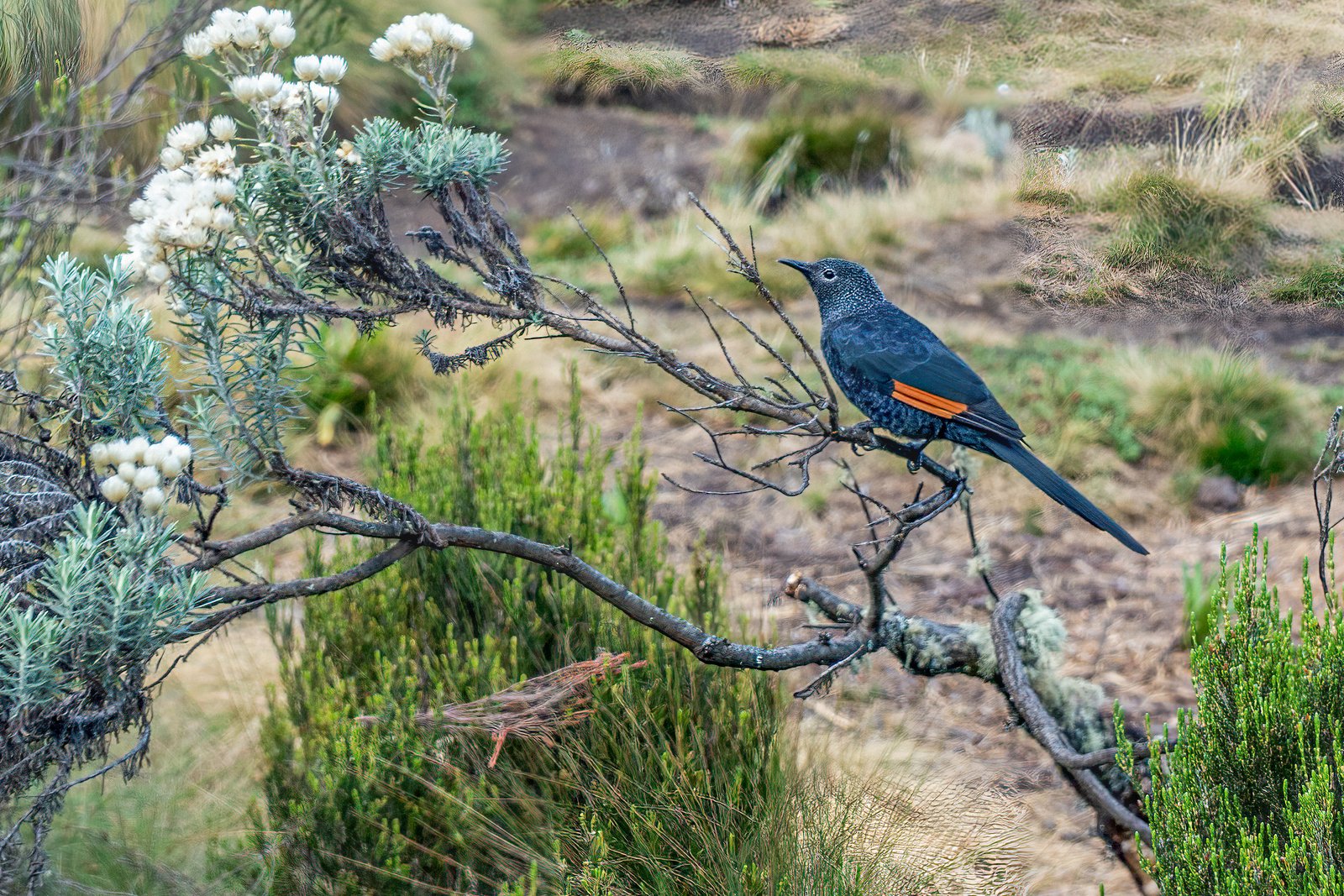
Click a thumbnail to switch the photo above.
Voice
Clear, melodious whistles, such as a rising chuwee and a falling cheeoo, often in flight, mixed with harsh rasping notes and long series of 'conversational' sounds in flocks.
Recording: Andrew Spencer — CC BY-NC-SA 4.0 · shortened to the first 60 s, mono · xeno-canto
Identification
31–35 cm, much of it tail. The male is glossy blue-black with a greenish sheen; the primaries are rufous with black tips and form a large cinnamon patch in flight. The tail is long, graduated and tapering to a point. The bill is strikingly long, thin and slightly curved, clearly slimmer than in other red-winged starlings. The female resembles the male but is duller, with grey feather tips on the head, neck and breast that give a greyish scaly look. The eye is dark. Juveniles are dull black with a shorter tail.
Confusion species
Red-Winged Starling Onychognathus morio has a shorter, less pointed tail and a clearly thicker bill; the female has a plain grey head rather than grey scaling. Waller's Starling Onychognathus walleri is much smaller, with a short tail, and lives in the canopy of montane forest. In all cases the long thin bill and long pointed tail are the best features, together with the behaviour at waterfalls.
Habitat
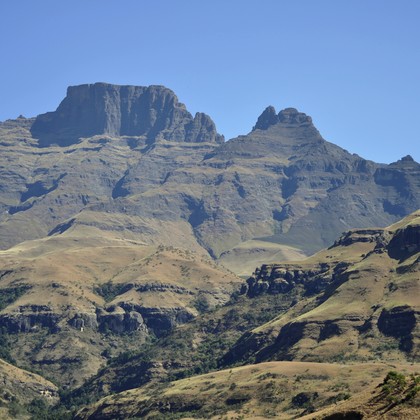
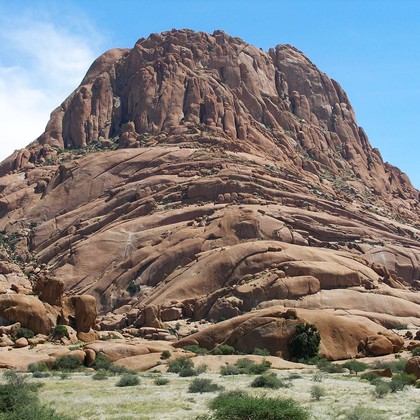
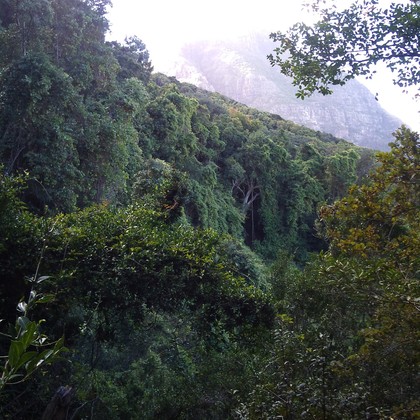
High montane grassland, heath and forest edges in the mountains, always near cliffs and waterfalls, roughly above 1800 m. It breeds colonially on ledges behind or beside waterfalls and on cliffs. It eats fruit, insects and nectar, and forages in flocks on the ground and in shrubs, at times around buildings.
Where the bird is most at home, classified by the vegetation units of southern Africa.
Range and movements
In the region only on the Nyika Plateau, in northern Malawi and adjacent north-eastern Zambia, where the population is small and local (subspecies theresae). Beyond the region in the highlands of Tanzania, Uganda, Kenya, Rwanda, Burundi and eastern DR Congo, and in Ethiopia and Eritrea (nominate form).
- Resident
- dark = core range, pale = thinly spread
How and when to look
All year, but only found on the Nyika Plateau. Search around waterfalls and cliffs, where birds fly back and forth in the morning and evening. Take time to check every red-winged starling for bill shape and tail length, since confusion with Red-Winged Starling is the obvious pitfall.
Conservation status
Not threatened; locally common in East Africa. In the region a very small, isolated population, sensitive to disturbance at breeding sites and to changes in montane grassland caused by fire.
Scientific name
Onychognathus tenuirostris | (Rüppell, 1836)
Rüppell described the species in 1836 as Lamprotornis tenuirostris; because it was later moved to another genus, the author and year stand in brackets. The genus Onychognathus was introduced in 1849 by Hartlaub. Onychognathus combines the Greek onyx 'nail, claw' and gnathos 'jaw'. tenuirostris is Latin for 'slender-billed', from tenuis, 'slender', and rostrum, 'bill'. The specimen the first description was based on came from Ethiopia (not further specified).