All species › Passerines › Starlings › Black-Bellied Starling
Black-Bellied Starling | Notopholia corusca
Zwartbuikglansspreeuw | Estornino Ventrinegro
Black-Bellied Starling is the smallest and darkest glossy starling of the region, an inhabitant of the coastal forests of eastern and south-eastern Africa. In poor light the gloss is barely visible, so that in the canopy it often simply looks black.
No photograph of a living wild bird of this species with a suitable Creative Commons licence exists. Do you have one that meets the rules? Send it in.
Voice
A continuous, rasping and chattering song of scratchy and whistled notes with imitations of other birds; the call is a harsh chrrr or a high cheek. Groups keep up a steady chatter in the canopy.
Recording: Walter Wallner — CC BY-NC-SA 4.0 · converted to mono · xeno-canto
Identification
18–21 cm, compact, with a fairly short tail. The male is blackish with a blue to purple-green gloss on the head, back, wings and breast; the belly is matt black and much duller, and the ear-coverts are dull too, so the whole bird looks dark. The eye is orange to yellow. The female is duller and browner black, with less gloss. Juveniles are dull brownish black with a dark eye. It lives in small groups in the canopy and is quick and restless.
Confusion species
Cape Starling Lamprotornis nitens is larger and brightly blue-green glossed all over, with a yellow eye and a small reddish shoulder patch; it lives in open woodland, not dense coastal forest. Greater Blue-Eared Starling Lamprotornis chalybaeus is also larger, with a dark blue ear patch and a glossy belly. The female Violet-Backed Starling Cinnyricinclus leucogaster is brown with streaked underparts. The dark belly, life in dense coastal forest and the creaky, chattering song are the best features.
Habitat
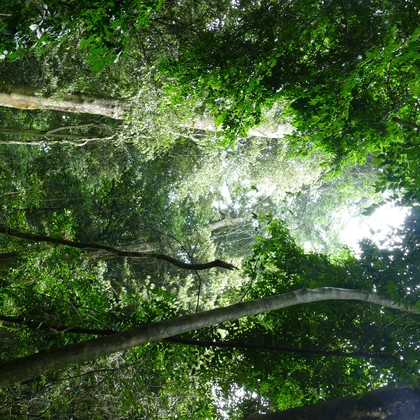
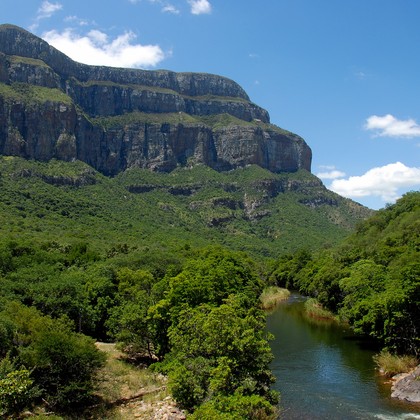
Coastal forest, dune forest, riverine forest, lowland forest and forest–savanna mosaic, also plantations, large gardens and parks with fruiting trees. It feeds in the crowns on fruit, berries and insects, often together with bulbuls and other frugivores. It nests in tree holes, including old woodpecker and barbet holes.
Where the bird is most at home, classified by the vegetation units of southern Africa.
Range and movements
Within the region along the coast and coastal plain of the Eastern Cape (from around East London) through KwaZulu-Natal to eastern Eswatini and over much of the coastal plain and lowlands of Mozambique; rare in the extreme east of Zimbabwe. Outside the breeding season groups wander along the coast and inland. Beyond the region north along the East African coast through Tanzania and Kenya to southern Somalia.
- Resident
- Summer visitor (c. Oct–Mar)
- Winter visitor (c. Apr–Sep)
- Passage (Mar–Apr, Oct–Nov)
- dark = core range, pale = thinly spread
How and when to look
Year-round, but more nomadic in winter. Good sites are the coastal forests of iSimangaliso (St Lucia, Cape Vidal), Mtunzini, the dune forests around Durban and the Maputo area. Look for small dark starlings flying in fast groups from crown to crown and listen for the creaky, chattering song.
Conservation status
Not threatened and fairly common in suitable coastal forest. The loss of coastal forest to development and agriculture affects it locally, but it also uses gardens and plantations.
Scientific name
Notopholia corusca | (Nordmann, 1835) (GBIF: Notopholia corrusca)
Nordmann described the species in 1835 as L[amprotornis] corrusca; because it was later moved to another genus, the author and year stand in brackets. The genus Notopholia was introduced in 1922 by Roberts. Notopholia comes from the Greek notos, 'south', and the starling genus Pholia — a 'southern Pholia'; Roberts separated the species in 1922 for its short, broad bill and smaller size. corusca comes from the Latin coruscus, 'flashing, glittering' — for the glossy plumage; Nordmann originally spelled it corrusca. The specimen the first description was based on came from southern Africa (probably the eastern Cape Colony).