All species › Passerines › Larks › Sclater's Lark
Sclater's Lark | Spizocorys sclateri
Namaqualeeuwerik | Alondra de Sclater
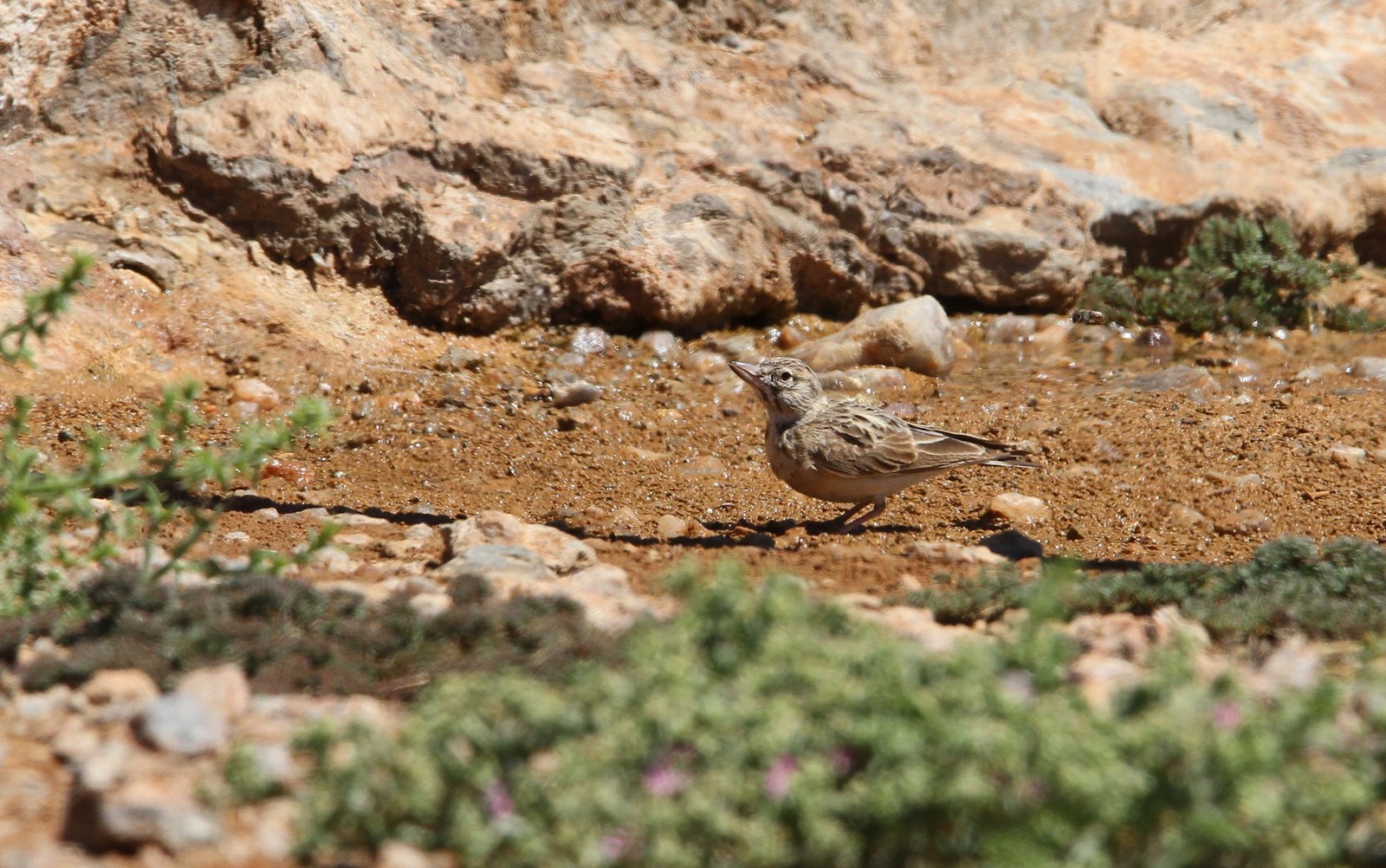
Sclater's Lark is a stocky, big-headed lark with a heavy bill, typical of the bare stony plains of Bushmanland and southern Namibia. It wanders in small groups, is shy and cryptic, and is most often seen when it comes to drink in the morning.
Voice
The call, mainly in flight, is a soft, disyllabic chweet or chree-chree. The song is a short, simple series of squeaky and twittering notes, usually in a low display flight. Birds coming to drink often call on approach.
Recording: Alan Collett — CC BY-NC-SA 4.0 · converted to mono · xeno-canto
Identification
13–14 cm. Compact, with a large head, a short tail and a thick, conical bill that is horn to pale yellowish-pink. The face is pale, with a striking dark, vertical teardrop mark below the eye and a pale supercilium. The upperparts are grey-brown to reddish-brown with dark streaks, matching the red or grey stony ground. The underparts are pale buff to white with fine streaks on the breast. The tail is dark with white outer feathers. Sexes alike.
Confusion species
Stark's Lark Spizocorys starki is paler, with an obvious crest, a finer pink bill and no teardrop. Pink-Billed Lark Spizocorys conirostris is warmer brown, lacks a teardrop and lives in grassland. Female sparrow-larks, such as Grey-Backed Sparrow-Lark Eremopterix verticalis and Black-Eared Sparrow-Lark Eremopterix australis, have a heavier, greyer bill and a dark belly patch without a teardrop. Lark-Like Bunting Emberiza impetuani is a bunting with a plain face and a finer bill that drinks on the same plains.
Habitat
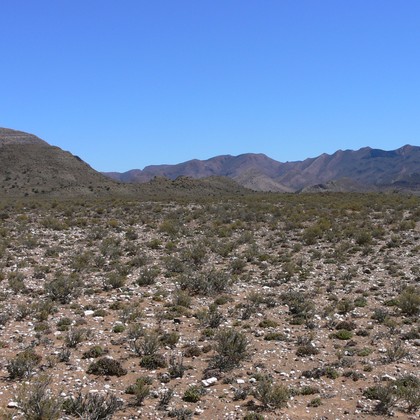
Bare, stony plains and low ridges with scattered dwarf shrubs and little grass in the dry Nama Karoo, often on red or dark stony soils. Nomadic; after rain sometimes also on plains with fresh grass. It depends on drinking water daily and visits livestock water points mainly in mid-morning.
Where the bird is most at home, classified by the vegetation units of southern Africa.
Range and movements
Endemic to the west of southern Africa. In South Africa in Bushmanland and the western Karoo in the Northern Cape, for example around Brandvlei, Kenhardt, Pofadder and Loeriesfontein, with extensions into the Western Cape. In Namibia in the south, in the Karas Region and southern Hardap. Not known outside the region.
- Resident
- Summer visitor (c. Oct–Mar)
- Passage (Mar–Apr, Oct–Nov)
- dark = core range, pale = thinly spread
How and when to look
In Bushmanland, on a warm morning between about nine and eleven, wait at a livestock water trough or dam, staying quietly in the car; groups of larks arrive to drink in waves. Look for the teardrop below the eye and the heavy bill. Numbers vary greatly from year to year; ask local birders where the last rain fell.
Conservation status
Near Threatened. The range is limited and numbers appear to be slowly declining. Overgrazing, development of solar and wind farms and mining on the stony plains, and a drier future under climate change are the main threats.
Scientific name
Spizocorys sclateri | (Shelley, 1902)
Shelley described the species in 1902 as Calandrella sclateri; because it was later moved to another genus, the author and year stand in brackets. The genus Spizocorys was introduced in 1872 by Sundevall. Spizocorys comes from the Greek spiza, 'finch', and korudos, 'crested lark' — for the short, finch-like bill of these small larks. sclateri honours the English ornithologist Philip Lutley Sclater (1829–1913). The specimen the first description was based on came from Hountop River, Great Namaqualand, Namibia.