All species › Passerines › Sunbirds › Scarlet-Tufted Sunbird
Scarlet-Tufted Sunbird | Nectarinia johnstoni
Lobeliahoningzuiger | Suimanga de Johnston
The Scarlet-Tufted Sunbird is a large, very long-tailed sunbird of the highest montane grasslands. In the region it lives only on the Nyika Plateau and the Mafinga Hills on the border of Malawi and Zambia.

Click a thumbnail to switch the photo above.
Voice
A hard metallic tchik or tchuk, often repeated during chases, and a dry rattling alarm. The song is a fast, high, scratchy twitter, often given from a protea or a projecting rock.
Recording: David C. Moyer — CC BY-NC-SA 4.0 · converted to mono · xeno-canto
Identification
The male measures 25 to 28 cm, much of it made up by the two long central tail feathers; the female is about 15 cm. The breeding male is deep metallic green with a blue sheen, blackish wings and tail, and scarlet pectoral tufts that fan out in display. In eclipse plumage the male is dark brown with green wing coverts and rump, and often still has the long tail. The female is dark grey-brown, slightly paler and faintly scaled below, with a dark tail and red pectoral tufts that are sometimes visible. The bill is long and decurved.
Confusion species
Malachite Sunbird (Nectarinia famosa), which also occurs on Nyika, is a paler, more yellowish green, has a shorter tail and yellow pectoral tufts; its female is olive and yellowish below. The male Bronze Sunbird (Nectarinia kilimensis) looks black with a coppery-bronze gloss, lacks tufts and lives lower down on forest edges. Females are best told by the dark, virtually unstreaked underparts of this species.
Habitat
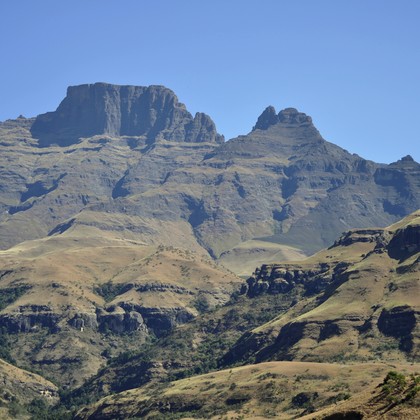
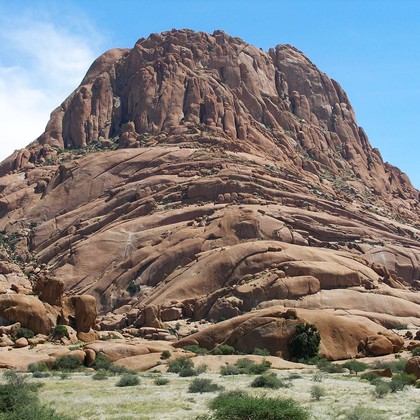
Montane grassland and heath above about 2,000 m, with scattered proteas, Leonotis, lobelias and shrubs along stream valleys and forest edges. It fiercely defends flowering shrubs against other sunbirds and also hawks many insects in flight.
Where the bird is most at home, classified by the vegetation units of southern Africa.
Range and movements
Within the region confined to the Nyika Plateau in northern Malawi and adjacent Zambia, and the Mafinga Hills on the same border. Beyond the region it occurs on the high mountains of Tanzania, Kenya, Uganda, Rwanda and eastern DR Congo, up into the alpine zone of Kilimanjaro and Mount Kenya.
- Resident
- dark = core range, pale = thinly spread
How and when to look
On Nyika it is best looked for among the proteas and at the grassland-forest transitions around Chelinda, especially in the months when proteas and Leonotis are in flower. The male stands out by its long tail trailing behind in flight; wait until it opens its wings to see the red tufts.
Conservation status
Not threatened. The global range is fragmented across mountaintops but well protected. The small population in the region lies largely within Nyika National Park; overly frequent burning of the grassland can locally damage the nectar plants.
Scientific name
Nectarinia johnstoni | Shelley, 1885
Shelley described the species in 1885 and placed it straight away in the genus where it still stands. The genus Nectarinia was introduced in 1811 by Illiger. Nectarinia derives from the Greek nektar, the drink of the gods in Greek mythology, via nektarinos, 'of nectar' — for the flower nectar on which sunbirds feed. johnstoni honours the British explorer and colonial administrator Sir Harry Hamilton Johnston (1858–1927), who collected on Kilimanjaro in 1884. The specimen the first description was based on came from Kilimanjaro, Tanzania (c. 3,350 m).