All species › Passerines › Sunbirds › Malachite Sunbird
Malachite Sunbird | Nectarinia famosa
Emeraldhoningzuiger | Suimanga Malaquita
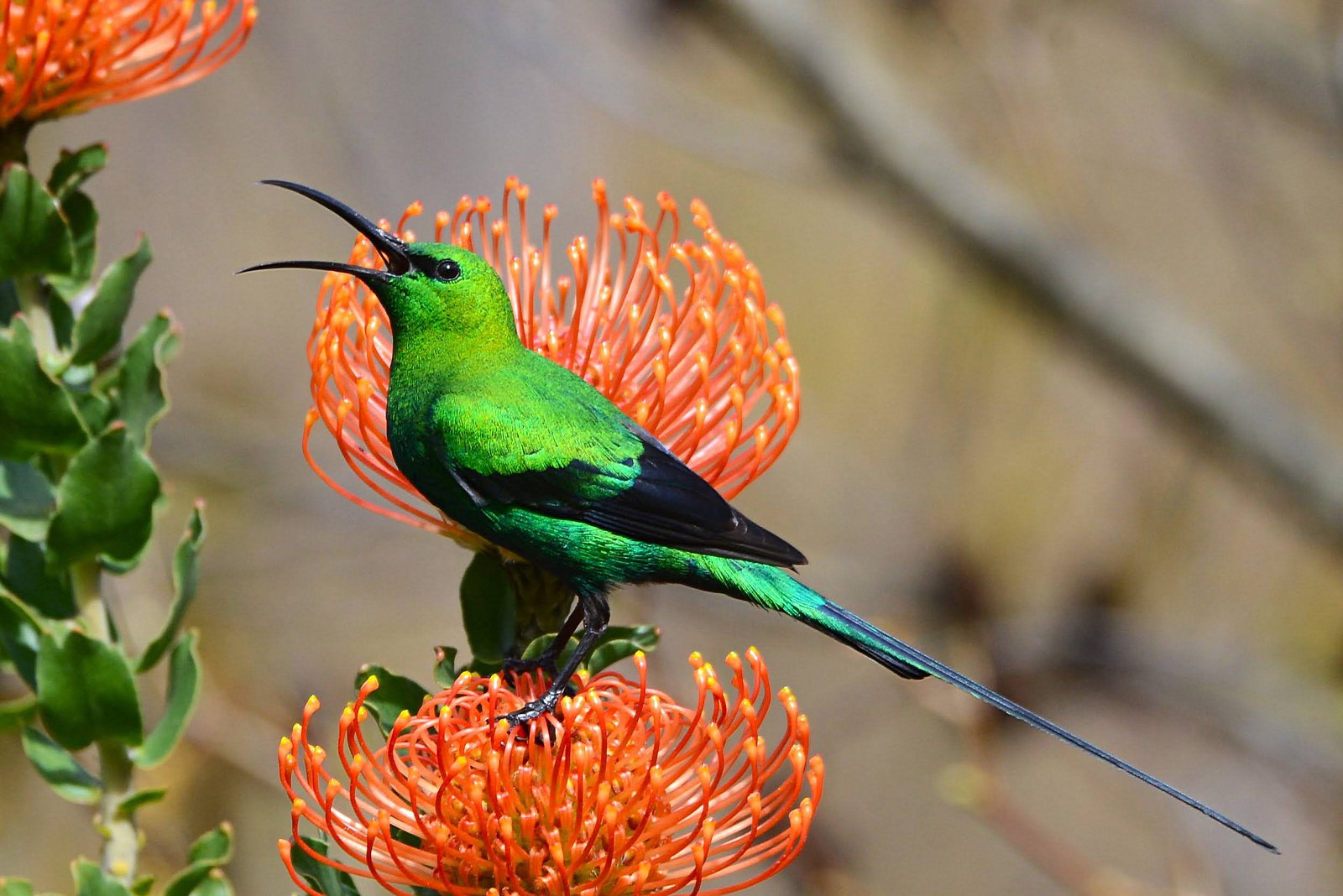
The Malachite Sunbird is the large, long-tailed sunbird of fynbos, montane grassland and aloe slopes. The breeding male is entirely glossy emerald-green with two long central tail feathers; outside the breeding season it resembles the much duller female.
Click a thumbnail to switch the photo above.
Voice
A loud, sharp tseep-tseep contact note, often during chases. The song is a rapid, scratchy twitter of high chirping notes, delivered from a high lookout or a flowering aloe. Males also sing in a short display flight.
Recording: Walter Wallner — CC BY-NC-SA 4.0 · shortened to the first 60 s, mono · xeno-canto
Identification
The male measures 22 to 25 cm including the elongated tail feathers, the female about 15 cm. The breeding male is wholly metallic green with a golden-bronze sheen, blackish wings and tail, and yellow pectoral tufts that show in display. In eclipse plumage, roughly March to July, the male is brown with scattered green feathers but keeps the green wing coverts and often the long tail. The female is olive-brown above and dingy yellow below with faint mottling, with a narrow pale supercilium and a dark loral stripe. The long, decurved bill and upright stance are distinctive in every plumage.
Confusion species
Bronze Sunbird (Nectarinia kilimensis) of the eastern highlands of Zimbabwe and further north looks black in the field with a coppery-bronze gloss and lacks yellow pectoral tufts; the female is clearly yellowish and streaked below. Scarlet-Tufted Sunbird (Nectarinia johnstoni) of the Nyika Plateau is darker green, has an even longer tail and scarlet pectoral tufts. Females of Southern Double-Collared Sunbird (Cinnyris chalybeus) and Orange-Breasted Sunbird (Anthobaphes violacea) are smaller, shorter-billed and greyer.
Habitat
Fynbos with proteas and ericas, montane grassland with rocks and shrubs, karoo scrub along rivers, aloe slopes, forest edges and gardens. It fiercely defends flowering proteas, aloes and Leonotis, and also hawks many insects in flight. It breeds in spring and summer; the nest often hangs low in a bush over water.
Where the bird is most at home, classified by the vegetation units of southern Africa.

Range and movements
Widespread in South Africa, from the Western Cape through the Karoo and the Eastern Cape to the Drakensberg, the Highveld and Mpumalanga, and in Lesotho, Eswatini and the far south of Namibia. Separate montane populations live in the eastern highlands of Zimbabwe and adjacent Mozambique, and on the Nyika Plateau and the Mafinga Hills of Malawi and Zambia. Beyond the region it occurs in the highlands of East Africa north to Ethiopia and Eritrea.
- Resident
- Summer visitor (c. Oct–Mar)
- Winter visitor (c. Apr–Sep)
- dark = core range, pale = thinly spread
How and when to look
In the Cape and the Drakensberg, look in winter at flowering aloes, where several males chase one another noisily. In summer it is best found in high-altitude fynbos and montane grassland on flowering Leonotis and proteas. A plain brown bird with green wing coverts is likely an eclipse male.
Conservation status
Not threatened. The species is common over a large range and benefits locally from gardens with aloes and other nectar plants. It disappears locally where montane grassland and fynbos are converted to plantations or burnt too often.
Scientific name
Nectarinia famosa | (Linnaeus, 1766)
Linnaeus described the species in 1766 as Certhia famosa; because it was later moved to another genus, the author and year stand in brackets. The genus Nectarinia was introduced in 1811 by Illiger. Nectarinia derives from the Greek nektar, the drink of the gods in Greek mythology, via nektarinos, 'of nectar' — for the flower nectar on which sunbirds feed. famosa is Latin for 'famous, splendid', for the male's brilliant glossy green plumage. The specimen the first description was based on came from Cape of Good Hope.