All species › Tubenoses › Albatrosses › Salvin's Albatross
Salvin's Albatross | Thalassarche salvini
Salvins albatros | Albatros de Salvin
Salvin's Albatross is a large mollymawk of the shy albatross group that breeds on rocky islands south of New Zealand and in small numbers on Crozet. Off southern Africa it is a rare visitor among the Shy and Black-Browed Albatrosses at the trawlers, and a prized species on any pelagic trip.
Voice
At trawlers cackling and croaking calls; at the colony hoarse braying and bill-clapping.
Recording: Dan Lane — CC BY-NC-SA 4.0 · converted to mono · xeno-canto
Identification
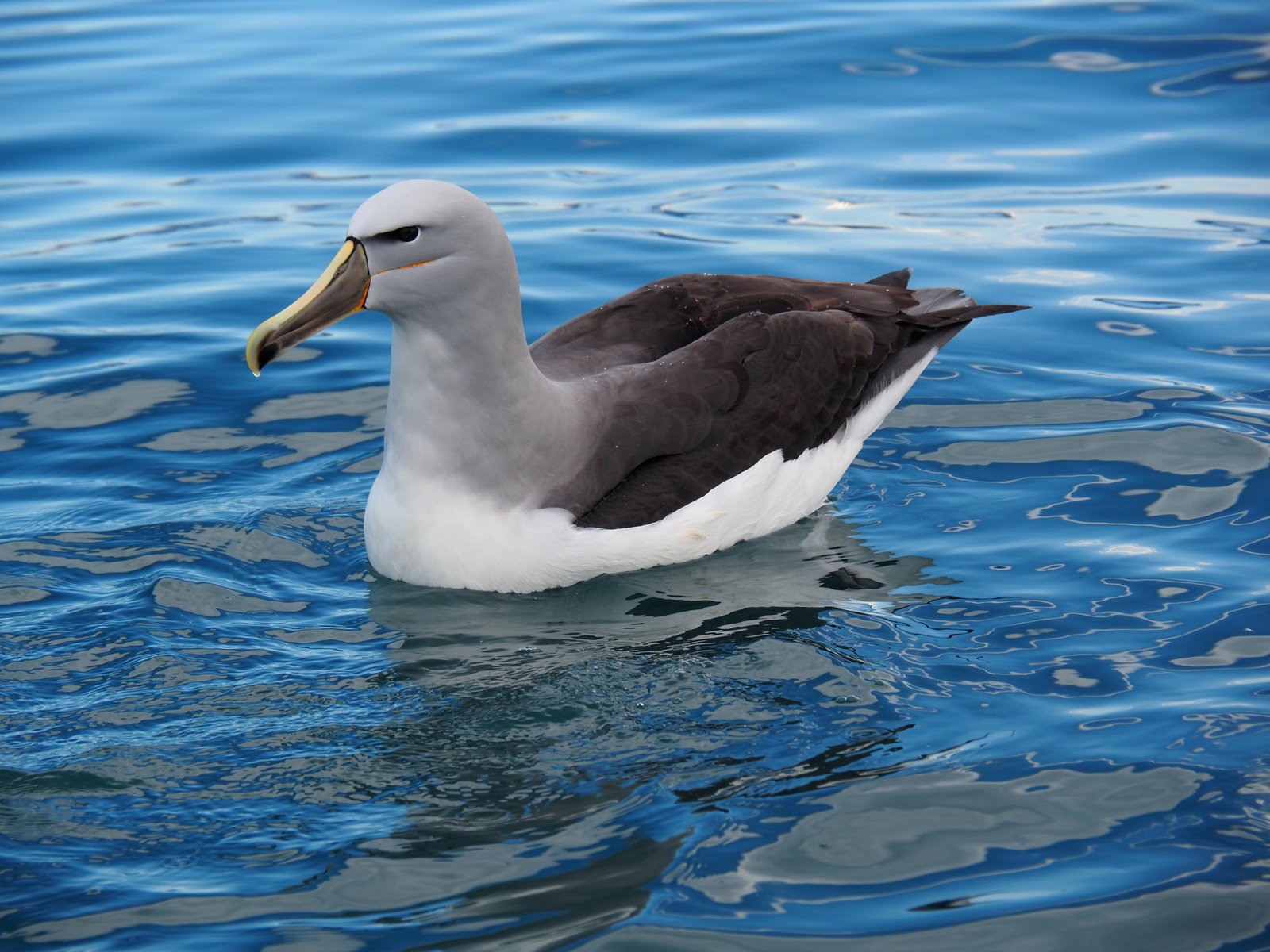
90–100 cm, wingspan 2.1–2.5 m. Built like the Shy Albatross, but with the head and neck washed greyish brown, so that only the forehead and forecrown are paler; the grey hood extends as a collar onto the upper breast. Mantle and upperwing are dark greyish brown, rump and underparts white. The underwing is white with narrow black margins, a black thumbprint at the axilla and slightly more black at the primary tips than in Shy. The bill is olive-grey with a pale yellow ridge and upper tip and a dark spot at the tip of the lower mandible. Juveniles have a greyer bill with a black tip and closely resemble young Shy Albatrosses.
Confusion species
The Shy Albatross (Thalassarche cauta) has a white head with only a pale grey wash on the cheeks and a grey bill with a yellow tip, without a dark spot on the lower mandible. The Grey-Headed Albatross (Thalassarche chrysostoma) is smaller, with a black bill with yellow edges and an underwing with a broad black leading edge. Immature Shy Albatrosses with a grey head can closely resemble this species; judge bill colour and the contrast between forehead and cheeks on photographs.
Habitat
Open sea, especially over the shelf edge and deep water, where it follows trawlers and longliners with other albatrosses. It eats fish and squid. It breeds on bare, steep rocky islands without vegetation.
Where the bird is most at home, classified by the vegetation units of southern Africa.
Range and movements
Rare but almost annual at sea off the Western Cape, mainly at the trawlers beyond the shelf off Cape Town; a few records off Namibia and along the south coast. It breeds mainly on the Bounty Islands and the Snares off New Zealand, with a small colony on Crozet; outside the breeding season it forages mainly in the Humboldt Current off Peru and Chile.
How and when to look
On winter pelagic trips from Cape Town check every Shy Albatross that seems to have a dark head or neck. A grey hood down onto the breast, a pale forehead and an olive-grey bill with a dark spot on the lower mandible point to Salvin's Albatross. Take close photographs of the bill; without evidence a record is usually not accepted.
Conservation status
Vulnerable. Almost the entire world population breeds on one small island group, so storms, disease or a disaster there would have major consequences. The main threat at sea is bycatch in longline and trawl fisheries, especially off South America and New Zealand.
Scientific name
Thalassarche salvini | (Rothschild, 1893)
Rothschild described the species in 1893 as Thalassogeron salvini; because it was later moved to another genus, the author and year stand in brackets. The genus Thalassarche was introduced in 1853 by Reichenbach. Thalassarche comes from the Greek thalassa, 'sea', and arkhos, 'ruler' — 'ruler of the sea', for these masterly gliders of the open ocean. salvini honours the English ornithologist Osbert Salvin (1835–1898), known for his work on the birds of Central America and on petrels. The specimen the first description was based on came from New Zealand (not specified).