All species › Passerines › Larks › Sabota Lark
Sabota Lark | Calendulauda sabota
Sabotaleeuwerik | Alondra Sabota
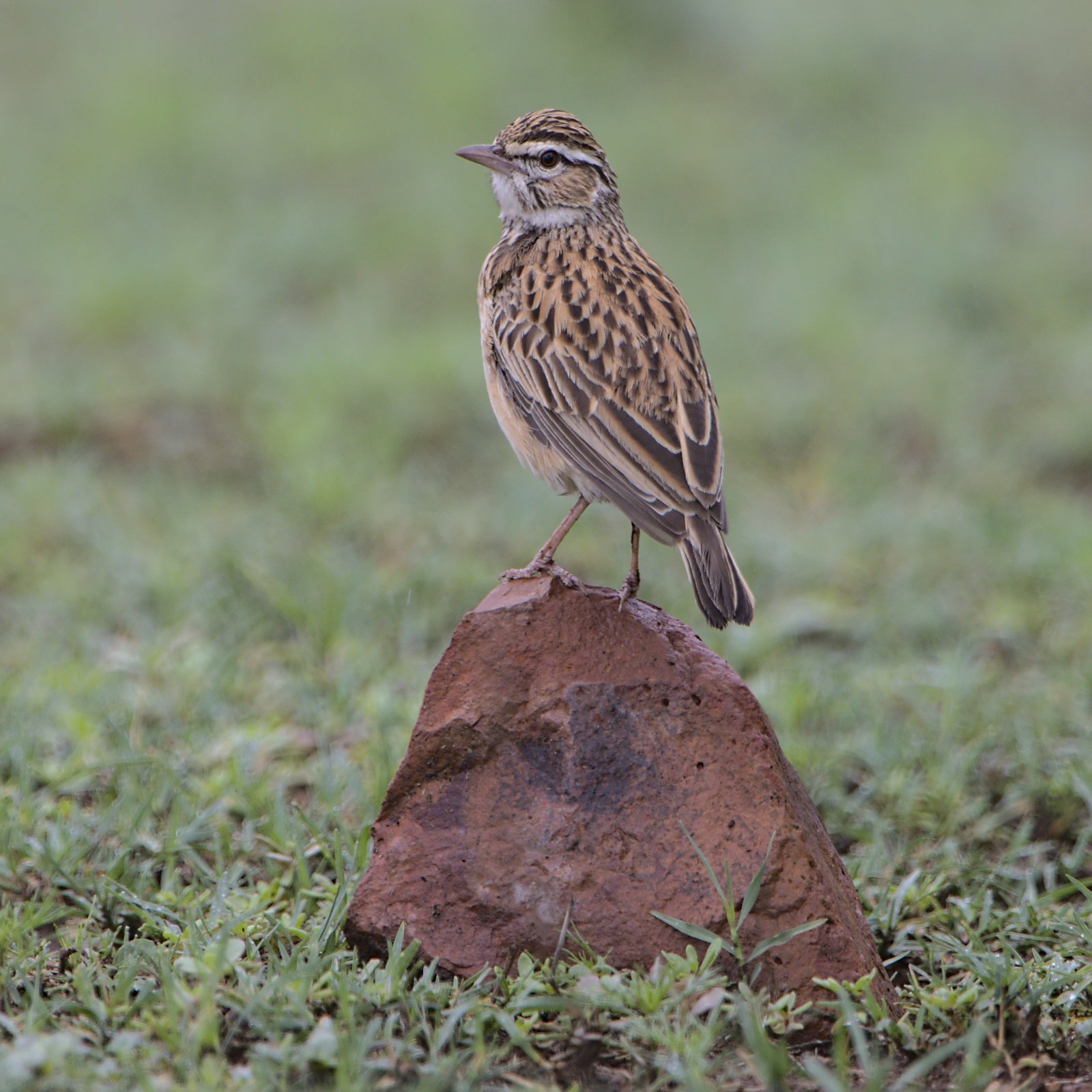
The Sabota Lark is the common lark of dry woodland and thornveld: a streaked, brown lark with a broad white supercilium that delivers a lively, heavily mimetic song from a bush top. It is nearly endemic to southern Africa and shows strikingly different bill shapes.
Voice
A rich, loud and varied song of short whistled and chirping phrases, often with much mimicry of other species, delivered from a bush, post or termite mound and sometimes in a short song flight. A typical motif is a clear chip-chip-cheeree-chew.
Recording: Niall Perrins — CC BY-NC-SA 4.0 · converted to mono · xeno-canto
Identification
14–15 cm. Upperparts brown to grey-brown with dark streaking, the crown finely streaked. The long white supercilium runs back to the nape and is set off by a dark eye-stripe and a dark moustachial stripe. White below with a buff breast and distinct dark streaks on the breast. No rufous in the wing. In the west (Namibia, south-western Angola, the Kalahari) there are forms with a short, thick, almost finch-like bill; in the east the bill is slimmer.
Confusion species
Fawn-Colored Lark Calendulauda africanoides is more rufous or sandy above, cleaner white below with at most fine streaks on the upper breast, and lives on deep sand. Rufous-Naped Lark Corypha africana has a small crest, a rufous nape and clearly rufous wings. Monotonous Lark Mirafra passerina also has rufous wings and sings a monotonous, repeated ditty. When in doubt, the song decides.
Habitat
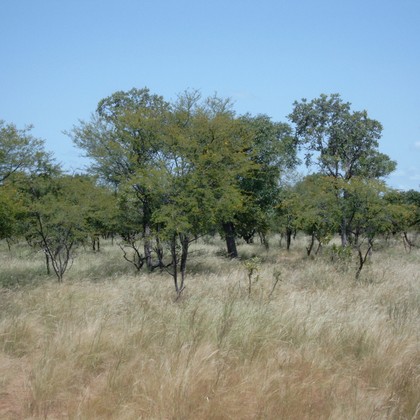
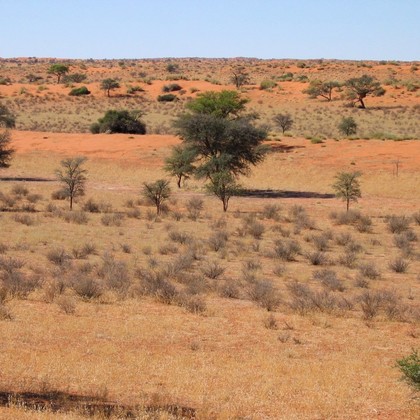
Dry, open woodland and thornveld with bare ground and scattered bushes, mopane, rocky hillsides with scrub and the edges of the Kalahari. It avoids dense woodland and open grassland without bushes. It forages on the ground for insects and seeds.
Where the bird is most at home, classified by the vegetation units of southern Africa.

Range and movements
Within the region in Namibia (except the bare Namib), south-western Angola, Botswana, southern and western Zimbabwe, southern Mozambique and northern South Africa (Limpopo, Mpumalanga, North West, Gauteng and the Northern Cape), with an extension into the Free State and Eswatini. Not found beyond: nearly endemic to southern Africa.
- Resident
- Summer visitor (c. Oct–Mar)
- Winter visitor (c. Apr–Sep)
- Passage (Mar–Apr, Oct–Nov)
- dark = core range, pale = thinly spread
How and when to look
Year-round; best in early spring and summer, when males sing from bush tops. Listen for a lark imitating all sorts of other birds: in dry woodland this is almost always this species. Note the lack of rufous in the wing.
Conservation status
Not threatened; common and widespread. The species tolerates grazing and some bush encroachment well and faces no significant threats.
Scientific name
Calendulauda sabota | (Smith, 1836)
Smith described the species in 1836 as Mirafra Sabota; because it was later moved to another genus, the author and year stand in brackets. The genus Calendulauda was introduced in 1855 by Blyth. Calendulauda is a combination of two other lark names: Calendula and Alauda, the Latin word for 'lark'. sabota derives from sebotha or sebothé, the general Tswana name for a lark, adopted by Andrew Smith. The specimen the first description was based on came from between Latakoo (near Kuruman, South Africa) and the Tropic of Capricorn.