All species › Passerines › Larks › Fawn-Colored Lark
Fawn-Colored Lark | Calendulauda africanoides
Savanneleeuwerik | Alondra Leonada
The Fawn-Colored Lark is the lark of the Kalahari sands: a slim, sandy to rufous lark with a white supercilium and clean white underparts. It often sings from the top of a tree or bush, unusually high for a lark, delivering a busy, rattling song.

Voice
A rapid, rattling and somewhat harsh series of chirping notes ending in a buzzy trill, chip-chip-chrrrrr-cheeoo, delivered from a tree or bush top or in a short song flight in which the male flutters up and then drops. Call: a dry cheet.
Recording: Campbell Fleming — CC BY-NC-SA 4.0 · converted to mono · xeno-canto
Identification
15–16 cm. Upperparts sandy brown to rufous, strikingly rufous in the Kalahari and greyer in the east, with fine dark streaking. Clear white supercilium, dark eye-stripe and pale cheek. White below, with a buff wash and fine short streaks on the upper breast; the rest of the underparts unstreaked. Little rufous in the wing. The bill is fairly slender and the tail relatively long.
Confusion species
Sabota Lark Calendulauda sabota is browner and less rufous above, has a more heavily streaked breast and lives on harder, stony ground; it mimics many other birds. Rufous-Naped Lark Corypha africana is bulkier, with a small crest and rufous wings. Red Lark Calendulauda burra of Bushmanland is larger and plain rufous with a heavier bill.
Habitat
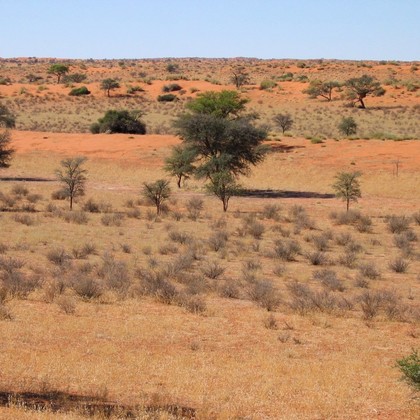
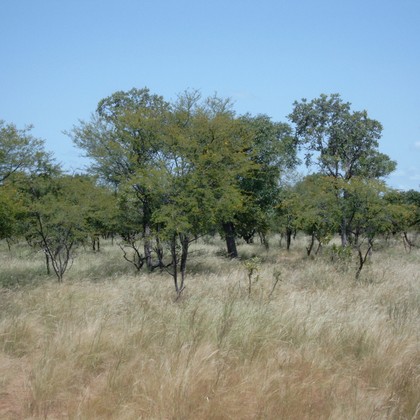
Open woodland and thornveld on deep, loose sand, especially Kalahari sand with scattered trees, shrubs and grass tufts; also open miombo on sand. It forages under bushes and among grass on the ground, and flies up into a tree when disturbed.
Where the bird is most at home, classified by the vegetation units of southern Africa.
Range and movements
Within the region in Botswana, Namibia (mainly the north, east and Kalahari), southern and eastern Angola, western Zambia, western and southern Zimbabwe, south-western Mozambique and northern South Africa (Northern Cape, North West and Limpopo). Beyond, isolated populations in East Africa (Kenya, Tanzania), sometimes treated as a separate species Calendulauda alopex.
- Resident
- Summer visitor (c. Oct–Mar)
- Winter visitor (c. Apr–Sep)
- Passage (Mar–Apr, Oct–Nov)
- dark = core range, pale = thinly spread
How and when to look
Year-round. In the Kalahari, for example in Kgalagadi Transfrontier Park and the Central Kalahari Game Reserve, often seen on treetops along the roads. Listen for the rattling song with its buzzy ending and note the clean white belly; Sabota Lark usually perches on lower bushes on harder ground.
Conservation status
Not threatened; common in suitable habitat. Bush encroachment through overgrazing in the Kalahari is altering its habitat, but the species tolerates this reasonably well.
Scientific name
Calendulauda africanoides | (Smith, 1836)
Smith described the species in 1836 as Mirafra africanoides; because it was later moved to another genus, the author and year stand in brackets. The genus Calendulauda was introduced in 1855 by Blyth. Calendulauda is a combination of two other lark names: Calendula and Alauda, the Latin word for 'lark'. africanoides means 'resembling africana' (Greek -oidēs, 'like') — for its resemblance to Rufous-naped Lark, Corypha africana. The specimen the first description was based on came from eastern Cape Colony and the country towards Latakoo, South Africa.