All species › Passerines › Starlings › Red-Winged Starling
Red-Winged Starling | Onychognathus morio
Roodvleugelspreeuw | Estornino Alirrojo
Red-Winged Starling is a large, long-tailed starling with rufous primaries, of rocks, cliffs and increasingly of towns in the east and south of the region. Its clear whistled call belongs to mountain passes and city centres from Cape Town to Harare.

Click a thumbnail to switch the photo above.
Voice
The familiar call is a loud, pure, descending whistle, cher-leeeoo, often in flight and in duet by pairs. The song is a melodious, varied warbling of whistles; in alarm a harsh charrr.
Recording: Walter Wallner — CC BY-NC-SA 4.0 · shortened to the first 60 s, mono · xeno-canto
Identification
27–30 cm, with a long, graduated tail. The male is black with a blue-purple gloss; the female has an ash-grey head, neck and breast with fine dark streaks and a greenish gloss. In both sexes the primaries are rufous with black tips, showing as a narrow rusty edge on the perched bird and as a broad, glowing wing patch in flight. The eye is dark red, the bill and legs black. Juveniles resemble the male but are duller, with a brown eye. Outside the breeding season it forms flocks, sometimes hundreds at communal roosts on cliffs or buildings.
Confusion species
Pale-Winged Starling Onychognathus nabouroup has an orange eye and pale, almost white primaries, and both sexes are black; the two meet in the eastern Karoo and southern Namibia. In northern Malawi Slender-Billed Starling Onychognathus tenuirostris (long, thin bill and a long, pointed tail; often at waterfalls) and Waller's Starling Onychognathus walleri (much smaller, short-tailed, in montane forest) also have rufous wings. Common Myna Acridotheres tristis in towns shows white, not rufous, wing patches and has a yellow bill.
Habitat
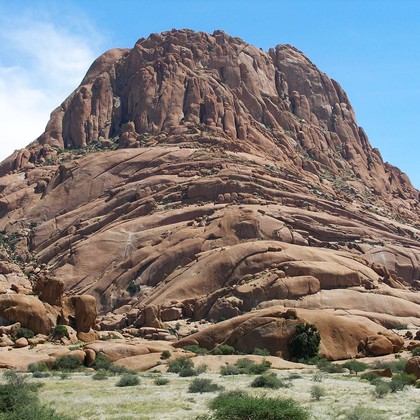
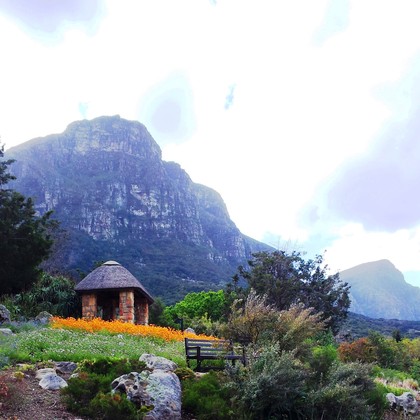
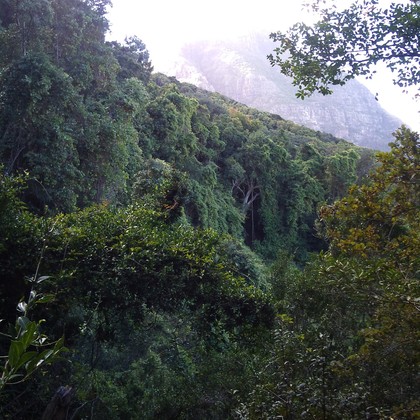
Cliffs, gorges, rocky hills and mountains from sea level to high in the Drakensberg, also forest edges and open woodland near rocks. It has become closely tied to people: it breeds on tall buildings, bridges and in gutters and forages in parks, gardens and markets. It eats fruit, nectar, insects and scraps and sometimes picks ticks from large mammals.
Where the bird is most at home, classified by the vegetation units of southern Africa.
Range and movements
In the east and south of the region: South Africa except the driest parts of the Northern Cape, Lesotho, Eswatini, locally eastern Botswana, Zimbabwe, Mozambique (mainly the interior and hills), Malawi and eastern Zambia. It is virtually absent from Namibia and Angola. Beyond the region north through East Africa to Ethiopia and Eritrea.
- Resident
- Winter visitor (c. Apr–Sep)
- Passage (Mar–Apr, Oct–Nov)
- dark = core range, pale = thinly spread
How and when to look
Year-round and regularly seen in many towns, such as Cape Town (Table Mountain, Kirstenbosch), Pretoria, Harare and Blantyre. In the mountains it is heard before it is seen; the whistle and the rufous wing patch in flight together are decisive. In flocks, look for the grey heads of the females.
Conservation status
Not threatened, common and increasing in southern Africa as it has taken to buildings as nest sites. It is sometimes regarded as a pest by fruit growers.
Scientific name
Onychognathus morio | (Linnaeus, 1766)
Linnaeus described the species in 1766 as Turdus morio; because it was later moved to another genus, the author and year stand in brackets. The genus Onychognathus was introduced in 1849 by Hartlaub. Onychognathus combines the Greek onyx 'nail, claw' and gnathos 'jaw'. morio (or morion) is Latin for a dark brown stone or black quartz — for the glossy black plumage. The specimen the first description was based on came from Cape of Good Hope.