All species › Woodpeckers and allies › Woodpeckers › Red-Throated Wryneck
Red-Throated Wryneck | Jynx ruficollis
Afrikaanse draaihals | Torcecuello Africano
The Red-Throated Wryneck is a woodpecker that does not behave like one: it barely excavates, forages for ants on the ground and, when threatened, twists its neck back and forth like a snake. The southern population is confined to the grasslands of eastern South Africa, Lesotho and Eswatini.

Voice
A series of three to eight high, even notes, kwee-kwee-kwee-kwee, from a high perch, very like the call of Eurasian Wryneck. When disturbed at the nest it hisses and gives a short, dry pik.
Recording: Dries Van de Loock — CC BY-NC-SA 4.0 · converted to mono · xeno-canto
Identification
About 19 cm, slim with a short, pointed bill and a fairly long, rounded tail. Upperparts grey-brown, finely vermiculated and streaked with black, brown and white, with a dark stripe down crown and back. Throat and breast warm rufous; rest of the underparts pale buff with fine dark streaks. The tail is grey with narrow black bars. Sexes alike; juveniles show less rufous on the breast.
Confusion species
No real confusion within the region: no other woodpecker has this cryptic plumage with a rufous throat. Ground Woodpecker (Geocolaptes olivaceus) also forages on the ground but is larger, grey with a red rump and belly, and lives on rocky slopes. At distance the wryneck may suggest a warbler or pipit, but the clinging posture and rufous throat decide it.
Habitat
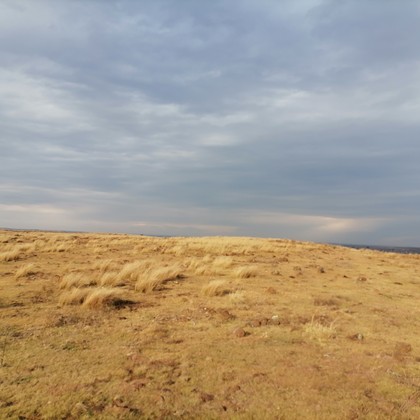
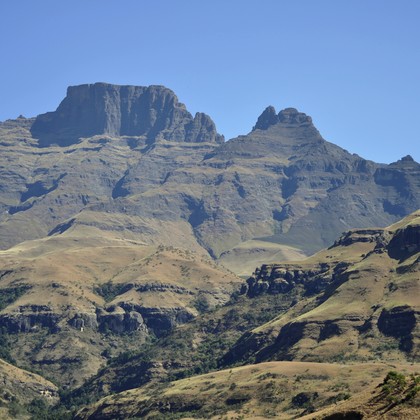
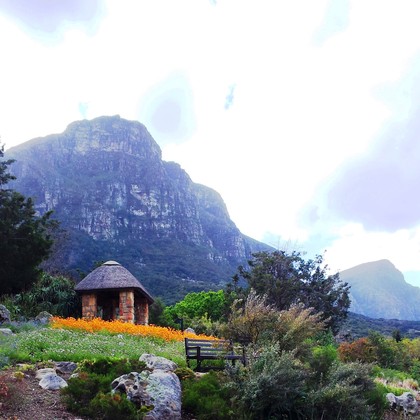
Open grassland with scattered trees, copses or hedges, highland forest edge and well-treed farmyards, villages and gardens; also rows of eucalyptus and willows. It eats almost exclusively ants and termites, extracted with its long sticky tongue. It nests in old holes of woodpeckers and barbets, natural cavities, nest boxes and hollow posts.
Where the bird is most at home, classified by the vegetation units of southern Africa.
Range and movements
In the region only in eastern South Africa, from Limpopo and Mpumalanga through Gauteng, the Free State and KwaZulu-Natal to the Eastern Cape, in Lesotho and in Eswatini; also locally in northern Angola. Beyond the region in scattered populations in the grasslands of Central and East Africa, from Cameroon and Gabon to Uganda, Kenya and Ethiopia.
- Resident
- dark = core range, pale = thinly spread
How and when to look
Look for it in highveld and Drakensberg grassland with scattered trees, often around farmsteads. In the breeding season, September to January, the high kwee series from a dead branch or post gives away where it sits.
Conservation status
Not threatened. It has disappeared locally where grassland was converted to cropland and timber plantations, but elsewhere it benefits from planted trees and nest boxes around farms and villages.
Scientific name
Jynx ruficollis | Wagler, 1830
Wagler described the species in 1830 and placed it straight away in the genus where it still stands. The genus Jynx was introduced in 1758 by Linnaeus. Jynx is the Ancient Greek name for this bird, iunx. ruficollis comes from the Latin rufus, 'rufous', and collum, 'neck' — for the rufous throat and breast. The specimen the first description was based on came from Uitenhage, Eastern Cape, South Africa.