All species › Gamebirds › Pheasants and partridges › Red-Billed Spurfowl
Red-Billed Spurfowl | Pternistis adspersus
Roodsnavelfrankolijn | Francolín Piquirrojo
The Red-Billed Spurfowl is the characteristic spurfowl of the thornveld of Namibia and Botswana, recognised by its red bill and bare yellow skin around the eye. At waterholes in Etosha and the Kalahari it is often one of the first birds to appear on the bank in the morning.

Voice
A loud, harsh, rattling chaa-chaa-chek-chek-chek that speeds up and fades, mainly at dawn and dusk. Pairs and groups often call in quick succession, so that the sound seems to come from all sides.
Recording: Luca Forneris — CC BY-NC-SA 4.0 · converted to mono · xeno-canto
Identification
About 35 cm. The whole plumage is brown and very finely vermiculated and barred black and white, without bold pattern; the underparts are slightly paler and more regularly barred. The bill is bright orange-red and the eye is surrounded by a bare, bright yellow ring of skin. The legs are red, spurred in the male. The sexes are alike; juveniles are duller with a brownish bill. It prefers to run off, and when flushed whirrs away to cover.
Confusion species
The Natal Spurfowl also has an orange-red bill but lacks the yellow eye-ring and has black-and-white scaled underparts; the two overlap only in a narrow zone in eastern Botswana and western Zimbabwe. Swainson's Spurfowl has a bare red throat and red eye skin, a dark bill and black legs. Hartlaub's Spurfowl is much smaller and lives on rocks.
Habitat
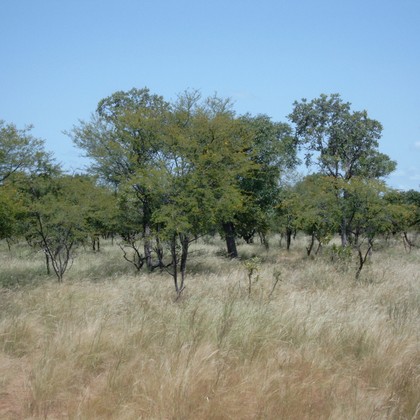
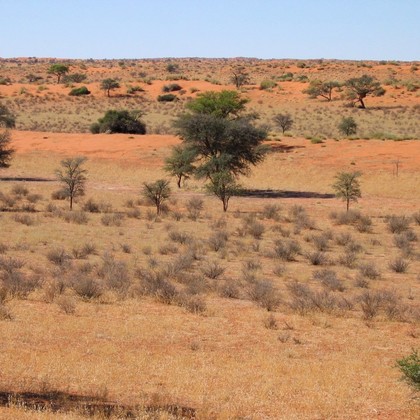
Thornveld, Kalahari savanna, mopane woodland, riverine woodland and dense scrub along dry riverbeds, usually within a few kilometres of water. It forages on the ground in pairs or family groups for seeds, berries, bulbs, termites and other insects, and comes to drink daily.
Where the bird is most at home, classified by the vegetation units of southern Africa.

Range and movements
Most widespread in central and northern Namibia and across most of Botswana; also in south-western Angola, western Zimbabwe and north-western South Africa (Northern Cape and North West). Not found beyond the region; an endemic of the arid west of southern Africa.
- Resident
- Summer visitor (c. Oct–Mar)
- Winter visitor (c. Apr–Sep)
- Passage (Mar–Apr, Oct–Nov)
- dark = core range, pale = thinly spread
How and when to look
Etosha is the best site: groups drink at the Okaukuejo and Halali waterholes in the early morning. In the Central Kalahari and along the Boteti and Chobe rivers it is also met with regularly. In the late afternoon birds often cross sandy tracks.
Conservation status
Not threatened and common in suitable habitat. It benefits locally from artificial water points on cattle farms. It is hunted as a gamebird, with no apparent effect on numbers.
Scientific name
Pternistis adspersus | (Waterhouse, 1838)
Waterhouse described the species in 1838 as Francolinus adspersus; because it was later moved to another genus, the author and year stand in brackets. The genus Pternistis was introduced in 1832 by Wagler. Pternistis comes from Greek pternistēs 'one who strikes with the heel', from pterna 'heel', after the spurs on the legs. adspersus is Latin for 'sprinkled', for the fine, dense vermiculation of the plumage. The specimen the first description was based on came from Fish River, Great Namaqualand (Namibia).