All species › Gamebirds › Pheasants and partridges › Cape Spurfowl
Cape Spurfowl | Pternistis capensis
Kaapse frankolijn | Francolín del Cabo
The Cape Spurfowl is the largest spurfowl in southern Africa and a near-endemic of the Western Cape. It is common in fynbos, renosterveld and farmland, and so used to people that it forages in gardens, on golf courses and around picnic sites.
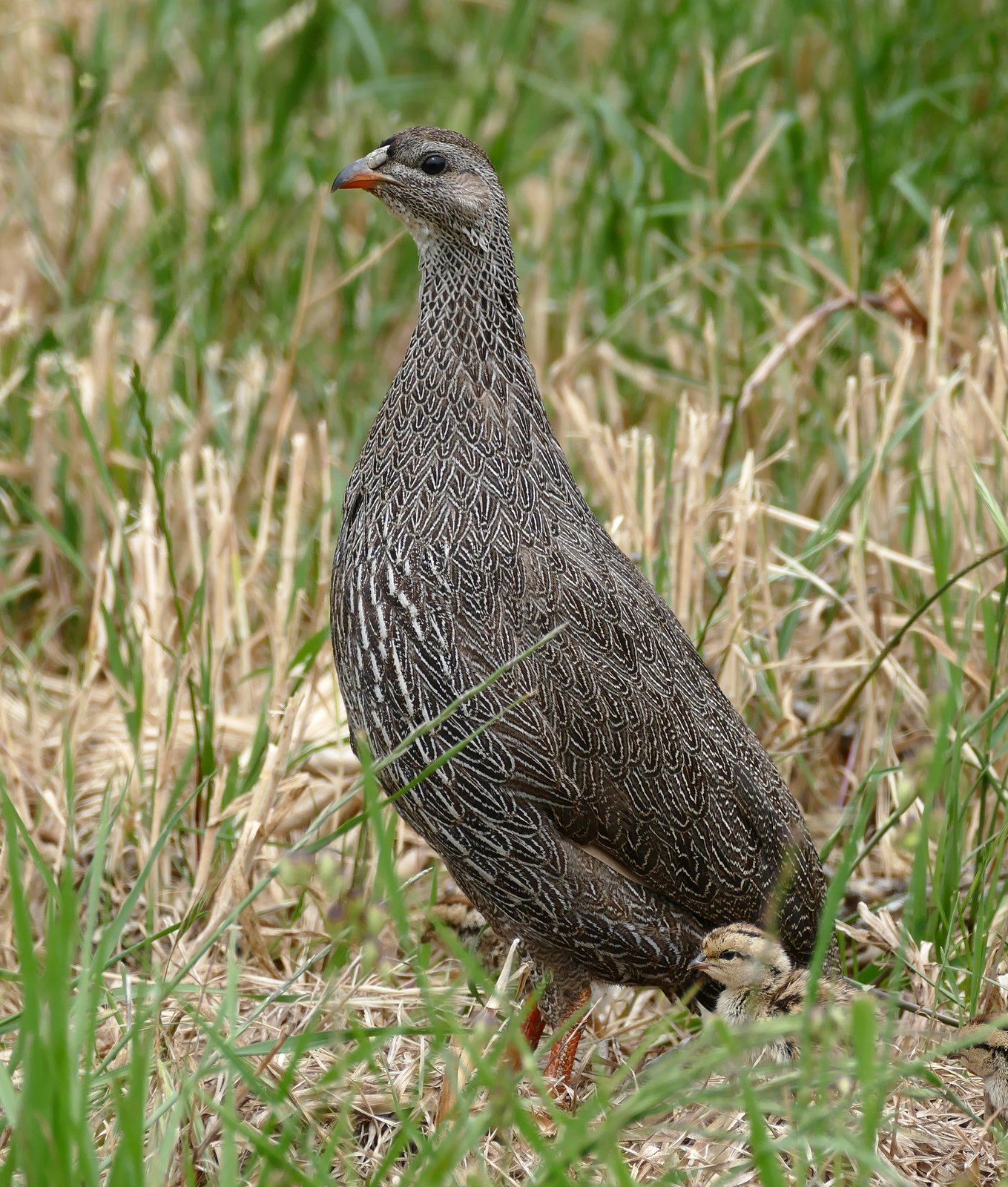
Click a thumbnail to switch the photo above.
Voice
A very loud, harsh, rattling ke-kek-kek-kekerrr that carries far, mainly at dawn and dusk and often from several birds at once. A short, sharp kek in alarm.
Recording: African Bioacoustics Community — CC BY-NC-SA 4.0 · converted to mono · xeno-canto
Identification
About 42 cm, large and dark. From a distance the plumage looks uniformly dark grey-brown, but close up it is finely vermiculated and streaked with white, especially on the underparts, giving a scaly grey effect. The crown is darker and the throat somewhat paler. The bill is dark with an orange-yellow lower mandible; the legs are dull orange-red, with two spurs in the male. There is no bare facial skin. The sexes are alike, the female smaller.
Confusion species
The Red-Necked Spurfowl, which overlaps in the Eastern Cape, has a bare red throat and red skin around the eye. The Grey-Winged Francolin of mountain fynbos is smaller, with a rufous, black-and-white speckled throat and yellow legs, and flushes more readily. The Natal Spurfowl does not occur within its range.
Habitat
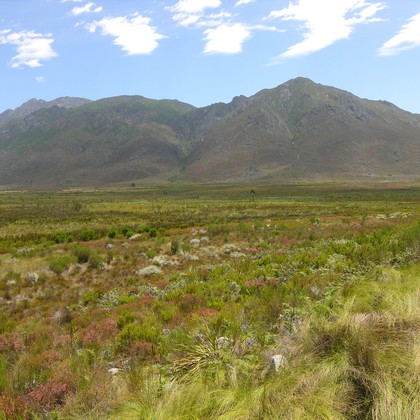
Fynbos, renosterveld, strandveld, riverine scrub in the Karoo, vineyards, cereal fields, gardens and parks, usually not far from cover and water. It forages on the ground for bulbs, tubers, seeds, berries and insects, and digs with its bill for underground parts.
Where the bird is most at home, classified by the vegetation units of southern Africa.


Range and movements
Restricted to south-western South Africa, from the Western Cape north along the west coast to Namaqualand and east to about the Eastern Cape, with an extension along the lower Orange River into the far south of Namibia. Not found beyond the region.
- Resident
- Winter visitor (c. Apr–Sep)
- dark = core range, pale = thinly spread
How and when to look
Usually seen on the Cape Peninsula, at Kirstenbosch, at the Cape of Good Hope and in West Coast National Park, where birds forage around the car parks. An early-morning walk brings the loud chorus; along roadsides in the Overberg they often allow photography.
Conservation status
Not threatened and common, locally even more numerous thanks to the spread of cultivation and gardens. It is hunted as a gamebird; in urban areas birds suffer from traffic and from free-roaming dogs and cats.
Scientific name
Pternistis capensis | (Gmelin, 1789)
Gmelin described the species in 1789 as Tetrao capensis; because it was later moved to another genus, the author and year stand in brackets. The genus Pternistis was introduced in 1832 by Wagler. Pternistis comes from Greek pternistēs 'one who strikes with the heel', from pterna 'heel', after the spurs on the legs. capensis is Latin for 'of the Cape', after the Cape of Good Hope, where the type material came from. The specimen the first description was based on came from Cape of Good Hope.