All species › Passerines › Cisticolas › Rattling Cisticola
Rattling Cisticola | Cisticola chiniana
Ratelgraszanger | Cistícola Cascabel
The Rattling Cisticola is the commonest and noisiest cisticola of savanna woodland in the north and east of the region. The male sings from the top of a bush or small tree, a few harsh notes ending in a dry rattle, and gives himself away from far off. A cisticola singing openly from a bush top in woodland is usually this species.

Voice
The song, from a high perch, consists of two to four harsh notes followed by a dry rattle: chi-chi-chi-chrrrrrr or choo-choo-kwirrrr, repeated endlessly and with much regional variation. Alarm and scolding calls are a sharp, grating cher-cher-cher and a rattling trrrrr, often given by both birds of a pair together. It sings almost all year, most in the rains; there is no high song flight.
Recording: JJSUN — CC BY-NC-SA 4.0 · converted to mono · xeno-canto
Identification
14–16 cm; the male is clearly larger and heavier than the female. The upperparts are grey-brown with distinct dark streaking on mantle and back; the crown is warm rufous and finely streaked, and the flight feathers are edged rufous. There is a narrow, indistinct pale supercilium. The underparts are off-white with a buff wash on the flanks. The medium-length tail is grey-brown with a dark subterminal band and pale tips. The bill is fairly stout, black in the breeding male, otherwise horn-brown. Breeding and non-breeding plumages differ little. Juveniles are warmer toned with a yellowish wash below. It perches openly on bushes and small trees rather than hiding in the grass.
Confusion species
Tinkling Cisticola Cisticola rufilatus is very similar but has an unstreaked grey-brown back, a brighter rufous crown and tail and a bolder white supercilium, and sings a soft, bell-like tink-tink-tink. Wailing Cisticola Cisticola lais is more heavily streaked, lives on grassy hillsides rather than in woodland and sings plaintive, drawn-out notes. Singing Cisticola Cisticola cantans has an unstreaked back and a rufous wing panel and lives in rank growth at woodland edges. Croaking Cisticola Cisticola natalensis is larger and heavier-billed, with a croaking song, in open grassland. Neddicky Cisticola fulvicapilla is smaller, with an unstreaked back and a plain rufous head, and sings a fast, monotonous chee-chee-chee. The best feature remains the song: harsh, grating introductory notes and a rattling ending.
Habitat
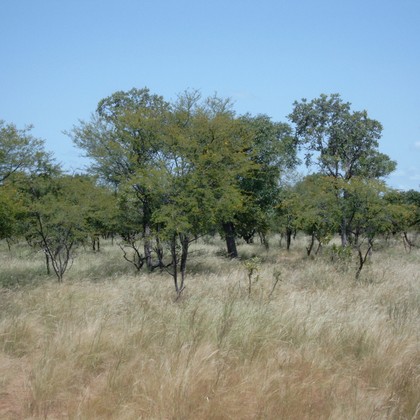
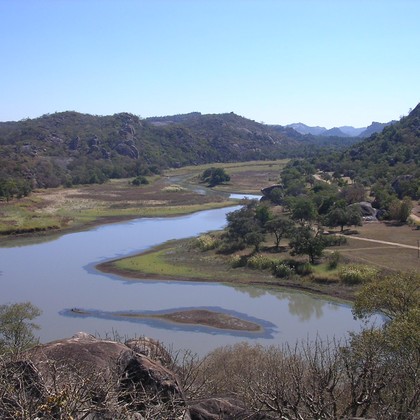
Open to semi-open woodland with grass and bushes: acacia savanna, mixed broadleaf woodland, mopane, miombo with a rank understorey, fallow land and field edges. It avoids dense forest, treeless grassland and true desert. It forages low in bushes and on the ground for insects and spiders. The nest is a ball of grass, low in a grass tuft or bush.
Where the bird is most at home, classified by the vegetation units of southern Africa.

Range and movements
Widespread and common in the north and east of the region: all of Zimbabwe, Zambia, Malawi and Mozambique, northern and eastern Botswana, northern Namibia including the Caprivi Strip, most of Angola away from the north-western coastal plain, and in South Africa the bushveld of Limpopo, Mpumalanga, North West and northern KwaZulu-Natal; also Eswatini. Absent from the Karoo, the Cape provinces and Lesotho. Beyond the region north through East Africa to Kenya and southern Ethiopia, and west to southern DR Congo.
- Resident
- Summer visitor (c. Oct–Mar)
- Winter visitor (c. Apr–Sep)
- Passage (Mar–Apr, Oct–Nov)
- dark = core range, pale = thinly spread
How and when to look
All year; in Kruger, Hwange, the Okavango Delta and the Luangwa Valley, for example, the male sings from the highest bush. Look for the streaked back and, in the breeding season, the black bill of the singing male. Because the song varies so much, listen to its structure, first harsh notes and then a rattle, rather than to the exact sound. A cisticola that lands on a bush when approached and scolds loudly is, in woodland, almost always a Rattling Cisticola.
Conservation status
Not threatened. One of the most numerous birds of savanna woodland, holding up well in lightly grazed or cleared woodland and on farmland with bushes.
Scientific name
Cisticola chiniana | (Smith, 1843)
Smith described the species in 1843 as Drymoica chiniana; because it was later moved to another genus, the author and year stand in brackets. The genus Cisticola was introduced in 1829 by Kaup. Cisticola combines the Ancient Greek kisthos 'rock-rose' with the Latin colere 'to dwell'. chiniana is probably a place name, after the Chenyane or Tshwenyane hills north of Zeerust. The specimen the first description was based on came from Zeerust, South Africa.