All species › Cuckoos › Cuckoos › Olive Long-Tailed Cuckoo
Olive Long-Tailed Cuckoo | Cercococcyx olivinus
Bruine langstaartkoekoek | Cuco Colilargo Oliváceo
The Olive Long-Tailed Cuckoo is an inconspicuous bird of the Central African rainforest that reaches the edge of the region in northern Angola and the far north-west of Zambia. It lives hidden in the canopy and is found almost exclusively by its loud, whistled call.
Voice
A loud, clear two-part whistle, wee-wheeu, the second note longer and falling, repeated many times; also long series of loud whistles rising in pitch and tempo. It often calls from the high canopy, also at night.
Recording: Alain Verneau — CC BY-NC-SA 4.0 · converted to mono · xeno-canto
Identification
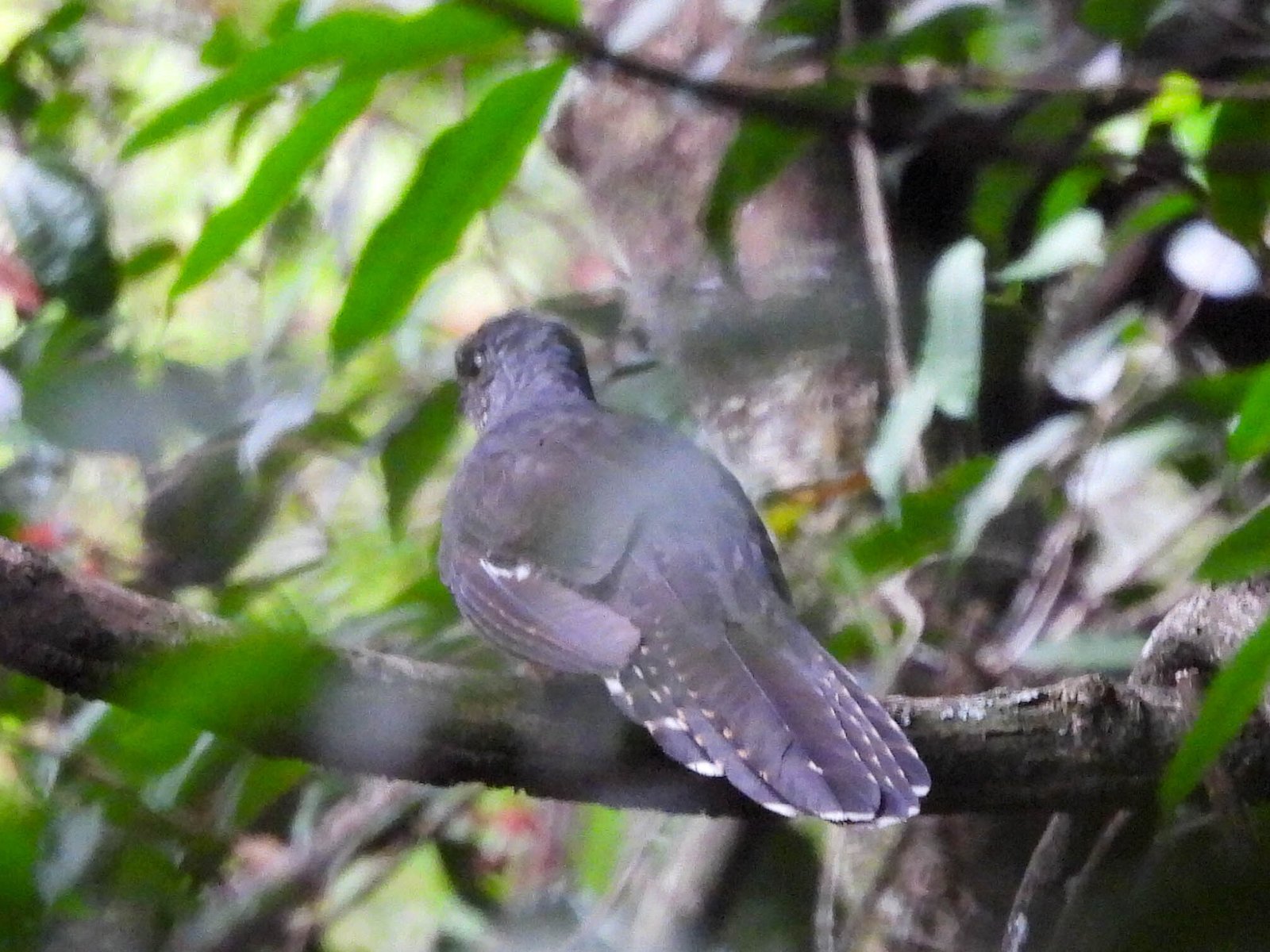
32–34 cm, with a very long, graduated tail and short, rounded wings. The upperparts are plain olive-brown to warm grey-brown, without a purple gloss and with at most a few pale spots on the wing. The underparts are white to cream with broad blackish-brown bars, the throat more finely barred. The tail is brown with pale notches along the edges and white tips. The legs are yellow and the bill dark with a yellow base to the lower mandible. The sexes are alike; juveniles have a dark throat and rufous fringes on the upperparts.
Confusion species
Dusky Long-Tailed Cuckoo (Cercococcyx mechowi) is barely separable in the field: it is darker brown with a purple-blue gloss and more pale spots on the wing; voice is the best feature. Barred Long-Tailed Cuckoo (Cercococcyx montanus) of the east has rufous-barred upperparts. A briefly seen bird can suggest an immature African Goshawk (Aerospiza tachiro), which has a shorter tail and a heavier head.
Habitat
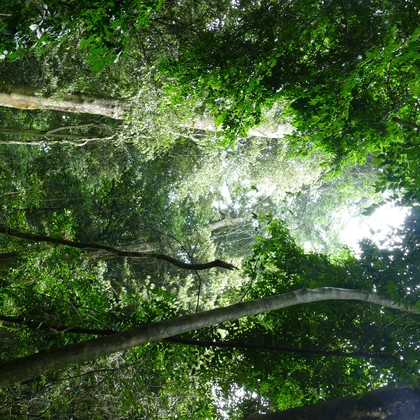
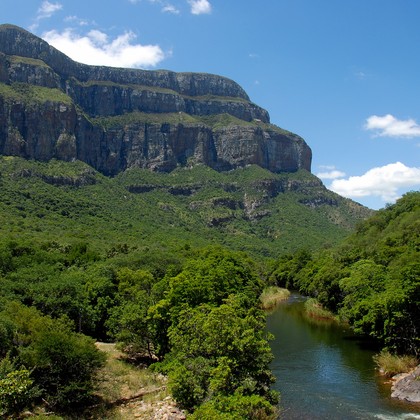
Humid lowland and transitional rainforest and gallery forest along rivers, in Zambia mainly the evergreen 'mushitu' forests along stream valleys. More than its relatives it keeps to the middle and upper canopy, where it searches for caterpillars. Its hosts are poorly known; illadopses and akalats are suspected.
Where the bird is most at home, classified by the vegetation units of southern Africa.
Range and movements
Within the region in northern Angola, from Cabinda to the Lunda provinces, and in the far north-west of Zambia, mainly in Mwinilunga District. Beyond the region it ranges from Ghana and Nigeria through the Congo Basin to Uganda.
- Resident
- dark = core range, pale = thinly spread
How and when to look
In Zambia the gallery forests around the source of the Zambezi near Mwinilunga are the best site; visit them at the start of the rains, from October to December, when the bird calls most. Direct your binoculars high into the canopy and be patient: the bird sits still for long spells on a horizontal branch.
Conservation status
Not threatened and widely distributed. Within the region it is confined to small, isolated forest remnants under pressure from logging, fire and farming; there it is scarce and poorly studied.
Scientific name
Cercococcyx olivinus | Sassi, 1912
Sassi described the species in 1912 and placed it straight away in the genus where it still stands. The genus Cercococcyx was introduced in 1882 by Cabanis. Cercococcyx comes from the Greek kerkos, 'tail', and kokkyx, 'cuckoo' — for the exceptionally long tail. olivinus is Latin for 'olive-coloured' — for the olive-brown upperparts. The specimen the first description was based on came from Mountain forest bordering the Rutshuru Plain, DR Congo.