All species › Cuckoos › Cuckoos › Barred Long-Tailed Cuckoo
Barred Long-Tailed Cuckoo | Cercococcyx montanus
Gestreepte langstaartkoekoek | Cuco Colilargo Montano
The Barred Long-Tailed Cuckoo is one of the most sought-after forest birds of eastern Zimbabwe and central Mozambique: a long-tailed, brown-barred cuckoo that in dense forest is almost only ever heard. Its stirring call series, rising higher and faster, are the first sign of its presence in the rains.

Voice
A loud, whistled two-part call, hwee-hweeoo, repeated many times, and a long series hwee-hwee-hwee... that becomes ever faster and higher to a frenzied climax and then stops abruptly. It calls mainly in the morning and evening, also at night.
Recording: isaac kilusu — CC BY-NC-SA 4.0 · converted to mono · xeno-canto
Identification
33–35 cm, with a very long, graduated tail. The upperparts are dark brown with distinct rufous to buff bars on the back, wings and tail. The underparts are creamy white to pale buff with heavy blackish-brown bars and spots, more streaked on throat and breast. The tail is brown with rufous bars and white tips. The legs are yellow and the bill dark with a paler lower mandible. The sexes are alike. Juveniles are more rufous above and less heavily marked below.
Confusion species
Red-Chested Cuckoo (Cuculus solitarius) has a shorter tail, plain grey upperparts and, in adults, a rufous breast. Immature accipiters such as African Goshawk (Aerospiza tachiro) have a shorter tail, a heavier head and a hooked bill. Olive Long-Tailed Cuckoo (Cercococcyx olivinus) has plain olive-brown upperparts, but does not occur in the same area.
Habitat
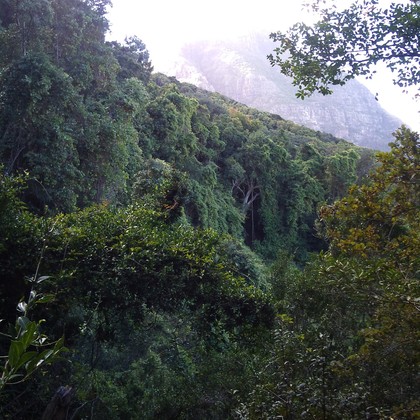
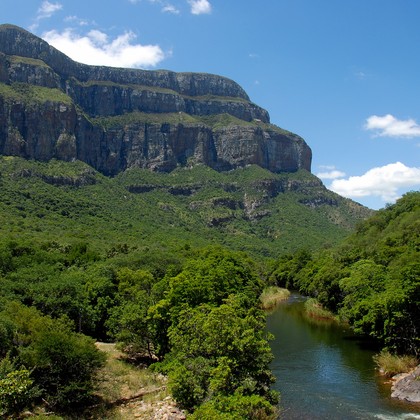
Humid lowland and mid-altitude forest, gallery forest, coastal forest and dense thickets, in East Africa also high into the mountains. It keeps to the middle and upper forest storeys, often in lianas, and feeds mainly on caterpillars. Its hosts are barely known.
Where the bird is most at home, classified by the vegetation units of southern Africa.

Range and movements
Within the region in the lowland forests of eastern Zimbabwe (Haroni-Rusitu), central Mozambique (including Moribane and the Chimanimani foothills) and north through northern Mozambique, southern and northern Malawi and north-eastern Zambia. Beyond the region from Tanzania and Kenya to the Albertine Rift in Uganda, Rwanda and eastern Congo.
- Summer visitor (c. Oct–Mar)
- Passage (Mar–Apr, Oct–Nov)
- dark = core range, pale = thinly spread
How and when to look
The Haroni-Rusitu area in Zimbabwe and Moribane forest in Mozambique are the best-known sites; go there from November to February. Listen at dawn for the rising call series, then search patiently in the lianas of the mid-storey. Often it remains a heard-only; a glimpse of the long barred tail as it flies off already counts as success.
Conservation status
Not threatened and widely distributed. In the south of its range it depends on small remnants of lowland forest that suffer heavily from clearing and farming, as at Haroni-Rusitu; there it is vulnerable and scarce.
Scientific name
Cercococcyx montanus | Chapin, 1928
Chapin described the species in 1928 and placed it straight away in the genus where it still stands. The genus Cercococcyx was introduced in 1882 by Cabanis. Cercococcyx comes from the Greek kerkos, 'tail', and kokkyx, 'cuckoo' — for the exceptionally long tail. montanus is Latin for 'of the mountains' — for the montane forests where the species was first found. The specimen the first description was based on came from Kalongi, Butahu Valley, Ruwenzori, DR Congo.